City Councilor Lydia Edwards is holding a series of meetings on the Suffolk Downs development project.
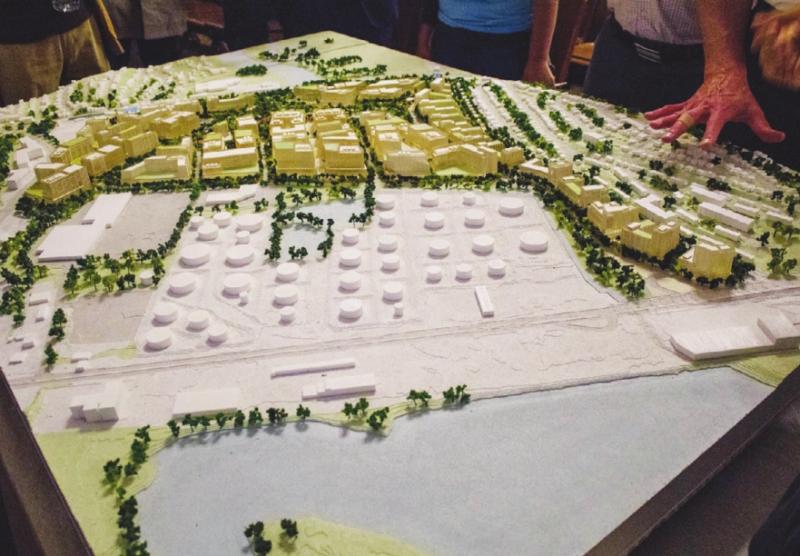
A scale model of the Suffolk Downs redevelopment plan presented at a public meeting in East Boston.
Urges caution on 10,000-unit development
Suffolk Downs, a vast tract of vacant land in East Boston, could soon become Boston’s newest neighborhood, with 10,000 units of housing planned for an area more than four times the size of the Seaport District.
While the Seaport District has been widely criticized for its expensive micro-units and lack of diversity — just 94 blacks live among the 3,443 residents counted in the neighborhood — the HYM Investment Group’s plans for the Suffolk Downs site may not be much different. District 1 City Councilor Lydia Edwards said HYM Investments is planning a neighborhood with rents and condo prices that will exclude most current East Boston residents.
“When you look at how they envision themselves, it is to our total exclusion,” she said. “They don’t see us there — our incomes, our family sizes — none of that is in their plan.”
Although the developers’ plans call for 1,000 percent of the units to be affordable, in accordance with the city’s Inclusionary Development Policy, that policy allows for incomes as high as $74,500 a year, far above the average individual income of $38,000 in East Boston. Edwards also points to HYM Investments’ estimates of 1.5 people per unit in their development, lower than even the Seaport Districts 1.7 people per unit and far below the current 2.6 per unit in East Boston.
“We have babies,” Edwards said. “We have families. We are an immigrant community.”
HYM Investments Managing Partner Thomas O’Brien said the firm hasn’t settled on pricing for units in the development.
“We’re still in the permitting phase,” he said.
O’Brien said the only way Boston can overcome its current crisis of affordability is to build enough units to meet demand.
“There
is no other single site where this many units can be built,” he said.
“We think this is a tremendous opportunity for the city.”
He
noted that the Suffolk Downs development will include 1,000 affordable
units — the largest number of affordable units ever built in a
privately-owned development in Boston.
“This is a fantastic opportunity,” he said.
The
1,000 affordable units would represent less than the 13 percent
affordability guidelines under the city’s Inclusionary Development
Policy guidelines because approximately a quarter of the 160- acre
parcel lies in Revere, which is does not have an affordable housing
policy.
Boston
Planning and Development Agency spokeswoman Bonnie McGilpin said the
city is working with the HYM Investments on affordability issues.
“The
Boston Planning & Development Agency is working closely with HYM to
ensure that the mixeduse development under review at Suffolk Downs
adequately addresses affordability for a range of incomes and minimizes
displacement in neighboring residential areas,” she said in a written
statement.
Edwards,
however, cautions that the BPDA, in working closely with developers,
doesn’t always put the needs of the city’s current residents first.
“They
don’t have an overarching mission for social justice,” she said. “They
don’t plan for it. Because they don’t plan for it, we have to fight for
it.”
Edwards, who has
lived in East Boston for the last 11 years, said she has seen her
neighbors forced out as rents and housing prices rise rapidly in the
neighborhood. Luxury high rises have been built on the East Boston
waterfront, ringing the Maverick Landing public housing development.
“There
are parts of Jeffries Point with housing over $1 million,” Edwards
said. “You have new buildings that rise up and block everybody’s view of
the waterfront.”
The
plans for the Suffolk Downs site will include 16.5 million square feet
of residential, commercial, retail, hotel and office space built on the
former thoroughbred racetrack site.
Edwards,
who has been a critic of the city’s supply-side economics theory that
developers will build Boston’s way out of the housing affordability
crisis, said the Suffolk Downs site could accelerate the displacement of
middle- and low-income families already happening in East Boston or, if
done right, expand opportunity.
“It
is the single largest opportunity to grow the middle class in Boston,”
she said, noting the project is expected to bring thousands of
construction jobs to Boston over the next 20 years. “It will either be
the greatest opportunity or the greatest loss.”
Edwards
said she would like to see firm commitments from the development team
to hire local workers in the construction and pay the prevailing wage.
As
HYM Investments’ Suffolk Downs development project goes through a
90-day community review process mandated by the Boston Planning and
Development Agency, Edwards is holding a series of neighborhood
workshops on the development plan.
The
series will include workshops on housing, local economy and good jobs,
transportation, resiliency and open space and homeless and recovery
services.
Edwards said
Bostonians from across the city have an interest in the development
plans, which will account for more than 10 percent of Mayor Martin
Walsh’s goal of creating 69,000 new units of housing by 2030.
“Roxbury
needs to come,” she said. “Pack a lunch and come to East Boston. This
is a conversation about whether we believe there is going to be a middle
class or not. This is a racial justice issue. This is an economic
justice issue.”
O’Brien
said representatives from his firm were present at Edwards’ first
meeting on housing and would continue to attend, noting that he has
participated in more than 300 community meetings on the project over the
last two years.
“We’re happy to participate,” he said. “We applaud what she is doing.”
Edwards
said she expects that East Boston residents will continue to weigh in
on the Suffolk Downs project, noting a tradition of neighborhood
activism stretching back to battles over airport expansion in decades
past.
“This is our generation’s airport,” she said. “It’s in our DNA in East Boston to organize. It’s the legacy we have inherited.”