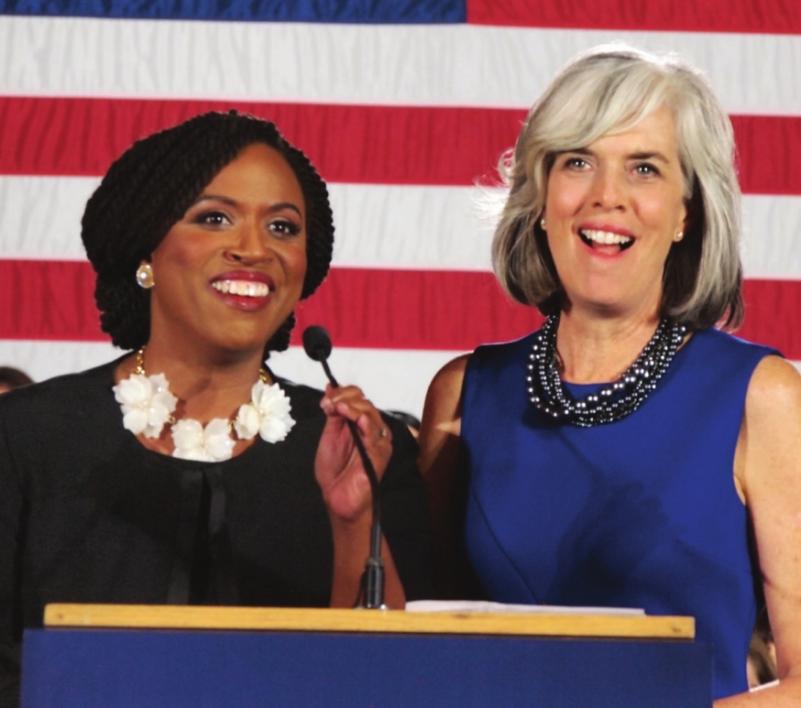
Ayanna Pressley, elected to represent the state’s 7th Congressional district, shares the stage with 5th Congressional District Rep. Katherine Clark at the Fairmount Copley Plaza Hotel on election night last week.

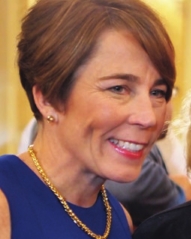
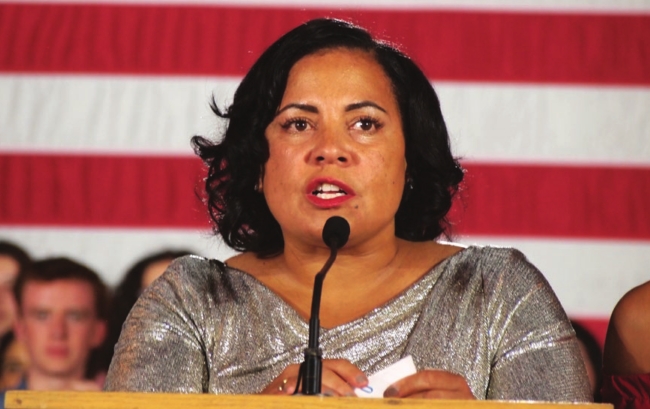
Savoring electoral victory
are U.S. Sen. Elizabeth Warren, Attorney General Maura Healey and
Suffolk County District Attorney-elect Rachael Rollins, the first black
woman to hold that office.
Year of historic firsts includes Pressley’s win in 7th
The Democratic surge that swept across the United States last week blew through Massachusetts too. At the national level, Democrats regained control of the House of Representatives. At the local level, the party slightly expanded its supermajority in the Massachusetts Legislature.
But more than anything, Tuesday night was a night of firsts near and far, from Ayanna Pressley’s historic victory as the first black woman elected to Congress in Massachusetts, to Sharice Davids’ and Deb Haaland’s election in Kansas and New Mexico as the first Native American women in Congress, to the election of Muslim-Americans Ilhan Omar of Minnesota and Rashida Tlaib of Michigan. The five were among 35 women elected to Congress, pushing the number of women in that body to 107 for the first time ever.
“None of us meant to make history,” Pressley said in her victory speech during the Democratic Coordinated Campaign election night celebration at the Fairmount Copley Plaza hotel. “We ran to
See ELECTIONS, page 17
election
continued from page 1
make change. However the historical significance of tonight is not lost on me.”
Turnout
for Tuesday’s midterm election was unexpectedly high, with many voters
in Massachusetts spurred by a desire to repudiate the policies and
rhetoric of the Trump administration and the national Republican party.
Although
that Democratic backlash wasn’t enough to propel Democrat Jay Gonzalez
into the governor’s office, it may have helped push public defender Tram
Nguyen to defeat Republican incumbent state Rep. Jim Lyons in the
Andover-based 18th Essex District, paving the way for her to become the
first Vietnamese-American to serve in the Legislature.
The
Democratic push may have helped nudge incumbent Gov. Charlie Baker to
the left. During the campaign, the governor pledged to work on
increasing affordable housing and touted his administration’s record on
expanding renewable energy in the state.
Environmental
activist Bob Massey, who lost a bid for the Democratic nomination for
governor in the September primary election, said Baker’s embrace of
progressive issues is a victory.
“One of the objects is to move the debate forward, to talk about issues like climate change,” he said. “We’ve made progress.”
Attorney
Rachael Rollins, who was elected Suffolk County district attorney, said
the voters called for sweeping changes to the criminal justice system.
“In this election, you’ve spoken loudly and clearly against the status quo,” she said.
Massachusetts
voters also passed ballot measures to continue protections for
transgender people and to call on Congress to repeal the controversial
Citizen’s United Supreme Court ruling, which enables corporations to
make unlimited donations to political action committees without public
disclosure.
Despite
the gains in Massachusetts and across the country, Sen. Elizabeth Warren
cautioned her Democratic supporters against becoming complacent.
“The
road ahead of us will not be easy,” Warren said. “The powerful in
Washington don’t give up just because they get knocked down. Our
government is still captured by the wealthy and the well-connected and
the economy is still rigged against working people, women and
communities of color.”
Warren vowed to continue to fight against the Republican agenda.
“It’s gonna be hard,” she said. “Nevertheless, we will persist, and we will deliver the change this country deserves.”
A new day for Democrats
The
2.7 million Massachusetts voters who turned out on Nov. 6 set a record
for a midterm election. As was the case across the nation, the turnout
skewed younger and more progressive. In battleground states such as
Florida, Texas and Arizona, the surge in progressive voters helped put
more women and people of color in office.
In
Boston, where most races were decided in the Sept. 4 Democratic
primary, that pattern held, with District Attorney-elect Rachael Rollins
and candidates including Nika Elugardo and Jonathan Santiago running to
the left of incumbent progressives and winning.
At
the Democratic Party’s combined campaign celebration, held last Tuesday
at the Fairmount Copley Plaza hotel, party activists expressed optimism
that campaign victories would translate into progressive change.
Suffolk
County Sheriff Steve Tompkins said Rollins’ election, along with the
appointment of Boston’s first black Police Commissioner, William Gross,
has changed the complexion of law enforcement leadership in the city.
“People
like the idea that there’s a black D.A., sheriff, police commissioner
and president of the City Council,” Tompkins said, referring to Boston
City Council President Andrea Campbell. “Now communities have to work
with us and know that we have their best interests at heart.”
At
the state level, Gov. Baker won re-election with a commanding 67
percent of the vote to Democratic challenger Jay Gonzalez’s 33 percent.
Baker, who drew flak from Gonzalez for his incremental approach to
improving the state’s transit infrastructure and funding public schools,
pledged to continue his work on affordable housing, education and
improvements to the MBTA.
While
Baker and the state’s Democratic leadership in the Legislature have
been reluctant to raise revenue for education, Massachusetts Teachers
Association President Merrie Najimy said her union plans to push forward
with an effort to increase the foundation budget — the state’s baseline
spending on public education — to keep pace with increased costs of
special education and health care.
“We were frustrated that the House and Senate failed to come to a resolution on the foundation budget,” she said.
Najimy said the MTA would likely launch an effort to increase school spending next year.
“This
feels like the moment,” she said. “There’s definitely momentum.
Students and educators have been living under a policy of austerity for
too long.”


