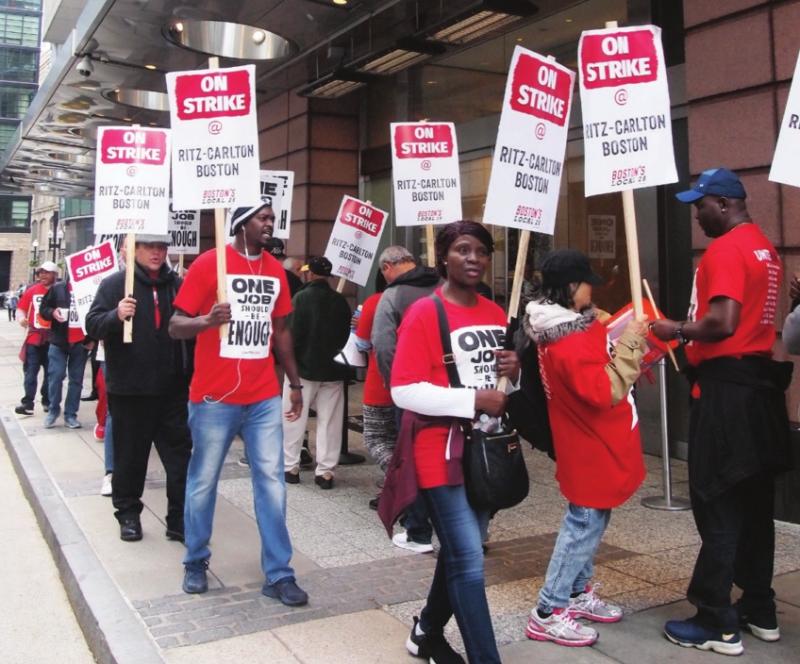
Hotel workers form picket lines outside the Ritz-Carlton in Boston’s downtown area, as Unite Here Local 26 members continue contract negotiations with Marriott International.
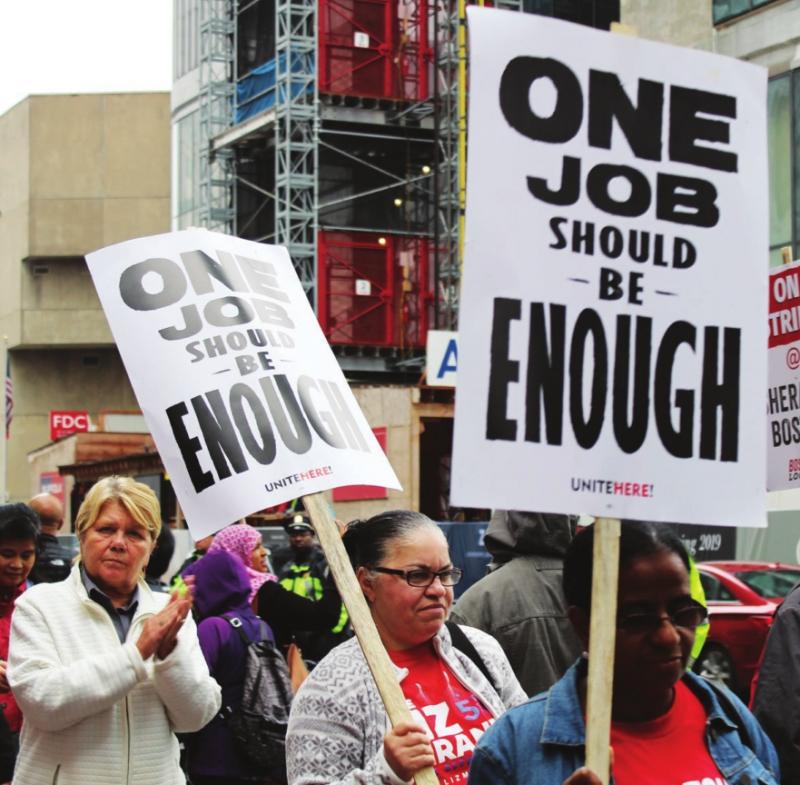
Workers on strike outside the Sheraton Hotel on Dalton Street.
Decisive action by union members demanding higher wages
Hotel workers took part in coordinated strikes at Marriott hotels across the city Wednesday Oct. 3, as contract negotiations between the billion-dollar hotel chain and union members stalled.
Beating plastic-bucket drums and waving signs, Unite Here Local 26 union members stopped work and circled in front of the Sheraton Hotel on Dalton Street, in one of seven similar strikes beginning last Wednesday at 6 a.m. that also took place at Aloft Boston and the Element Boston, both in the Seaport district, the Ritz-Carlton, the W Hotel Boston, the Westin Boston Waterfront and the Westin Copley Place.
“We’re not looking to get rich, just to make enough money to support our families in the area we live,” said Brian Lang, Unite Here Local 26 president.
More than 1,500 Marriott hotel workers — housekeepers, bartenders, bellmen, cooks, and dishwashers — united under the banner, “One job should be enough.” They have been asking since April, when the latest round of contract negotiations began, for wage increases to cover the rising cost of living in Boston. They are also pushing for guaranteed job security, better health and pension provisions, and for changes to be made to Marriott’s Green Choice initiative, which workers say reduces their hours, slashes their wages and risks their health coverage.
“The
cost of living in Boston is enormous,” said Jody Payne, who makes the
two-hour, 23-mile commute from Brockton each day to get to her job as a
banquet server at the Sheraton, which she has held for 37 years. She can
no longer afford to pay rent or a mortgage in the city.
For
Payne and other food and drink servers employed by Marriott
International, an increase in gratuity would help pay monthly bills.
While most restaurants and bars across the city levy an 18-percent-plus
gratuity payment, Marriott’s staff members receive 15 percent, an amount
that has not been revised for 12 years.
Carlos
Daveiga, a Dorchester resident who has worked as a houseman, cleaning
the hallways and common areas at the Sheraton, for 19 years, said
workers’ modest proposals are what Marriott’s management should have
given them five years ago. “Life is now too expensive in Boston,”
Daveiga said. “One job should be enough, and Marriott can do better for
its employees.”
There
is no question that Marriott International can afford their demands,
workers say. As one of the largest hotel chains in the world, in 2017
its net worth was more than $49 billion.
Green choice
Workers
are also unhappy with the implementation of Marriott’s Green Choice
program, which rewards hotel guests for skipping housekeeping services
for up to three days during their stay.
“Green
Choice is basically a way for the hotel to lay off housekeepers,” said
Payne. “It has nothing to do with being green, because this hotel
recycles nothing.” Her cynicism is born out of decades working in the
Sheraton’s kitchen and dining areas, where she told the Banner she sees
very little evidence of recycling or any other environmental
initiatives.
Payne
described how the Green Choice program dramatically reduces
housekeepers’ hours, as they do not know when rooms will need servicing,
and this impacts their eligibility for health insurance coverage. If
their average number of hours over a three-month period becomes too low
to meet the insurer’s minimum requirement, then workers are dropped from
their plans for the following three months. Payne said this is
particularly harmful for Marriott’s elderly workers, of which she said
there are many, who suffer from age-related or other conditions. Without
coverage they are unable to pay for medication, leaving them little
choice but to continue to work well past retirement age.
Since
Sept. 12, when 96 percent of union members voted in favor of strike
action, ongoing negotiations between a board of about 30 union members,
including Lang, and Marriott International representatives have yielded
little agreement on terms.
At
time of publication, strikes in Boston were entering their seventh day,
with Marriott hotel workers in eight cities, including San Jose, San
Francisco and Detroit, forming their own picket lines from Oct 4.
A
spokesperson from Marriott International would not respond directly to
questions from the Banner, but instead emailed a written statement.
“We
are disappointed that Unite Here has chosen to resort to a strike at
this time,” the statement read. “Marriott’s current economic proposal
matches the economic terms in the parties’ last contract, which included
the largest increases in the parties’ bargaining history. We have not
proposed any changes to our associates’ health, welfare or retirement
benefits.”
These
proposals were brought before workers when both sides last met Oct. 1,
and were deemed still to be unsatisfactory. “What they bring us is a
real joke,” said Daveiga. “We employees, we need more respect.”
“They’re tone deaf,” said Lang. “I don’t think Marriott has quite grasped what we mean by equality.”
Despite
setbacks, Lang said he is keeping all lines of communication open with
company management and is willing to find collaborative, creative
solutions in these negotiations.
“This
is an opportunity for Marriott to set an example for the hotel industry
… to set a new standard in the hottest hotel market in the world,” said
Lang. He acknowledged that Marriott is not the only chain that could
improve workers’ conditions, but they are the city’s largest, which is
why they have become the union’s primary target.
The
union is paying members $300 a week while they spend 12 to 18 hours a
day on the picket lines. Calling their participation “a big sacrifice,”
Lang added, “I don’t know how long it will take Marriott to come to
their senses.”
“We take one day at a time. It’s the only way to win strikes,” he said.