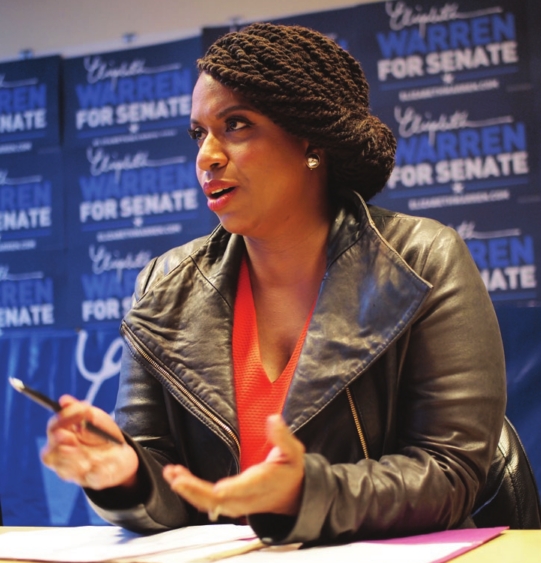
Ayanna Pressley speaks to reporters at the Massachusetts Democratic Party’s coordinated campaign office in Dorchester.
Seeks seat on Judicial Committee, will weigh in on criminal justice reforms
At-large City Councilor Ayanna Pressley, who won the Democratic primary for the 7th Congressional District seat in September, plans to prioritize reforming the Democratic Party, work to have President Donald Trump impeached and tackle issues of economic inequality in Massachusetts.
Pressley, whom polls had trailing incumbent Michael Capuano by as much as 13 points just weeks before the primary election, said she won by engaging non-traditional voters the Democratic Party often ignores.
“I hope that we’ve ushered in a new paradigm shift about how to run and win campaigns,” Pressley said, speaking to reporters at the coordinated campaign office in Dorchester, where party activists coordinate support for U.S.
Sen. Elizabeth Warren, gubernatorial candidate Jay Gonzalez, Pressley and other Massachusetts Democrats. “We have challenged assumptions about who is a likely primary voter. We have challenged assumptions about who deserves to have a seat at the table of democracy, or who wants to. Every single constituency that pundits considered to be unlikely showed up and turned out in this race: millennials, immigrants, people of color.”
Pressley wasn’t the only Democratic primary candidate to upend the conventional calculus of Democratic campaigns. Across the nation, women and people of color have won upset victories, not by running the centrist strategy Democrats have relied on to sway conservative-leaning independents, but rather by running to the left of the party’s center.
Congressional candidates including Pressley and Alexandra Ocasio-Cortez, as well as Florida gubernatorial candidate Andrew Gillum, won primaries where people of color were not expected to win, by appealing to the millennials and people of color who traditionally have ignored primary votes in non-presidential election cycles.
Pressley said her victory underscores the need for the party to change the way it’s doing business.
“To be frank, the first order of business … is to push our party, the Democratic Party, to have a real conversation about the heart and the guts and the soul of this party,” she said. “There are many takeaways that we learned in the campaign.”
Pressley says that among her first priorities before taking office in January will be assembling a diverse staff and securing committee assignments. Top on her list: the Judiciary Committee.
“I plan on working actively to see Donald Trump impeached,” she said. “Those proceedings would happen there.”
Pressley
said she would also like to work on criminal justice reform issues
important to people in the 7th Congressional District, advancing reforms
to make it easier for ex-offenders to expunge their records,
eliminating the cash bail system and implementing restorative justice
practices. Pressley said she would work in coalition with local
activists on those reforms, which would be implemented at the state and
county level.
At the federal level, Pressley said she would lead efforts on campaign finance reform.
“I
think it’s a bellwether of a direction we need to move in that I
rejected corporate PAC money,” she said. “We raised a million dollars in
grassroots donations. There’s far too much corporate money and
influence in federal policy.”
Pressley
said she would also fight to dismantle the U.S. Immigration and Customs
Enforcement agency that conducts raids on undocumented immigrants and
assign its duties to other U.S. agencies. She said she will not under
any circumstances support Trump’s call for a border wall.
“I
can sit at a table and work with anyone in the name of progress,” she
said. “But there are some things I’m unwilling to compromise on. And
those are the rights of immigrants, the rights of workers, the rights of
women and the rights of the LGBTQ community.”
In
the immediate future, the Senate’s vote on whether to confirm Brett
Kavanaugh, Trump’s nominee for the U.S. Supreme Court, has taken up much
of Pressley’s time. She attended a rally in Boston last week opposing
the nomination, and members of her campaign staff attended a Washington,
D.C. rally, bringing pizza and drinks to activists camped out on the
steps of the Supreme Court.
Me too
Pressley,
who spoke during a City Council hearing about her own experience of
child sexual abuse and sexual assault during college, said she faced
harassment after going public with her story.
“I
was called a liar,” she said. “I was called a whore. And I was called
an attention-seeker. My experience of victim blame and victim shame is
certainly not unique to me. I’ve told that story and many more.”
Pressley
expressed disgust about the recent Senate hearing, during which
Kavanaugh reacted angrily to questions from Senators who probed
allegations of sexual assault that several women have lodged against the
Supreme Court nominee.
“What
happened yesterday is personally and for many survivors triggering,
demoralizing, devastating,” Pressley said of the hearing.
“I think it is a stain on the institution of the United States Senate.
If Brett Kavanaugh had an iota of decency, he would have withdrawn his nomination, which is what I was calling for.”
Pressley
praised the activism of those who have protested Kavanaugh’s nomination
and said she would work in Congress to strengthen victims’ rights.
“I
want to see that activism codified in lawmaking to ensure that
survivors can get on a pathway to healing and get the justice they
deserve, be it in the halls of Congress or in the workplace or in the
courts,” Pressley said. “I’m also going to fight for federal investment
for those programs on the ground like the Boston Area Rape Crisis
Center, like the Victim Rights Law Center. More people are coming
forward, are disclosing every day, but [the agencies] don’t have the
resources for survivors. I certainly see that being a role that I will
play.”


