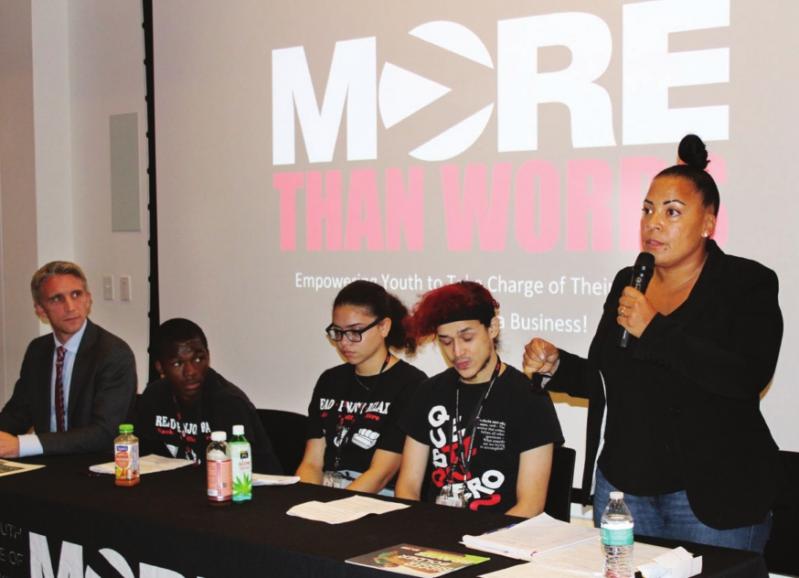
Michael
Maloney (far left) and Rachael Rollins (far right) discussed their
intentions for the District Attorney’s office if they are elected on
Nov. 6.
Rollins and Maloney on juvenile justice
The Suffolk County District Attorney candidates may share progressive platforms, but fundamental differences were revealed last Thursday evening during occasionally heated discussions about juvenile justice and criminal reform, at a nonprofit bookstore in the South End.
Rachael Rollins, the Democratic nominee in the D.A. race, and Michael Maloney, an independent candidate, attended the forum Sept. 27, hosted by More Than Words, a nonprofit working to uplift youth entangled in the foster care or court systems. In the recently refurbished warehouse space on East Berkeley Street, about 50 youth and local residents gathered to hear about the candidates’ platforms, both of which have been positioned as progressive and reform-oriented.
“Tonight, we’re going to shine the light on how the adults and the criminal justice system needs to be accountable to all of you, to provide you with the resources, the opportunities and the expectations that support you to thrive,” said Jodi Rosenbaum, founder and chief executive officer of More Than Words.
The event got off to positive start, with both candidates sharing their strikingly similar backgrounds. Both Rollins and Maloney
are the eldest of five children and are part of a wider foster family.
Maloney’s parents were foster carers during his childhood, and Rollins
is a foster mother to her 9- and 5-year old nieces.
Similarities
Personal similarities became parallels in policy, as the candidates unveiled their platforms.
Rollins
and Maloney both support the expansion of diversion programs that would
put defendants into rehabilitative programs rather than jail. Both
candidates also said they would work to ensure more defendants receive
mental health support or treatment for addiction before entering the
criminal justice system.
“They’re
going to be evaluated before the justice system swallows them whole,”
said Maloney, who has a decade of prosecutorial experience and formerly
owned a number of medical marijuana evaluation facilities, until he sold
the company in December 2017.
Rollins,
who won the Sept. 4 primary with 40 percent of the vote, said these
cases are “clogging up the criminal justice system.” She said counselors
will train assistant attorneys in her office, so that they can
respectfully seek treatment for more defendants. On addiction, Rollins
said, “It’s not a criminal problem, it is a societal issue and it is a
health problem.”
Another area in which the candidates seemed to agree was the existence of racial disparities within the criminal justice system.
According
to information posted online by the ACLU as part of its “What A
Difference a D.A. Makes” campaign, Maloney believes that the D.A.’s
office contributes to racial disparities in the criminal legal system.
To tackle this problem, he proposed immediately setting “office metrics”
to examine a wide range of data, including a comparison of the numbers
of white, black and Latino defendants they prosecute.
Rollins
said she would take a more vocal approach to the issue. “The biggest
group of people who are impacted negatively by the criminal justice
system are poor people. Next, it’s people of color,” said Rollins. “I
want to make sure we are explicit and speak out loud about these
issues.”
Rollins said
she will leverage the connections she has built during her 20-year
career with organizations like the Boston Bar Association, the
Massachusetts Black Lawyers Association and the Boston Branch of the
NAACP, where she volunteers and is the chair of Legal Redress, to make
sure her voice is heard.
The
two candidates also said they would reform the bail system. Maloney is
calling for the elimination of cash bail for non-violent offenders in
cases where jail time is not being sought. Rollins said she will look at
New Jersey and California, where cash bail has already been partially
ended, as models of reform for Massachusetts.
Differences
The
first point at which differences between Rollins and Maloney started to
emerge was on the issue of representation. While Rollins went to some
lengths to emphasize her desire to build a District Attorney’s office
that reflects Suffolk County, Maloney stayed relatively quiet on this
issue. “We will actually have a District Attorney’s office that reflects
the rich diversity of age, ability, orientation, gender, language of
Suffolk County, which it does not in the least right now,” said Rollins.
When
raising the minimum age of criminal responsibility came up for
discussion, the divide between the two candidates deepened. Rollins said
she would support raising the minimum age to 21 years old.
“I
want to make sure we are bold and say that when people get in trouble,”
she said, “we are not branding them with a record, that what we are
doing is making decisions about pre-arraignment, diverting them so that
they do not have a record for the rest of their lives.”
Meanwhile,
Maloney called raising the minimum age “a quick fix” and said,
“Diversionary programs, not increasing the age, are the way to break the
… school-toprison cycle.”
Divided
The
mood took a marked turn when a More Than Words associate asked the
candidates to explain their stance on police accountability,
particularly when it comes to the shooting of unarmed, black youth — a
question that elicited a cloud of favorable clicking from the audience.
Maloney
said that in every case of unarmed shooting by a police officer, he
would bring in an independent prosecutor to investigate and determine if
charges should be brought.
“I
mean this tongue-in-cheek, but on a much smaller scale this is kind of
like a Robert Mueller comes into Suffolk County,” said Maloney, alluding
to the special investigation currently underway into the alleged
Russian interference in the 2016 U.S. presidential election.
Appearing
to take offense at this remark, fighting back her emotions, Rollins
said, “First and foremost, there is nothing ‘tonguein-cheek’ about this.
Black people are dying in the streets. That is why I’m running. It’s
not a joke.”
Having
sued the Boston Police Department for racial discrimination twice,
Rollins’ track record seems to support her proactive stance.
“Even
if they are found not guilty, we will be bringing charges because it’s
the right thing to do, and the community needs to know that they matter,
that their lives matter and I support them,” she said.
The
candidates clashed once more when Rollins said she would use her
position as a platform to highlight inadequate education, health and
housing services in the county. Maloney said that it was fantastical to
think that the D.A.’s office could tell third party agencies, like
Boston Public Schools and the Boston Public Health Commission, how to
operate, closing his comments with an attack on Rollins’ professional
experience, which she hotly contested.
“My
credentials are exceptional, and I have no problem saying that out loud
as a black woman, because I have to, because people look at people like
Mike Maloney and assume that he’s qualified,” said Rollins. “The work
that I’ve done I stand by, and I am qualified to do this job. 34,000
people thought so.”
Whoever is elected on Nov. 6 will be responsible for 275 employees and manage a budget of $20 million.


