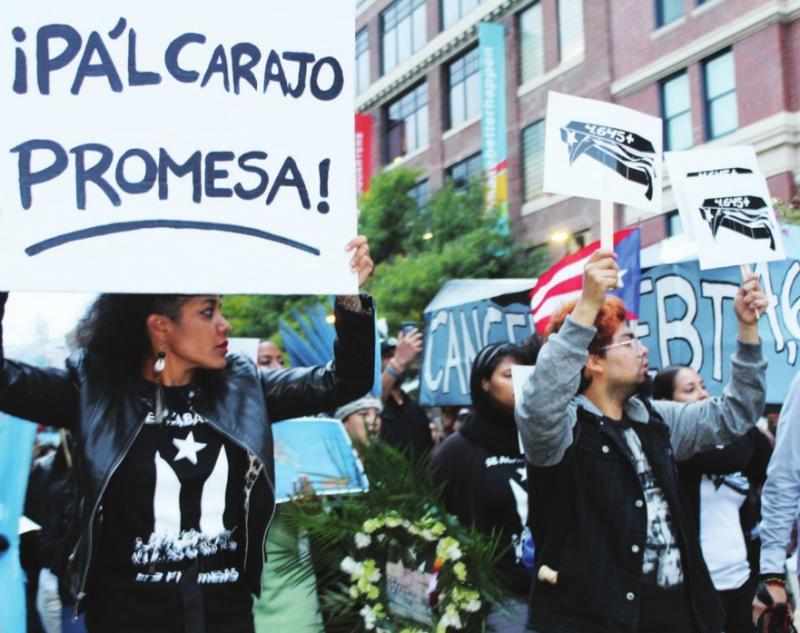
Protestors
carry signs with Hurricane Maria’s death toll, 4,645 and counting,
according to a report released in May by Harvard University.
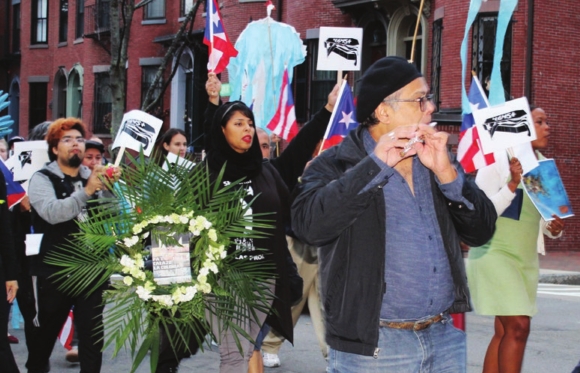
Activists and community members marched from the South End to hedge fund manager Seth Klarman’s offices in Back Bay, carrying a full-size casket and banners.
Protest marks one year since Hurricane Maria
Activists calling for the “decolonization of Puerto Rico” marched through the South End last Thursday in protest against the U.S. government and to mourn the thousands of lives lost since Hurricane Maria hit last year.
Members from the event’s 12 co-sponsor groups, including the Boston crew of Mijente, the nationwide Latinx collective that issued the initial call for action, rallied alongside survivors and those directly impacted by Hurricane Maria, in Betances Plaza on West Dedham Street at around 6 p.m. Sept. 20. Protestors marched from the South End to the offices of Seth Klarman, an investor and hedge fund manager who owns a large amount of Puerto Rico’s national debt, before gathering at St. Stephen’s Church on Shawmut Avenue to share their experiences and remember those who have died in the 12 months since the storm.
“This event is a space to mourn, to heal and to hold each other, because although many lives have been lost, we’re still here and we’re still fighting,” said Vero Navarro, a BPS teacher at Blackstone Elementary School and an organizer with Mijente.
Activists, including members from AgitArte, the Raíces Borikén Collective and United American Indians of New England, called for an end to what they see as the colonization of Puerto Rico by the U.S. government through decades of oppressive policies and economic exploitation.
“We
want freedom from the U.S.,” said Navarro. “Puerto Ricans are oppressed
citizens without the ability to vote for president, with no vote in
Congress.”
Puerto Rico
has been a U.S. territory since the end of the Spanish-American War in
1898, but residents were not granted full citizenship until 1917.
Jenniffer Aydin González-Colón is currently the resident commissioner of
Puerto Rico, and the island’s one non-voting representative in
Congress.
Many
protesters agreed with Navarro, who said that the federal response to
Hurricane Maria was another example of the government’s “ongoing
sabotage and woeful neglect of Puerto Rico.”
Chronic
underfunding by the U.S. government exacerbated Hurricane Maria’s
impact, particularly on the island’s infrastructure, Navarro added. It
took 11 months for the Puerto Rico Electric Power Authority to return
electricity to the majority of homes.
“This
disaster was not a natural disaster, this was a manmade disaster,” said
Jasmine Gomez, co-founder of the Raíces Borikén Collective. “This event
is not just a reaction to the hurricane, but an acknowledgement of a
history of oppression.”
This
history includes enactment of the Jones Act, protectionist legislation
from the 1920s that mandates all goods transported between U.S. ports
must be shipped on vessels that are primarily American-owned, a policy
that severely hindered relief efforts following Hurricane Maria.
Decolonization,
to advocates and members of the Puerto Rican community, also means the
dissolution of the Fiscal Control Board (FCB), also known as “la junta,”
the unelected body nominated by Congress to help restructure Puerto
Rico’s outstanding $73 billion debt and encourage economic growth. The
FCB was established under the 2016 federal Puerto Rico Oversight,
Management, and Economic Stability Act (PROMESA).
“PROMESA
is a terrible colonizing policy,” said Gomez, who believes that FCB
decisions have led to further economic exploitation of Puerto Rico.
One
of the fiscal board’s most controversial restructuring policies was to
reduce the federal minimum wage from $7.25 to $4.25 an hour for workers
in Puerto Rico aged 25 and under. Continued underfunding of education
means that more than 400 schools have closed since 2016, and the FCB has
slashed the University of Puerto Rico’s budget by $201 million. As more
homes are foreclosing, being bought by U.S. and other foreign
investors, Gomez said the political dynamic between Puerto Rico and the
U.S. is “shifting from colonial in nature, to settler colonial,” which
also involves the privatization of precious resources.
In
June, Puerto Rico’s governor, Ricardo Rosselló, signed a bill
privatizing the island’s power grid. But electricity is not the only
facility falling into private hands. Roads, ports and water systems are
all up for grabs, as are the island’s world-famous beaches.
“That’s
all they use us for, is for our beaches, is for tourism,” said Maritza
Agrait, a retired occupational therapist and one of about 100 protestors
at the Boston rally carrying signs printed with pictures of coffins,
whose Puerto Rican family members’ prospects were ruined by Maria.
Her
brother left Puerto Rico after the hurricane hit because he was unable
to get the cardiac care and medical assistance he needed. He was one of
the few who managed to leave the island early on and has relocated, like
three of Agrait’s cousins, to Florida. One of her cousins was a farmer
whose entire crop of plantains and cilantro was destroyed by the storm.
Agrait
told the Banner that even after rebuilding his farm, the island’s
continued reliance on imported produce from countries like China means
her cousin is still struggling to rebuild his business.
“The
results are as expected,” said Gomez. “People on the ground are being
hurt, while hedge fund folk are getting their timely payments.”
The
group set off for the Back Bay offices of the Baupost Group, a hedge
fund managed by investor Seth Klarman that owns $900 million of Puerto
Rican sales-tax bonds.
The
FCB last month approved an agreement to restructure Puerto Rico’s
sales-tax bond debt, reducing this class of debt by 32 percent.
A federal court judge overseeing the island’s bankruptcy case is expected to sign off on the deal Oct. 15.
While
taper candles were handed out for the procession to St. Stephen’s
Church, where healing ceremonies were performed, Gomez thanked the
collective effort of event coordinators, recognizing the diversity of
the groups present and the shared experience of oppression across the
world.
“If we don’t do
the work now to break these cycles of abuse, they’ll continue to
happen,” said Gomez. “When they bury us they forget, we are seeds and we
will grow.”


