Patricia Brown and her family congratulated by Mayor Martin Walsh, DND chief of housing Shelia Dillon, and BHA Administrator Bill McGonagle.
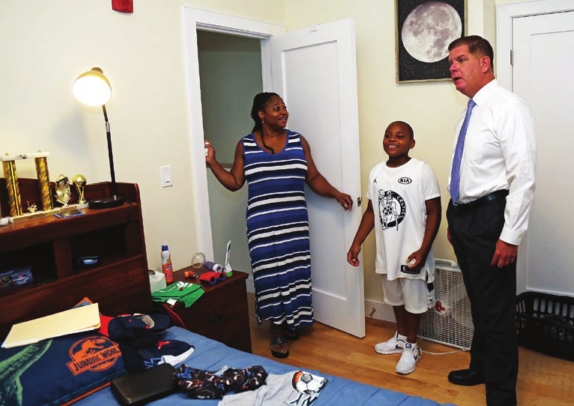
Patricia Brown’s grandson shows the mayor his new room at home in Olmsted Green, challenges him to a dunk contest.
New homeowner supported by city agencies
Patricia Brown, a former resident of the Whittier Street Development, became a first-time homeowner in Mattapan last month, proving that city agencies can successfully help public housing residents purchase their own homes.
Brown hosted Mayor Martin Walsh for breakfast at her new home on Wednesday, along with Boston Housing Authority (BHA) Administrator Bill McGonagle and Shelia Dillon, the city’s chief of housing and director of the Department of Neighborhood Development (DND), as well officials from several organizations that supported her through the home buying process. The single mother of four was able to purchase the property in Olmsted Green thanks largely to financial support from a DND lottery, a $7,200 grant from the Whittier Choice Neighborhood Initiative, and guidance from Economic Mobility Pathways (EMPath) and the Boston Home Center.
“I’m just grateful for all of the support that I was given and I continue to get from all the different agencies, the City of Boston, EMPath, Boston Housing and Boston Home Center,” said Brown. “I’m still a little shocked, but I’m very thankful, grateful, blessed — and we’re happy.”
After
a brief basketball dunk contest in Brown’s 9-year-old grandson’s
bedroom, Walsh congratulated the new homeowner, who moved in with her
grandson and her mother on Aug. 1, for achieving “the Boston dream” of
owning her own home.
“It
was just a good feeling, to walk in the front door and know it’s
yours,” said Walsh, recalling how he felt when he bought his first home
in Savin Hill. “That’s important, so I want to congratulate Patricia and
her mom and her grandson.”
Brown
and her family previously lived in Whittier Street public housing,
which is currently undergoing a $30 million redevelopment, courtesy of a
federal grant from the Choice Neighborhoods Initiative, awarded to the
BHA and the DND. Demolition of the site, which began in February, is now
complete and the foundations for the first new building, expected to
open in fall 2019, are being laid. The first phase of the redevelopment
will create 92 mixed-income apartments in three new buildings on site,
and the second phase will add 76 mixed-income apartments in Madison Park
Village. The entire project is scheduled for completion by 2021.
Brown
was offered coaching by a dedicated mentor from EMPath, which is
supporting all Whittier Street tenants during their relocation. She also
received financial support from the Whittier Choice Neighborhood
Initiative, which aims to give residents economic independence,
McGonagle said.
The
DND lottery funding Brown received was central to making the purchase
financially possible. “You’re not rich, but you’re one of many now,” she
said, describing how she felt when she realized she would receive the
grant. Eligibility for the lottery is judged according to certain
criteria that stipulate applicants must be first-time homebuyers, have
assets that do not exceed $75,000 and meet income limits based on
household size.
But,
“it didn’t happen just by filling out a lottery slip,” said Walsh,
emphasizing the responsibilities that lie with applicants and potential
homeowners to ensure their credit ratings are healthy and their personal
finances are in order.
He
also spoke about the relationship building his administration is
undertaking with banks. “It’s not just simply building housing, it’s
creating access to that money, that capital, to be able to build a
home,” said Walsh. He hopes this will make it easier for people of color
to find lenders that will enable them to purchase their own home,
something the mayor admitted has been difficult in the past.
Homeownership
is important for Boston, said Dillon, because it creates stable
neighborhoods and helps families increase their equity.
“As
prices get less and less affordable in the city, we’re really trying to
build affordable home ownership stock,” Dillon told the Banner. “We’re
doing everything we can to encourage affordable home ownership in the
city.”
The latest
phase of Olmsted Green, developed on the former Boston State Hospital
site, was completed this past July, and brings 514 mixed-income units to
the area, 41 of which will be for sale at prices ranging from $210,000,
for first-time buyers making at or below 80 percent of the Area Median
Income (AMI), to about $350,000 for market-rate units.
“We created a neighborhood here,” said Walsh, who stressed the importance of building communities as well as physical homes.
“This is not a house on a street that was an empty lot, this is actually a neighborhood.”
The
sense of community in Olmsted Green can be credited to the
development’s design, said Dillon, who noted that having houses face one
another and communal outdoor spaces can have a significant social
impact. “[This design] was really important because otherwise it could
have felt like a bunch of single-family homes and there would be no
connectivity,” she said.
Dillon
also said it was important that DND and BHA initiatives support a
diverse group of firsttime buyers. “Were looking for integrated
communities and spaces where people can gather and really feel like a
part of something,” she told the Banner.
Settling
into the neighborhood and becoming part of the community is what Brown
is most looking forward to, and “being able to come home and not have to
worry about the traffic that we had to live with,” she said.
While
she’s met many of her new neighbors, who she described as friendly,
she’s excited to attend her first neighborhood association meeting.
“That’s going to be a big thrill,” she said.