PHOTO: RT TUTKO Staff members and supporters of the William Joiner Institute at the Dorchester Vietnam War Memorial.
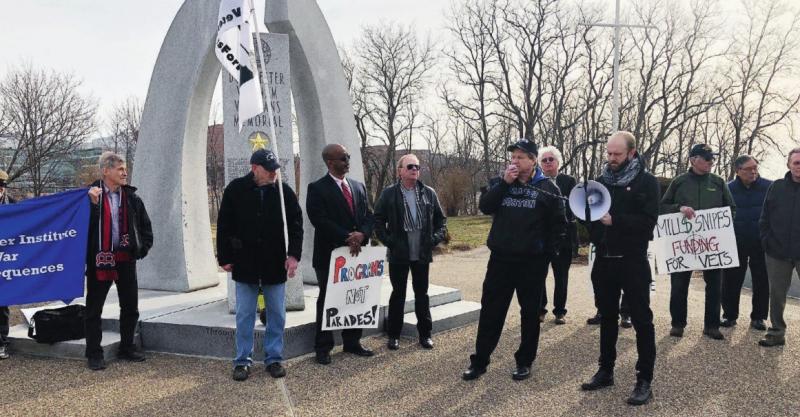
Thomas Kane, director of the Joiner Institute, addresses staff members and supporters at the Vietnam Veterans Day demonstration.
Joiner Institute forced to lay off staff
Following a period of financial turmoil at UMass Boston, war veterans, staff members and supporters of the William Joiner Institute for the Study of War and Social Consequences gathered last week at the Dorchester Vietnam War Memorial to protest the school’s decision to cut funding.
On National Vietnam War Veterans Day, March 29, the demonstrators said that within the last year, the institute has had to lay off all of its full-time staff members and cut programs such as the
Veterans Upward Bound Program, which helped veterans matriculate from service into higher education.
The cuts are part of a schoolwide crisis of staff layoffs, program cancellations and increased tuition rates to offset UMass Boston’s $30 million budget deficit, linked to campus construction projects.
“What the university did to us totally devastated, demoralized and devalued us,” said Thomas Kane, director of the Joiner Institute.
According to Mitch Manning, program coordinator for the institute, the school cut the center’s funding by nearly $300,000 in fiscal year 2017.
The Joiner Institute has specialized in research, education, advocacy and outreach since 1982, when it was created and named after black Vietnam War veteran William Joiner. It provides veteran support on campus and in the Greater Boston community for former combat soldiers suffering from post traumatic stress disorder, substance abuse and brain injuries.
The center has also been the epicenter of peaceful relations between the U.S. and other countries previously at war with the U.S., including Vietnam and Iraq.
“We have a 30-year relationship with the country of Vietnam,” said Manning. “This was a big part of
the Joiner Institute when they were founded in 1982. The Joiner was
doing exchanges with Vietnam while there was still an embargo between
the two countries.”
“Our
impact is global,” said Kane. “The work we do here is vital to veterans
and their families and to civilian victims and refugees of war.”
Self-sufficiency
Late
last month, Barry Mills, UMass Boston interim chancellor, published a
statement outlining the $1.5 million in funding cuts to the school’s 17
centers and institutions, including the Joiner Institute. Other centers
losing funds include the William Monroe Trotter Institute for the Study
of Black Culture, the Mauricio Gastón Institute for Latino Community
Development and Public Policy, the Center for Women in Politics and
Public Policy, the Institute for New England Native American Studies,
the Labor Resource Center, and the Center for Social Policy.
In
his statement, Mills said the cuts were a way to decrease the school’s
budget deficit as well as help the centers reach financial independence
by encouraging staff to instead seek funding from private donors and
grants.
“My hope is that the centers and institutes affected, like other centers and institutes at UMass Boston
and around the nation, will replace the funds they are losing in the
short term and become self-sufficient,” the statement reads.
In
addition, the statement reads, “Every dollar not spent subsidizing the
operations of a center or institute is a dollar saved — or available for
use in our financial aid or academic programs.”
Kevin
Bowen, former director of the Joiner Institute, spoke at the Vietnam
Veterans Day demonstration and addressed the chancellor’s statement.
“The chancellor released the memo which pitted funding for the Joiner
Center against funding for student financial aid and the academic
mission of the university,” he said expressing disapproval. “And he
suggested that our subsidy might actually be responsible for student
debt.”
The staff at
the Joiner Center said that the budget cuts will impact their annual
writer’s workshop; their high school teachers workshop, titled
“Humanizing How We Teach about War and Violent Conflict”; music therapy
programs for veterans; research into the health effects of war; cultural
exchanges; speaker series; and translation projects.
“There is no place like this in the country,” said Bowen.
William
Joiner’s son, also named Bill Joiner, attended the protest
demonstration and talked about his father’s work in helping former
soldiers adjust to civilian life after witnessing the horrors of war.
“The
decision to defund the center is really indicative of the
short-sightedness many people have when they send the best and the
brightest off to war ... and try to wash their hands of any effects of
the war,” he said.