TAPS THE IMMIGRANT IMAGINATION

AUTHOR JUNOT DÍAZ DISCUSSES DEBUT CHILDREN’S BOOK
On
Sunday afternoon, Harvard Book Store hosted Junot Díaz, renowned
author, MacArthur Fellow and professor of creative writing at MIT, for a
soldout book talk at the Brattle Theatre. His subject was not one of
the books that have earned him such awards as the Pulitzer Prize and
National Book Critics Circle Award. Instead, Díaz was there to talk
about and read from his debut children’s picture book, “Islandborn.”
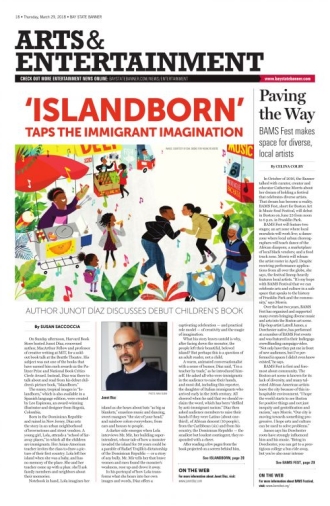
The
sunny, tropical images in “Islandborn,” which is also available in a
Spanish language edition, were created by Leo Espinosa, an award-winning
illustrator and designer from Bogotá, Colombia.
Born
in the Dominican Republic and raised in New Jersey, Díaz sets the story
in an urban neighborhood of brownstones and street vendors. A young
girl, Lola, attends a “school of faraway places,” in which all the
children are immigrants. Her Asian-American teacher invites the class to
draw a picture of their first country. Lola left her island when she
was a baby, and has no memory of the place. She and her teacher come up
with a plan: she’ll ask family members and neighbors about their
memories.
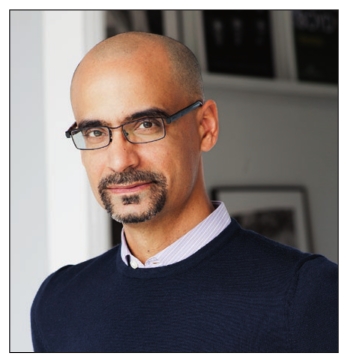
Junot Díaz
Notebook in hand, Lola imagines her island as she hears about
bats “as big as blankets,” ceaseless music and dancing, sweet mangoes
“the size of your head,” and rainbow colors everywhere, from cars and
houses to people.
A
darker side emerges when Lola interviews Mr. Mir, her building
superintendent, whose tale of how a monster invaded the island for 30
years could be a parable of Rafael Trujillo’s dictatorship of the
Dominican Republic — or a story of any bully. Mr. Mir tells her that
brave women and men found the monster’s weakness, rose up and drove it
away.
In his portrayal
of how Lola transforms what she hears into her own images and words,
Díaz offers a captivating celebration — and practical role model — of
creativity and the magic of imagination.
What
his story leaves untold is why, after facing down the monster, the
people left their beautiful, beloved island? But perhaps this is a
question of an adult reader, not a child.
A
warm, animated conversationalist with a sense of humor, Díaz said, “I’m
a teacher by trade,” as he introduced himself. He asked all who were
immigrants in the audience to raise their hands, and most did, including
this reporter, the daughter of Italian immigrants who arrived early in
the 20th century. All cheered when he said that we should reclaim the
word, which has been “defiled by anti-immigrant racism.” Díaz then asked
audience members to raise their hands if they were Latino (about
onethird), of African descent (10 people), from the Caribbean (six) and
from his country, the Dominican Republic — the smallest but loudest
contingent, they responded with a cheer.
After reading a few pages from the book projected on a screen behind him, Díaz invited questions, starting first with the kids in the packed theater.
One
asked him about Mr. Mir, the building superintendent. Díaz described
him as the kind of everyday hero who does the jobs we take for granted —
handing us our coffee and mopping the floor. Another asked, “What was
the monster’s weakness?” Díaz replied that what the monster feared most
was the power of “people sticking together.”
A
girl asked if it was hard to write the book. Díaz replied that it would
have been much easier to write it when he was a child. “You have so
much magic in you now. I took two years. A six-year-old would knock it
out in a half-hour.”
Encouraging
children of color to write their own stories and tap the power of their
inborn creativity, Díaz concluded by taking a turn into advocacy.
“About
94 percent of children’s literature is written by white authors,” said
Díaz, calling the dearth of literature about and by people of color “a
representational crime.” Observing that “global whiteness” consumes a
disproportionate share of the world’s resources, including its cultural
wealth, Díaz concluded by saying, “If we don’t shift this paradigm, we
have no future.”
At
the end, a long line formed for signed copies of “Islandborn” and photo
ops with Díaz, who asked parents with children to come first.
ON THE WEB
For more information about Junot Díaz, visit: www.junotdiaz.com