Coalition says district hasn’t done enough to recruit teachers of color
A coalition of civil rights and education groups released a scathing report Wednesday that questioned the city’s commitment to hiring and retaining teachers of color.
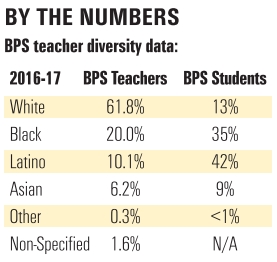
Although the city is under a decades-old court order to increase the diversity of its teaching staff, the school department has seen the percentage of black teachers in the system decline over the last ten years. Modest increases in the percentages of Latino and Asian teachers have not offset the losses of black teachers, leading to a slight increase in the percentage of white teachers, according to the report, titled Broken Promises: Teacher Diversity in Boston Public Schools.
The increased proportion of white teachers comes despite the district’s 2016 Opportunity and Achievement Gap Policy, which included goals to recruit and retain “employees at all levels who reflect the demographics of the District’s students.”
Because a large number of BPS teachers of color were hired early in the district’s effort to comply with a 1974 court order to diversify its teaching staff, many black and Latino teachers are now approaching retirement age, a dynamic the report authors say could lead to a further decline in the percentage of black teachers.
“This could create a problem that will last for decades to come,” commented Ivan Espinoza-Madrigal, executive director of the Lawyers’ Committee for Civil Rights.
Espinoza-Madrigal
noted that while the composition of the student body in BPS has changed
substantially over recent decades, with Latinos now making up the
largest group at 42 percent, the city’s hiring practices have remained
largely the same.
“We’ve been stagnant and have gone back in some ways,” he said.
Latinos
make up 42 percent of BPS students, but just 10 percent of BPS
teachers. Blacks are 35 percent of the students, but 20 percent of the
teachers — down from 24 percent ten years ago. Asians are 9 percent of
BPS students and 6 percent of the teaching staff.
“It’s
not acceptable,” Sociedad Latina Executive Director Alexandra
Oliver-Davila said of the underrepresentation of teachers of color in
the BPS system.
Oliver-Davila,
a member of the Greater Boston Latino Network, said students at
Sociedad Latina, a Mission Hill-based youth organization, complain about
teachers who refuse to call them by their proper names or chastise them
for speaking
Spanish. She said the absence of Latino teachers could contribute to
the achievement gap between Latino and white students.
“If
you have someone who comes from a similar background, they would be
more comfortable with students speaking a different language,” she said.
A BPS spokesman Dan O’Brien sent the Banner a statement noting a recent increase in hires of teachers of color.
“The
spring 2017 hiring season was our most effective on record, yielding 44
percent teachers of color hired to work in BPS this year,” read the
statement. ”Over the past several years, BPS has developed and grown
numerous initiatives intended to develop, recruit, select and retain
teachers of color.”
A call for action
The
report is signed by the NAACP Boston Branch, the Black Educators
Alliance of Massachusetts, the Boston Network for Black Student
Achievement, the Greater Boston Latino Network and the Massachusetts
Asian American Educators Association.
It alleges that BPS officials have left solutions to the lack of diversity among its teachers abandoned, unfunded or untried.
“BPS
once maintained a staff of three recruiters, which helped to bring the
district as close as it has come to complying with its desegregation
order,” the report reads.
“BPS needs to hire more recruiting staff to conduct outreach and ensure that recruits actually get interviews.”
The district’s so-called
pipeline programs, which target BPS students, midcareer professionals,
BPS paraprofessionals and substitute teachers, operate below their
capacity, according to the report.
“As
the number of applicants for these programs well exceeds the number of
seats available in them, these programs should be expanded to provide a
steadily growing pool of well-prepared teaching candidates,” the report
states.
The report
also recommends that the central office play a more aggressive role in
holding individual schools accountable for hiring more diverse teaching
staff. BPS schools select teachers, who are then hired by the district.
“To
meaningfully increase teacher diversity, BPS will need to hold each
school accountable for continuing diversity gaps,” the report reads.
“BPS must also play a more central role in approving hires, as its
Office of Equity did in past decades.”
The
report also recommends the district take affirmative steps to retain
teachers of color, including eliminating bias in the teacher evaluation
process, a process the report authors say is subjective.
“When
BPS implemented its current teacher evaluation process in 2013, Black
and Latino teachers, and older teachers, received disproportionately
negative reviews,” the report reads. “The Boston Teachers Union argued
that the new process allowed for too much discretion and subjectivity
from school administrators, and BPS has publicly stated its commitment
to addressing bias in the evaluation system. It must follow through.”
Scrutinizing city hiring
The
report is part of an ongoing effort undertaken by civil rights groups
to monitor hiring in city departments. Recent reports have found that
blacks, Latinos and Asians are underrepresented in city government and
are disproportionately concentrated in the lowest-paying city jobs.
“It’s
critically important for us to take a look at the racial breakdown of
city employees, not just in City Hall, but in the Police Department,
Fire Department and in the Public Schools. It’s important for all of our
communities to see themselves reflected in our city’s institutions,”
Espinoza-Madrigal said.


