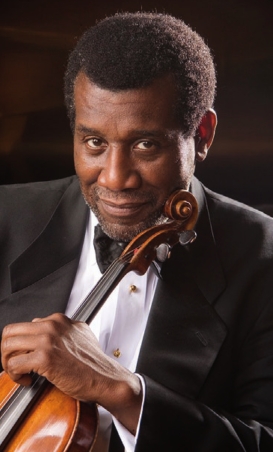
Marcus Thompson
One of only a few African Americans to find success in classical music, violist Marcus Thompson has garnered critical acclaim since the start of his illustrious career. The South Bronx native earned the Juilliard School’s first-ever doctorate in viola performance, and in 1968, he performed in Carnegie Hall as winner of the prestigious Young Concert Artists International Auditions. Also in 1968, Thompson made his Boston debut, on April 4, with a recital at the Isabella Stewart Gardner Museum.
That evening, Martin Luther King Jr. was assassinated, and the two pivotal events—King’s death and his start on the concert stage, mingle in Thompson’s memory.
On the evening of Feb. 24, at Kresge Auditorium, on the campus of the Massachusetts Institute of Technology, Thompson marked the 50th anniversary of his debut with a concert that reflected King’s legacy as well as his own.
Distinguished as an educator as well as a musician, Thompson has been a faculty member at MIT for more than four decades. In 2015, Thompson received MIT’s highest faculty honor, the title of Institute Professor.
Saturday evening, Thompson performed both on viola and viola d’amore, and designed a program that was a celebration of community—including the colleagues and students who shared the stage with him; and a demonstration of the power of music to bring people together.
Proceeds
from the Marcus Thompson Faculty Recital, an MIT Sounding Series
concert presented by the MIT Center for Art, Science & Technology
and Music and Theater Arts, benefited a local nonprofit, Artists for
Humanity, which employs young people in the visual arts and creative
industries.
The
concert’s inclusionary spirit began with Thompson’s choice of
instruments, the viola and its more exotic sibling, the viola d’amore.
Thompson brings much heralded mastery to each, coaxing a dark, rich
sound that is midway between the timbre of a violin or the still deeper
cello, and achieves an emotional eloquence that transcends virtuosity.
With
its name and design, the viola d’amore hints at an ancestry beyond
Europe to an earlier generation of string instruments such as the
Byzantine lyra. A blindfolded Cupid’s head crowns its tip instead of a
scroll, because love is blind; and “d’amore” echoes the phrase “of
Moors,” evoking the Berbers who migrated from northern Africa to Europe
in the eighth century, bringing their rich Muslim culture, including
stringed instruments. Framing the strings of the viola d’amore are twin
carved figures resembling “the flaming swords of Islam.”
Thompson
opened the program with a work showcasing the instrument, Antonio
Vivaldi’s “Second Concerto for Viola d’Amore and Strings” (1724). With
lively accompaniment by an ensemble of eight violinists, two cellists,
and a bassist, Thompson played sinuous solos that gave full voice to the
work’s plangent sweetness.
Next
came “Rothko Chapel” (1971), a stirring and spare meditation composed
by Morton Feldman to inaugurate the Rothko Chapel at the Menil
Foundation in Houston. An octagonal contemplative space open to all, the
chapel displays 14 wall-size black paintings by Mark Rothko, who did
not live to see its completion.
Conducted
by MIT professor Evan Ziporyn, a Grammy-winning composer and performer
who heads Music & Theater Arts at MIT, the 18-member MIT Chamber
Chorus delivered the composition’s wordless harmony in shimmering
currents while an ensemble provided textured accompaniment that included
the delicate, bell-like chimes of a celesta, rippling cymbals, subtle
drumming, and cricket-like percussive sounds. In between, Thompson’s
viola threaded exquisite, plaintive solos evoking the music of a
synagogue. All the musicians moved as one, as if to the rhythm of slow
breathing, and encompassed the audience with the work’s gravity and
grace.
One of
Thompson’s long-time colleagues, MIT lecturer and acclaimed composer
Elena Ruehr, composed a concerto for him, “Shadow Light” (2016), which
she describes as “a story about striving for light in the midst of
darkness.”
After an
intermission, Thompson performed the Boston premiere of its chamber
version, accompanied by two violinists and a violist, a cellist and a
bassist. Mingling dark and light musical elements from the start, the
concerto begins with a minor triad and leavens this phrase with a raised
fourth. This interplay of light and shadow continued throughout the
piece, as the ensemble responded with empathy to each of Thompson’s
lyrical solos.
Thompson
concluded the concert with the sumptuous, eccentric “Flos Campi”
(1925), by Ralph Vaughan Williams, which he performed with a 35-member
orchestra and the MIT Chamber Chorus, directed by Dr. William Cutter,
MIT’s director of Choral Programs.
The
work’s six movements interpret verses in the Song of Solomon, an Old
Testament paean to both erotic love and the bond between God and
humanity. The verses are quoted in the program in both Latin and
English. But these words are not sung by the chorus. Instead, with
wordless vocals, the singers join the orchestra and Thompson in
rendering the emotional momentum of the lines, which varies from soulful
yearning and tender pleas to a staccato march and a danceable rhythmic
passage. With a lively wind section complementing strings and
percussion, the orchestra adds plenty of color, following Thompson as he
alternates between delicate fingering and forceful rasping on his
strings until, reaching the end of the sixth movement, a slow arc of
notes brings a sense of fulfillment.