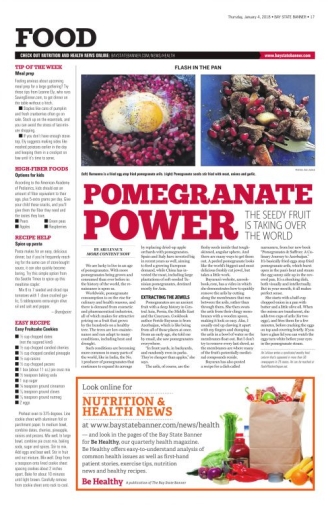
THE SEEDY FRUIT IS TAKING OVER THE WORLD
 We
are lucky to live in an age of pomegranates. With more pomegranates
being grown and consumed than ever before in the history of the world,
the renaissance is upon us.
We
are lucky to live in an age of pomegranates. With more pomegranates
being grown and consumed than ever before in the history of the world,
the renaissance is upon us.
Worldwide,
pomegranate consumption is on the rise for culinary and health reasons,
and there is demand from cosmetic and pharmaceutical industries, all of
which makes for attractive pricing on a fruit that grows by the
hundreds on a healthy tree. The trees are low-maintenance and can adapt
to many conditions, including heat and drought.
Such
conditions are becoming more common in many parts of the world, like in
India, the No. 1 producer of pomegranates that continues to expand its
acreage
by replacing
dried-up apple orchards with pomegranates. Spain and Italy have invested
big in recent years as well, aiming to feed a growing European demand,
while China has invested the most, including large plantations of
soft-seeded Tunisian pomegranates, destined mostly for Asia.
EXTRACTING THE JEWELS
Pomegranates
are an ancient fruit with a deep history in Central Asia, Persia, the
Middle East and the Caucuses. Cookbook author Feride Buyuran is from
Azerbaijan, which is like being from all of those places at once. From
an early age, she told me by email, she saw pomegranates everywhere.
“In front yards, in backyards, and randomly even in parks. They’re cheaper than apples,” she says.
The
arils, of course, are the fleshy seeds inside that toughskinned,
angular sphere. And there are many ways to get them out. A peeled
pomegranate looks like the world’s biggest and most delicious freshly
cut jewel, but takes a little work.
Buyuran’s
website, azcookbook.com, has a video in which she demonstrates how to
quickly remove the arils by cutting along the membranes that run between
the arils, rather than through them. She then swats the arils from
their clingy membranes with a wooden spoon, making it look so easy.
Alas, I usually end up clawing it apart with my fingers and dumping the
arils in a bowl of water so the membranes float out. But I don’t try to
remove every last shred, as the membranes are where many of the fruit’s
potentially medicinal compounds reside.
 Buyuran
has also posted a recipe for a dish called narnumru, from her new book
“Pomegranates & Saffron: A Culinary Journey to Azerbaijan.”
Buyuran
has also posted a recipe for a dish called narnumru, from her new book
“Pomegranates & Saffron: A Culinary Journey to Azerbaijan.”
It’s
basically fried eggs atop fried pomegranate arils, which burst open in
the pan’s heat and steam the egg sunny side up in the covered pan. It’s a
shocking dish, both visually and intellectually. But in your mouth, it
all makes perfect sense.
She
starts with a half-cup chopped onion in a pan with butter and a little
olive oil. When the onions are translucent, she adds two cups of arils
(for two eggs), and fries them for a few minutes, before cracking the
eggs on top and covering briefly. If you have a glass lid you can watch
the eggs turn white before your eyes in the pomegranate steam.
Ari
LeVaux writes a syndicated weekly food column that’s appeared in more
than 50 newspapers in 25 states. Ari can be reached at [email protected].