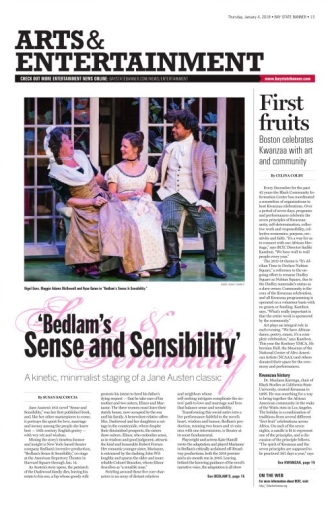
A kinetic, minimalist staging of a Jane Austen classic
Jane
Austen’s 1811 novel “Sense and Sensibility,” was her first published
book, and, like her other masterpieces to come, it portrays the quest
for love, marriage and money among the people she knew best —
18th-century English gentry — with wry wit and wisdom.
Mining
the story’s timeless humor and insight is New York-based theater
company Bedlam’s inventive production, “Bedlam’s Sense &
Sensibility,” on stage at the American Repertory Theater in Harvard
Square through Jan. 14.
As
Austen’s story opens, the patriarch of the Dashwood family dies,
leaving his estate to his son, a fop whose greedy wife protests his
intent to heed his father’s dying request — that he take care of his
mother and two sisters, Elinor and Marianne. The three women must leave
their stately house, now occupied by the son and his family. A
benevolent relative offers Mrs. Dashwood and her daughters a cottage in
the countryside, where despite their diminished prospects, the sisters
draw suitors. Elinor, who embodies sense, as in wisdom and good
judgment, attracts the kind and honorable Robert Ferrars. Her romantic
younger sister, Marianne, is entranced by the dashing John Willoughby
and spurns the older and more reliable Colonel Brandon, whom Elinor
describes as “a sensible man.”
Swirling
around these five core characters is an array of distant relatives and
neighbors whose self-seeking intrigues complicate the sisters’ path to
love and marriage and lives that balance sense and sensibility.
Transforming
this social satire into a live performance faithful to the novel’s
heart, wisdom and humor, Bedlam’s production, running two hours and 15
minutes with one intermission, is theater at its most fundamental.
Playwright
and actress Kate Hamill wrote the adaptation and played Marianne in
Bedlam’s critically acclaimed off-Broadway productions, both the 2014
premier and a six-month run in 2016. Leaving behind the knowing guidance
of the novel’s narrative voice, the adaptation is all show and no tell. Likewise, the staging, orchestrated by Bedlam artistic director Eric Tucker, plunges right into the action.
True
to its name, the Bedlam troupe creates a ruckus. The company is known
for tackling the classics with a kinetic, pared-down approach that
distills their emotional essence while remaining faithful to the texts.
Central Square Theater in Cambridge has hosted Bedlam productions of
“Saint Joan” and “Twelfth Night,” and in March, ArtsEmerson will present
Bedlam’s “Hamlet and “Saint Joan” at the Cutler Majestic Theatre.
Bedlam’s
minimalist staging demonstrates the power of live theater to cast a
spell through acting, words, sound and spectacle, with the audience as
knowing, complicit partner.
The
staging asks a lot of the cast, 10 actors who play 20 characters. An
ensemble of solid character actors, they are also as agile as circus
clowns. While playing their roles straight, they employ all the tricks
in an actor’s book, including plenty of dance and moments of
improvisation and semi-spontaneous exchanges with audience members.
Seeing
the same shape-shifting actor who is an ardent suitor become a moment
later a mumbling dowager and believing in both, the audience is aware
of its willing part in the artifice.
At
the ART, the audience sits on both sides of the ensemble’s long,
narrow performance area. Overhead are four scenes of an idyllic English
countryside.
As the
show begins, the cast comes out in casual jeans and sweaters and leaps
into pulsing, high-energy dancing to a punk rock track. The music then
changes to a country air, and, thanks to Angela Huff’s versatile
costumes, the actors strip off their outer wear to unfurl period attire
and move into the enforced order of a country line dance.
Now
dressed as English gentry, they babble at each other all at once. The
air crackles with the crow-like cacophony of their voices. Later, a
jealous wife howls like a wolf, acting out feral impulses only implied
in Austen’s text.
Dramatic payoff
The
actors also move around John McDermott’s mobile sets, which are
mounted on casters. These items include French doors, window frames
(the better for peering in on private conversations) and chairs. Before
our eyes, one scene molts into another, with the same speed as the
costume changes.
Gossip
becomes a visible force as, through Alexandra Beller’s choreography,
the ensemble swarms into a whirlpool, bodies miming the momentum of
hearsay and half-truths that surrounds the sisters and animates the
plot. Is one beau secretly betrothed to another woman? Does another
have a scandalous past?
Exploring
the thin veneer between propriety and the raw dynamics between people
is Jane Austen’s cup of tea, and Bedlam’s staging makes both social
niceties and more feral impulses visible, delivering real dramatic
payoff in a production that is revelatory as well as fun.
In
the first act, all the kinetic energy at times outweighs the content,
making it hard to keep the interactions among minor characters
straight. The second act is more focused, closing in on the sisters and
their increasingly dubious prospects in courtship. After the
intermission, before the lights go up, the theater goes completely dark
for a moment, with the only lights — those that mark rows of seats,
casting a haze as in a nighttime fog. Clarity does emerge, but not
before fake news and complicated pasts come to light.
The
ensemble is excellent throughout, including the actors in major roles:
Jessica Frey as Marianne; James Patrick Nelson, entirely credible as
the devoted Colonel Brandon; and Benjamin Russell as two feckless
characters, Willoughby and the sisters’ brother, John. But the spine of
this production is its gracious, steadfast and vulnerable Elinor,
played by Maggie Adams McDowell, who brings her character both dignity
and a touch of humor.
Austen
has her own ample bag of tricks when it comes to satire. For instance,
she pairs Elinor’s suitor, the modest and noble Edward, with a vain
buffoon of a brother, Robert. Director Eric Tucker trumps Austen by
casting the same actor, Jamie Smithson, as both Edward and Robert.
As
the worthy Edward finally bares his heart to Elinor, Smithson gets to
pronounce one of the adaptation’s best lines, which director Hamill
snipped from “Emma,” Austen’s 1816 comic novel: “If I loved you less, I
might be able to talk about it more.”
But
Smithson exults as the fatuous Robert, and he turns a passage from
Austen’s text into an extended comic aria that on Saturday night drew
the audience into a peak of euphoria.
In
the novel, the restrained Elinor silently endures the bombast of
Edward; for the audience of Bedlam’s production, his buffoonery just
adds to the great fun of the show.