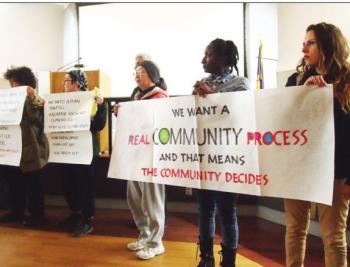
BPDA to hold meeting on planning process
5Frustrated
by what they perceived as a lack of transparency and limited community
input, in November a group of Dorchester activists interrupted a Boston
Planning and Development Agency meeting to outline demands for greater
community inclusion.
The
activists’ complaints, during a public meeting for the BPDA’s PLAN:
Glover’s Corner process, echoed those from groups in Roxbury and Jamaica
Plain who have argued that the BPDA processes are slanted toward real
estate developers and ignore the needs of the low- and moderate-income
people who live in Boston.
Now, BPDA officials are planning a community conversation on Jan. 10 covering the planning process itself.
“We
need to hear each other’s hopes and concerns so we can find solutions,”
said BPDA Deputy Director of Community Planning Lara Mérida. “The
concerns the advocacy groups have are the city’s concerns.”
During
the Nov. 29 meeting, community activists complained that the BPDA
process has been skewed toward developers and hasn’t offered local
residents and business owners enough opportunity to weigh in in a
meaningful way.
“The process doesn’t allow for deep community input,” said Dorchester resident Carolyn Chou. “We want to make sure there’s a genuine community process, not just a series of check boxes.”
As
Chou and other activists describe it, the BPDA process so far has
included meetings on specific aspects of planning, such as
transportation or open space. Community members, city officials and
developers typically are divided up to sit at tables for small group
discussions, then report back to the general meeting about their ideas
and concerns.
In one
exercise, meeting participants placed colored Legos on a map of the
area to demonstrate support for various categories of land uses they
would prefer to see in the area.
Mérida
and Deputy Director of Development Review Michael Christopher said the
planning exercises the BPDA deploys are used by planning agencies
across the country and are designed to facilitate participation. And
community input is not limited to participation in meetings, Mérida
said.
Community members can call, write, email or request in-person meetings with BPDA officials.
“We
ask people to reach out to us in any way they feel comfortable,” she
said. “Our job is to listen and hear what people are concerned about.”
While
the activists asked for a moratorium on the planning process, BPDA
officials refused that demand, instead inviting the demonstrators to
suggest better ways to facilitate community conversation during the Jan.
10 meeting.
But
Dorchester resident Davida Andelman said she fears the BPDA will use the
same methods as in the past, breaking participants up into small
groups rather than facilitating a large group discussion.
“They haven’t asked us for any input on planning for the meeting on the 10th,” she said.
At issue: affordability
At
the heart of the activists’ complaints are concerns that local
residents and businesses will be priced out, as has happened in other
areas of the city that have seen large-scale redevelopment projects.
In
the BPDA’s PLAN: JP/Rox planning process, the city agreed that 36
percent of new housing developed in the plan area, which includes
Jackson Square, Egleston Square and Forest Hills, would be designated
affordable. But in that area, city officials had leverage to demand
higher levels of affordability, with larger tracts of public land and
nonprofit developers planning dense developments.
In
the Glover’s Corner area, which includes parts of Savin Hill, Pleasant
Street and Freeport Street, most of the land is in the hands of
private developers. Mérida said developers in the area would be
required to either build 13 percent of a development’s housing units as
affordable or pay into the city’s affordable housing fund for
construction of affordable units offsite. Developers could be required
to go as high as 17 percent affordable in exchange for constructing
buildings that exceed height or density limits in the area’s zoning
code.
Mérida said the
lack of housing affordability is one of the driving forces behind
planning processes like the Glover’s Corner effort.
“Affordable housing is the number one issue facing the city,” she said.
Activist
Andelman said the city could do more to push developers to build
affordable housing, noting that Cambridge requires 20 percent of all new
housing to be affordable.
“The city has ways of influencing what developers do on their own land,” she said. “The city does it all the time.”
IF YOU GO
What: PLAN: Glover’s Corner community conversation
Where: Local 103 IBEW, 256 Freeport St., Dorchester
When: Jan. 10, 2018, 6–7:30 p.m.
Contact: [email protected], 617-918-4312
More information: Interpretation and translated materials will be provided in Vietnamese and Cape Verdean Creole languages.


