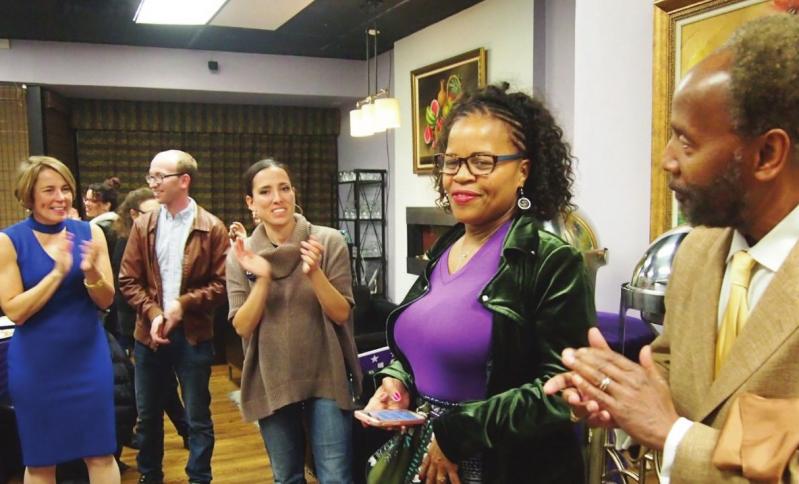
A long — and at times contentious — race to fill Tito Jackson’s District 7 city councilor seat ended Nov. 7 with Kim Janey the victor, having garnered 55.5 percent of the 8,901 votes cast.
Janey, the first woman to represent the Roxbury-based district on the City Council, beat Rufus Faulk after the pair had emerged as the top two contenders from a field of 13 candidates in the Sept. 26 preliminary.
She attributed her victory to hard work on and off the campaign trail.
“This has been about getting the work done, not just on the campaign trail, but the work we do as a community,” she said, addressing supporters during her victory party at Merengue Restaurant on Blue Hill Avenue.
Janey is a senior project director for Massachusetts Advocates for Children and has been active in education policy, in the Ward 12 Democratic Committee and in local civic groups.
She said issues around housing, education and income inequality figured prominently among the concerns she heard from constituents while knocking doors and participating in candidate forums.
Inequality
On the campaign trail, she often spoke of District 7 and the city being at a crossroads, with rising housing costs and inequality threatening the quality of life.
“To me, it’s all about issues of equity, making sure we all get to share in what the city of Boston has to offer,” she said. “Right now, too many of us are being left out. We’re seeing disparities in terms of access to opportunity. It’s incumbent on all of us to come together to address the demand for opportunities.”
Janey raised more than $80,000 during 2017. She said she personally knocked on 9,000 doors.
Along with volunteer canvassers, her campaign knocked on 25,000 doors and made nearly 10,000 calls, according to campaign manager Noah Coolidge.
Field manager Deborah Shah said the door-to-door campaigning is ultimately what wins in local elections.
“It’s really just about keeping on the doors and talking to the voters,” she said. “You’re not only able to win their support, you’re also going to gain insight from those conversations that enable you to be a better public servant.”
The race was not always civil. An anonymous letter accused Janey of being beholden to wealthy developers. Janey accepted campaign contributions from several individuals working in real estate and construction, including a $1,000 from her cousin Greg Janey. She said her contributions from people in real estate development-related fields accounted for less than 5 percent of her campaign funds.
Yet, after several weeks of enduring torn-down campaign signs, erroneously-implied endorsements and accusations of questionable campaign contributions, Janey said she would continue to stay out of the fray.
“I just tried to stay focused, stayed the course and knocked on doors,” she said. “If you keep doing the work, it will pay off.”
Conciliatory note
In her remarks to supporters, Janey thanked the other 12 candidates in the race, and said she would work with Faulk, who works as an anti-violence advocate for the Boston TenPoint Coalition.
“I share his passion,” Janey said. “I look forward to working with him.”
Along with newly-elected District 1 Councilor Lydia Edwards, incumbent District 4 Councilor Andrea Campbell and at-large councilors Ayanna Pressley, Michelle Wu and Anissa Essaibi-George, the new councilors could potentially form a bloc that challenges the traditionally white male-dominated body that has often voted conservatively on issues involving housing, law enforcement and civil rights.
The new near-majority of women on the council comes at a time when the majority people of color in the city face challenges and issues that were hotly contested during the mayoral race: the city’s recalcitrance on police reforms such as body-worn cameras and an independent civilian review panel, persistent disparities in student opportunities and achievement and a real estate market that has put much of the city’s housing beyond the reach of the majority of those who now live here.


