Board an aircraft at Kennedy Airport in New York City, fly 18 hours to Harare, Zimbabwe, and you will have landed a world away. As far from New York as the African continent may be, it has apparently attracted the attention of a couple of downstate legislators who have introduced a bill to ban importing what are commonly referred to as “big game trophies.” As well-intentioned as those legislators they may be, their proposed ban could have consequences that even they may not have anticipated.
While hunting is big business here in the U.S., it’s impact in Africa is even more profound. Sure, it’s easy to justify “banning the import of any part or product of the skin or body, whether raw or manufactured, of elephants, leopards, lions, black and white rhinos, and finally, giraffes,” as the proposed ban stipulates. And, to be sure, there are places on the Continent where those species should not be hunted. But decisions regarding wildlife management should be relegated to wildlife professionals there, not by someone sipping coffee and munching on a croissant in a sidewalk café overlooking Central Park in New York City.
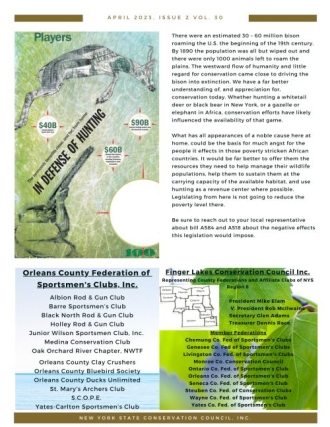
America’s nearly 14 million hunters spend as much as $40 billion a year. Just from 2006 to 2011, hunting-related expenditures increased by 55 percent. There are more that 680,000 Americans at work because of the hunting industry. Also, not to be overlooked is the $12 billion in taxes that the government collects. Those expenditures have a significant impact on the U.S. economy.
Let’s talk about how hunting impacts the African economy. Lion hunters in just nine countries, including Zimbabwe, contributed $60 million to their economies. One study revealed that regional in-country spending per hunter was $20,602. Total direct hunter spending in eight countries was approaching $327 million.
In those countries, foreign hunters created more than 53,000 jobs. Another 86,000 jobs in just five countries directly related to the hunting industry.
All of this in a region of the world where up to 75 percent of the population is living below poverty level. They need those hunters to continue to visit their countries.
Hunter clients in some countries pay 10, 20 or even 30 times more than photo tourist clients. An African safari typically costs each hunter client between $50,000 and $120,000. But one activity should not preclude the other; neither hunters nor photo tourists can carry the load alone.
No one is suggesting that wanton killing of big game animals is acceptable. And no one is endorsing continued hunting of endangered species. What should be permissible and desirable is management of the continent’s wildlife as a shared resource. Allow safe, responsible and ethical hunting programs that support lagging economies and help provide much needed revenue for conservation programs. Many of those programs would not exist or be as well-funded were it not for the hunting revenue and the support provided by pro-hunting and other conservation groups such as Safari Club International.
Wildlife is not always scattered evenly across the landscape. Even endangered species can present overpopulation problems in some areas. Carefully managed hunting programs can serve as one tool to keep those populations in check where necessary. Wildlife management on the African continent is going to become even more difficult in the future. By 2050 current projections say that there will be 2.5 billion people living on the African continent, almost twice what it is today. It is inevitable that habitat will be destroyed to make way for that human population growth. Hunting can help reduce wildlife populations where necessary.
There were an estimated 30 – 60 million bison roaming the U.S. the beginning of the 19th century.
By 1890 the population was all but wiped out and there were only 1000 animals left to roam the plains. The westward flow of humanity and little regard for conservation came close to driving the bison into extinction. We have a far better understanding of, and appreciation for, conservation today. Whether hunting a whitetail deer or black bear in New York, or a gazelle or elephant in Africa, conservation efforts have likely influenced the availability of that game.
What has all appearances of a noble cause here at home, could be the basis for much angst for the people it effects in those poverty stricken African countries. It would be far better to offer them the resources they need to help manage their wildlife populations, help them to sustain them at the carrying capacity of the available habitat, and use hunting as a revenue center where possible.
Legislating from here is not going to reduce the poverty level there.
Be sure to reach out to your local representative about bill A584 and A518 about the negative effects this legislation would impose.