PHD, 1ST VICE PRESIDENT
The CageyPillar is an adaptation of a simple and classic fly pattern that mimics an inchworm. In this case, the adaptation is not so much about the appearance and presentation, but about the function of the fly when used in a certain set of conditions. This is a very straightforward pattern and is for use when implementing an equally straightforward and basic fly-fishing technique.
Come the end of May, one starts to see the inchworms. The common name "inchworm" applies to a large group of caterpillars that includes many different species of moth larvae of several species of geometer moth. There are roughly 1,400 species of geometer moths in North America. Common caterpillars have a series of true legs and fleshy "prolegs" that support movement from head to tail. In contrast, inchworms have true legs at the front and prolegs at the rear with a legless expanse in between. To travel forward, inchworms take it one end at a time, as though they're measuring their route. First, the rear moves forward, causing the legless midsection to arch or "loop" up. Then the inchworm lifts and extends its front end, and the rear begins to move again.
Inchworm size depends on maturity and species, but they typically reach 1 inch long or more. Common colors include shades of green and brown, but vivid spots, stripes and patterns also exist. Mature inchworm moths vary significantly, too.
Colors range from dingy white, gray-brown or mint green to vibrant color combinations. The most noticeable color inchworms found are chartreuse or insect green, vivid greens that blend with the new leaves of spring. As we move into the summer and fall seasons, inchworm colors tend to be brown or grayishtan, very dull earth tones that blend with the bark and limb colors. Inchworm patterns as with any terrestrial pattern may be fished dry or wet.
Typically, the pattern is
tied with materials that will float if greased with floatant and sink
readily once soaked when no floatant is applied. An original “old
school” classic fly pattern for an inchworm is based on using deer hair
tied laterally along the hook shank. These patterns look as much like a
stick as they do an inchworm, but they float quite well due to the
hollow deer hair. Tying an inchworm in the style of a San Juan Worm
allows the tyer to create a more worm-like imitation and even imitate
the “grand arch” if so desired.
Trout
love inchworms, as do many other gamefish. I remember one outing on the
Salmon River (the one near Malone NY) where in one day I caught
rainbows, browns and a smallmouth bass on inchworm patterns. That was a
great day, but also a frustrating one because I only hooked about 25% of
the fish that ate the fly.
In
this stretch of river, there are some fast runs and glides that pile up
on foamy boils and pools against sharp angles in the river, with log
jams and such.
The
trick in spots like these that are hard to cast to, especially with fast
deep water and tree cover overhead, is to approach the fish lairs at
the end of fast runs from upstream. I like to take my stand about 20 or
30 yards above where I think fish are lying in wait for the food to wash
to them and “wiggle” the fly into their hide-out. This means feeding
line down the current with minor mends to allow the fly to “wash in” to
the slower water in the pile-up pools at the end of fast runs. The
problem is that there is a lot of line on the water, a fair bit of drag,
and you miss hooksets.
The
CageyPillar adaptation to the inchworm pattern came about to mitigate
this hook setting problem. I had seen the effectiveness of circle hooks
and octopus hooks in saltwater contexts when bait fishing, the way the
fish seem to hook themselves. I started to experiment with different
shaped hooks for the inchworm and settled on the Gamakatsu Octopus hook
in size 8, 6, or 4 (I try to have some of each size with me, but I like
size 6 best of all). The reason is that the Octopus hook acts much like a
circle hook in that once the fish turns with its food, the hook nestles into the
corner of the mouth and rotates, essentially setting itself, making it
unnecessary for the angler to hard-set the hook like they would with
other approaches, like a streamer or dry fly. In the style of fishing
and approach described above, the combination of the fish turning after
eating and the tension on the line due to the current “autosets” the
hook. One need only to sense the bite, and then get tight. Fish on!
CageyPillar Recipe
Hook: Gamakatsu Octopus (02307-G) size 6 (in either fluorescent chartreuse coated or green coated)
Thread: Uni 8/0 or equivalent in Chartreuse or regular green
Abdomen/Thorax: Chartreuse chenille (with sparkle/flash if possible) or Hareline Variegated Chenille - Black / Olive
The directions and photos
present a curved octopus hook, but it can be substituted with any number
of wet fly hooks if you can’t stand the thought of fly-fishing with a
fly tied on a bait hook.
The directions are for the simplest method.
Directions:
1) Thread wrap toward the bend, from three eyelengths from the eye to a point in line with the hook eye. Let the bobbin hang.
2) Select a two or three inch length of chenille and using scissors or
fingernails, strip the chenille from the core thread. Expose about an
eighth of an inch and tie in (at the rear of the hook) by the exposed
chenille thread.
3)
Advance the thread to the eye and wrap the chenille forward to three
eyelengths from the eye and tie off. Trim the excess chenille and tie in
a head. Apply head cement.
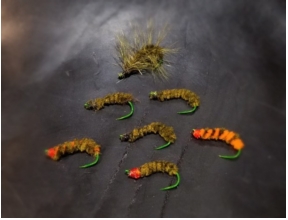
Larger Cageypillars tied by the author on green hooks, with multiple variations. Photo: KG Tidball
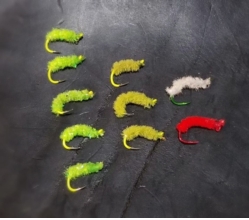
Cageypillars tied by the author in chartreuse and yellow, with a couple of experimental colors. Photo: KG Tidball
It’s
easy and only takes a few minutes. Feel free to experiment with other
color patterns. Remember, feel the bite, get tight, fish on!
Cageypillars tied by the author in chartreuse and yellow, with a couple of experimental colors. Photo: KG Tidball
Larger cageypillars tied by the author on green hooks, with multiple variations. Photo: KG Tidball