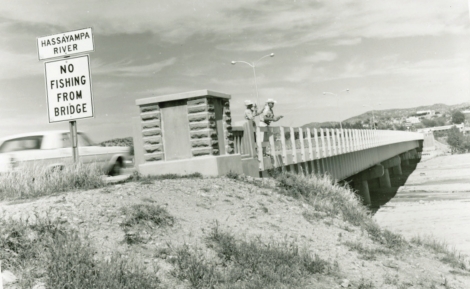
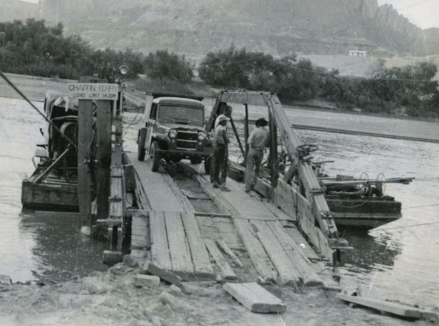
Left: Unauthorized fishing on the Hassayampa Bridge (now the Riverwalk), mid 1900s. Right: The Chaffin Ferry over the Hassayampa River, early 1900s. Photos courtesy Desert Caballeros Western Museum Archives.
Rancho Rio provides direct access to the dry washes of the Hassayampa River, which begins north of Wickenburg, in the Bradshaw Mountains and empties into the Gila River near Arlington. Although the river's water can be seen year-round north of town at Box Canyon and south of town at the Hassayampa River Preserve, it's rarely visible at the point closest to Wickenburg. For decades its nickname was “The Upside-Down River” because of its habit of disappearing underground.
There are some facts and many theories on where the word Hassayampa was derived. Once an oasis, with water flowing year-round, the western Yavapai made the banks their home, irrigating their crops of corn, beans, squash, and tobacco with river water. The Yavapai referred to the portion of the river nearest Wickenburg as Haviamp. Other records show it was called Ha-se-ya-mo, “following the water as far as it goes.” Still others claim it is a Yuma word for "hidden water.”
Regardless of the origins of its name, the Hassayampa was discovered to be a rich gold-bearing region. Ranchers and farmers accompanied miners and built homes along the fertile plain of the Hassayampa and a new West was born. The infant town went through many trials and tribulations in those first decades, surviving Indian wars, mine closures, desperadoes, drought, and a disastrous flood.
The Hassayampa may disappear underground in the course of its 100-mile meander, but in years of heavy rain floods are all too common. In 1887 the Walnut Grove dam was completed about 40 miles northeast of Wickenburg. Built, not only to provide water for mining, the dam was intended to irrigate 100s of acres of farmland. In 1890 an unusually wet winter caused the dam to burst and with it came the loss of life and the loss of much of the fertile soil of the Hassayampa.
According to Thomas Penfield, author of "Dig Here!", the great flood resulted in a lost treasure somewhere along the Hassayampa between Wickenburg and the mouth of the river. Penfield states, “...In the Conger Store at Seymore, $1500 was hidden in the rafters of the building. This was swept away together with $5000 in gold kept in a heavy iron safe in Bob Brow's Saloon." The safe and the money has never been found and may still be lying somewhere, just beneath the surface of the banks of the Hassayampa.
As the landscape changed, the future of Wickenburg became ever more dependent on mining. Through it all, the town continued to grow. Its prosperity was insured with the coming of the railroad in 1895. The historic depot still stands today as the Wickenburg Chamber of Commerce and Visitor's Center, a noteable tourist stop.
The lost treasure is not the only lore of the Upside-Down River. In fact, the most well-known legend is centuries old. Andrew Downing coined it as a verse that can be found etched on a wooden sign near Wickenburg's Wishing Well attraction located at the US 60/US 93 roundabout:
THERE’S A LEGEND CENTURIES OLD BY THE EARLY SPANIARDS TOLD OF A SPARKLING STREAM THAT LIES UNDER ARIZONA SKIES HASSAYAMPA IS ITS NAME AND THE TITLE TO ITS FAME IS A WONDROUS QUALITY KNOWN TODAY FROM SEA TO SEA THOSE WHO DRINK ITS WATERS BRIGHT RED MAN, WHITE MAN, BOOR OR KNIGHT GIRLS OR WOMEN, BOYS OR MEN NEVER TELL THE TRUTH AGAIN