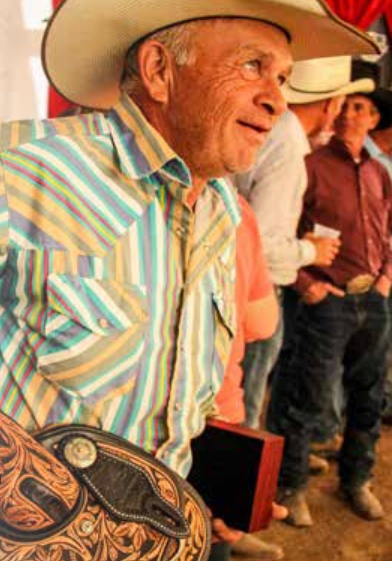
It’s been three months since the curtains closed on the NTR National Finals II, but for those who got to rope for that $100,000 payday, the memories have yet to fade. From March 6 to 12, the NTR paid a record-setting $876,930 in cash, plus $100,000 in prizes. Nearly 900 contestants made their way to the Team Roping Capital of the World for the Finals to compete at two of the highest-paying divisional ropings in the industry. When the NTR first introduced the National 9 program in 2015, the Wyoming team of Tamara Mann and Trace Steele took home $100,000. This year, in addition to the National 9, the Finals played host to the inaugural National 8 Finale, which also paid a guaranteed $100,000 to the winners. Combined, that makes for four very happy team ropers. Meet, Len LeBlanc, Bonnie Matlack, Don Ramsour and Sam Garside—the 2016 NTR $100,000 Champions.
NATIONAL 8 FINALE CHAMPIONS
Len LeBlanc and Bonnie Matlack
At a February National 8 Qualifier in Wickenburg, Ariz., Bonnie Matlack’s pick partner was a no show.
“I ran to the office last minute and asked if they could draw me a partner,” Matlack explained. “They got me Len, and we ended up qualifying for the Finale that day. He asked if I was coming back to the Finals and that was about the only time we ever spoke before we won it. I’m not sure I’d ever even seen him before that day.”
Len LeBlanc, Williams Lake, B.C., Can., and Matlack, Cave Creek, Ariz., roped four steers in 38.86 seconds to win the $100,000 in the National 8 Finale. The duo came back to the short round high call, and after the second and third high call teams fell out and one roped a leg, all they needed to do was make a clean run.
As he backed in the box the announcer came on and pronounced that this would likely be LeBlanc’s final team roping run of his career and that his horse would be for sale. It caught the crowd of guard, but even more so, the header himself.
“When the announcer said it might be my last roping I just about lost it,” LeBlanc said. “I had to take a second and pull myself back together. I knew we didn’t need to be fast we just needed to be good. I ran out there and roped him and Bonnie put a loop out there big enough you could rope a truck. I knew we had it then.”
Here’s the short story behind the announcer’s remarks about LeBlanc. But with a little luck and a lot of faith, the Canadian cowboy might not be calling it quits after all.
At just 10 years old, LeBlanc started doing day work for ranches around Williams Lake. As a young man he joined the Royal Canadian Mounted Police and went to Alberta for five years.
When he returned, he started leasing and purchasing ranches of his own. Always a cowboy, LeBlanc didn’t start team roping competitively until his four kids, Candy, Dusty, Mitch and Melissa, were pretty well grown.
“I started around ’95,” he recalled.
“When I started roping I was left handed so I was heeling but I switched to right handed and went to heading. I still heel a little, but not much.”
LeBlanc and his wife (of 42 years) Darlene were doing well, but their lives would quickly take a drastic turn for the worse.
In 2001, LeBlanc had quit roping when one of his hips got too bad. In 2003 he had a replacement that coincided within days of the historic BSE (Mad Cow) outbreak in Canada.
“We had the ranch then and cattle prices really went in the bucket. You had to do everything you could to survive and keep from going broke. I was able to ride again though, and I got to do plenty of roping on the ranch.”
Still, by the spring of 2004 he was thinking he was ready to start entering jackpots again.
He went to a two-day roping school in Canada only to return and find his home burnt to the ground.
“Squirrels had eaten up some wiring, and it was all gone,” LeBlanc recalled. “I didn’t rope in 2004 or 2005 and decided to just keep ranching in 2006 when cattle prices still hadn’t recovered. So I took some years off.”
Then, in 2007, LeBlanc was diagnosed with stage-four bladder cancer.
“I asked the surgeon if I didn’t do anything what would happen,” he recalled.
“He told me I’d be dead in less than a year.”
LeBlanc had the first of nearly a dozen surgeries and procedures that would help keep him alive. Over the next six months the cancer progressed even with the surgeries. In addition to removing his bladder they would later remove a kidney as well as his prostate.
“I’m cancer free now, and I hope that my story inspires someone to keep going, despite the odds,” LeBlanc said. “One foot in front of the other and you’ll go farther.
“After all of that, I said, ‘Heck with this.
I’m doing what I want from now on.’”
“I’M CANCER FREE NOW, AND I HOPE THAT MY STORY INSPIRES SOMEONE TO KEEP GOING, DESPITE THE ODDS. ONE FOOT IN FRONT OF THE OTHER AND YOU’LL GO FARTHER.” - Len LeBlanc
He and Darlene sold out from the ranching business and bought a place in Casa Grande, Ariz. In the fall of 2008 he made his first of many trips south for the winter.
Things were looking up again, until this past fall when his other hip got so bad he was ready to call it quits from roping for good.
“I hadn’t roped much all winter, and I almost didn’t go the day of the Finals.
My hip was giving out and my back was hurting so bad, I just figured I was about done.”
But the trip to Rancho Rio in March paid off in dividends.
“If I never could rope again it wouldn’t matter. I had to work a little harder to get there, but it was worth it,” LeBlanc said about his $100,000 win.
LeBlanc returned to Canada after the Finals and decide to go ahead with a second hip replacement in early May.
“I’m feeling a little better now. We’re hoping that once I’m not compensating for a sore hip I might get some of that pain out of my back. Since this hip surgery I haven’t had the kind of pain I was having. Either that or it’s some real good drugs,” LeBlanc laughed. “Besides, I still have a hell of a good rope horse.”
His 7-year-old gelding, Scooter, isn’t for sale after all.
“He’s turned out on a ranch over on the mainland. He probably won’t get ridden until the fall, but he’s not for sale, at least not yet.
“I always said if I had some throw away money I would buy a Camaro, but I had the money and I didn’t want the Camaro. Darlene got a new car, but that was coming whether we had the money or not.”
The couple recently sold their place in Arizona and with less storage space, LeBlanc decided to put his trophy Jeff Smith’s saddle on loan to the BC Cowboy Hall of Fame, and it’s currently on display at the Museum of The Cariboo-Chilcotin in Williams Lake.
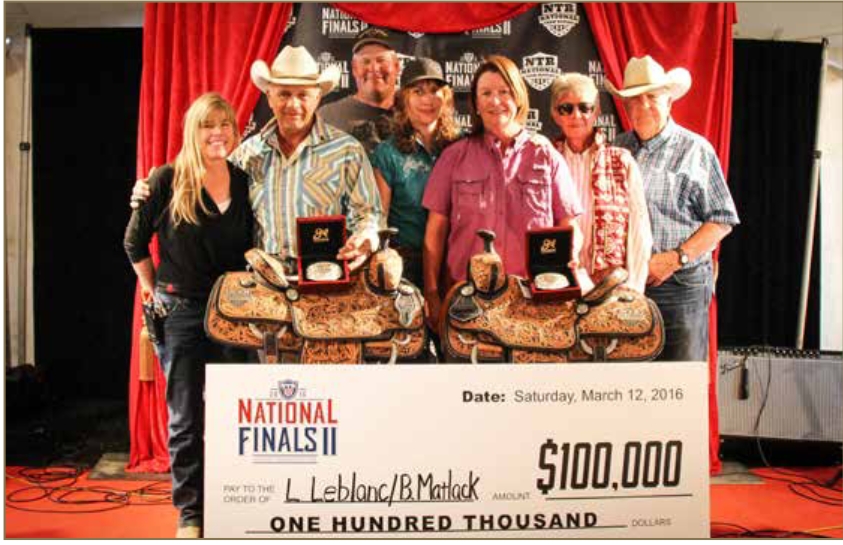
National 8 Finale Champs, Len LeBlanc and Bonnie Matlack with family and friends as they collect their $100,000 paycheck.
TOP TEN
NATIONAL 8
1. Len LeBlanc / Bonnie Matlack / 38.86 / $100,000
2. Tom Mcdonald / Willy Vietor / 40.95 / $20,000
3. Chi DeLaPena / Jr DeLaPena / 44.07 / $15,000
4. Bruce Berry / Bob Rose / 45.58 / $12,000
5. Dan Leadbetter / Jim Savoini /45.62 / $9,000
6. Ricardo Ramirez / George Parra / 46.03 / $8,000
7. Dave Bullock / Gary Olson / 46.55 / $7,000
8. Kim Bolinger / Leo Woodbury / 46.99 / $6,000
9. Jarret Baker / Shawn Small / 48.44 / $5,000
10. Julie Ballek / Jim Volk / 48.65 / $3,000
NATIONAL 9
1. Don Ramsour / Sam Garside / 35.61 / $100,000
2. Colleen Watson / Jim Stoddard / 37.21 / $35,000
3. Trey Emerson Begay / Tvon Yazzie / 38.06 / $25,000
4. Ketch Kelton / Sam Garside / 38.68 / $20,000
5. Rene Rascon / Saul Varela / 39.98 / $15,000
6. Skip Shamp / Gary Little / 40.38 / $12,000
7. Jace Engesser / John Alps / 41.87 / $9,000
8. Rick Smith / Harold Adema / 43.12 / $7,000
9. Lynda Jones / Dee Jones / 44.92 / $6,000
10. Jarret Baker / Luke Baker / 45.33 / $5,000
Bonnie Matlack and her husband Jim spent 23 years in Missouri where Jim owned and operated his own construction company, Bear Paw Construction, and Matlack first worked in radiology before transitioning to her current position as a supervisor for the Department of Veterans Affairs Office of Information & Technology.
“I worked in Radiology for about 17 years and as the medical field changed I really took a liking to the IT side of it. I just transitioned myself to IT and I’ll retire this year with 25 years of Government service.”
The Matlacks, however, were not about to retire in the Midwest.
“We got really tired of the winters and the lack of team roping available out there. We wanted to be where it was warm,” she explained. “About five years ago we moved back to Cave Creek. I work from home so we were able to do that. My family is here—it’s where I was raised— and so it’s been nice to be close to them again.”
From one extreme to the other, there’s obviously no shortage of team roping in Arizona, but the heat in the valley can be excruciating.
“We spend several months in Durango, Colo.,” Matlack added. “That’s actually where I plan to keep my (NTR Championship) saddle. It will go up there with us this summer.”
Matlack grew up in a roping family and spent time showing both reining and cow horses as well as competing in team roping and breakaway roping.
“My whole family has always roped. My sister, Karen, and her husband Bill, both rope. My dad, Alan Laneville, turns 81 this year, and he still rides actively almost every day. My mom, Jo Ann also roped, however she hung her rope up about 10 years ago.
After high school Matlack turned her focus to college and her budding career in the medical field. She had stopped competing all together and in fact wasn’t around the horses at all.
“My husband also comes from a roping family in Montana,” Matlack explained.
“When I met him he convinced me to rope again. I didn’t realize how much I’d missed it until I got on a horse.”
Now, most of the couple’s spare time is spent in the roping pen or traveling or both.
“We don’t have children so our fourlegged horses are our family. There’s plenty of roping in Arizona, but we like to travel around too. We go to Reno every year, and a few others, but we’re looking forward to retiring and hopefully getting out and going to more.
“Sometimes we leave the horses home,” she added. “We just got back from a fun trip in San Francisco. There are really a lot of places in the U.S. that we would like to see.”
Her $100,000 win with LeBlanc was Matlack’s biggest win of her roping career, and while the duo didn’t know each other before hand, they’ve had a chance to get acquainted since, and even roped again before LeBlanc went back to Canada.
“That’s by far the most I’ve won at one time. I didn’t do anything big or spectacular. It went right in the bank, and that’s where it stays.”
Rancho Rio is one of Matlack’s favorite places to jackpot in Arizona, and she’s looking forward to seeking a qualification to the 2017 NTR National Finals, but it will be unequivocally hard to top this year.
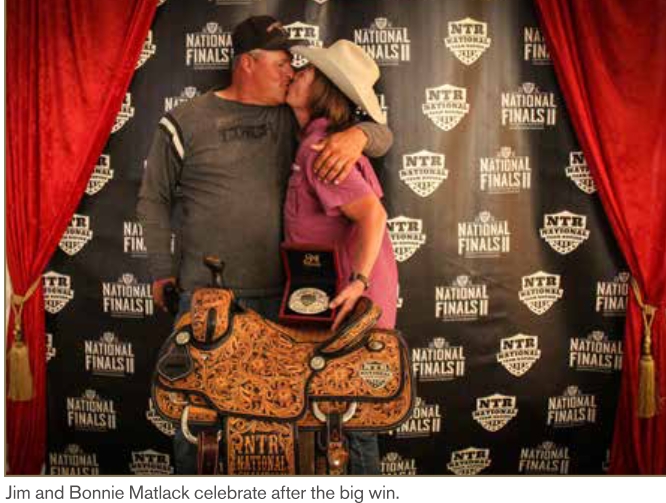
“It was a truly special and blessed day,” Matlack said. “The win was very big, but it was equally rewarding to not only have Jim by my side every step of the way but to also have my mom, dad and niece, Shawnie Jo there to watch as well as be a part of the award ceremony. It was priceless.
“And a big Thank You to Ty Yost and all of his crew that made this possible. They are all first class.”


