FAST TRAINS
continued from page 13
administration even concedes a number of challenges. Among them, a sort of brain drain among engineers and other train experts resulting from years of passenger rail decline, the need to gain support from private railroad companies, forming multi-state operating agreements, and establishing a new layer of high-speed rail safety standards.
The most formidable obstacle, of course, is funding. According to the U.S. Government Accountability Office, the 11 high-speed projects that have passed the environmental review phase would cost $82 billion while 44 other corridors around the country are in some stage of planning and development (see graph).
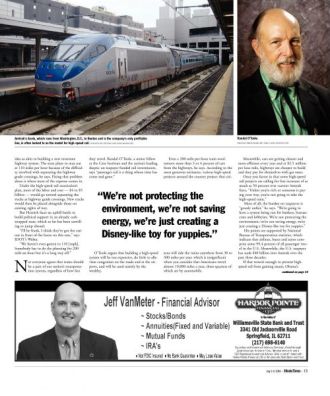
However, there is some light at the end of the train tunnel. Proponents of high-speed rail expansion hold up Amtrak’s only profitable system, the Acela, as a model for high-speed rail across the country. The Acela, which connects Washington, D.C., Boston and points in between including New York City and Philadelphia, accounts for 20 percent of all Amtrak’s revenue.
Consider that Amtrak projects 2009 passenger revenue to exceed that of fiscal year 2008 by more than $135 million and the picture for passenger rail looks rosier. The projection was made before gasoline prices dropped, but rail enthusiasts predict they’ll get back up to $4 a gallon before long. Another factor that could bode well for the future of the state’s high-speed rail program is Chicago’s bid for the 2016 Summer Olympics.
China was able to get its maglev system up in two years, just in time for that country to host the summer games in 2008. The Midwest High-Speed Rail Association believes that if Chicago is selected in September as the future host city, it could speed up plans for 200-mile-an-hour trains in Illinois.
Harnish: “I believe that if the governor and the president said ‘I want to have a highspeed train running by the Olympics,’ and the mayor [of Chicago] was behind it, it could happen.”
Contact R.L. Nave at [email protected].
A quick look at the
funding needs, totaling $82 billion, of corridors now operating 79mph
service that have passed the environmental review phase for high-speed
rail development; 44 other HSR corridors are at some stage of planning
and development.
Los Angeles to San Francisco $32.8 - $33.6 billion
Anaheim to Las Vegas maglev $12 billion
Eugene, Ore. to Vancouver, B.C. $6.5 - $6.8 billion
Florida Overland Express $6 billion (terminated in 1997)
Baltimore-Washington, D.C., maglev $5.15 billion
Washington, D.C. to Charlotte, N.C. $3.8 - $5.3 billion
Texas TGV $4 billion (terminated)
Washington, D.C.,-NYC-Boston $3.8 billion
Los Angeles to Las Vegas maglev $3.5 billion
Chicago-Springfield-St. Louis $2 billion
Chicago to Minneapolis $1.5 billion
NYC to Scranton, Pa. $551 million
Chicago to Detroit $39 million