idea as akin to building a new interstate highway system. The state plans to max out at 110 miles per hour because of the difficulty involved with separating the highway grade crossings, he says. Fixing that problem alone is where most of the expense comes in. Under the high-speed rail association’s plan, most of the labor and cost — $4 to $5 billion — would go toward separating the tracks at highway grade crossings. New tracks would then be placed alongside those on existing rights of way. But Harnish faces an uphill battle to build political support in an already cashstrapped state, which so far has been unwilling to jump aboard.
“I’ll be frank, I think they’ve got the cart out in front of the horse on this one,” says IDOT’s Weber. “We haven’t even gotten to 110 [mph].
Somebody has to do the planning for 200 mile-an-hour but it’s a long way off.”
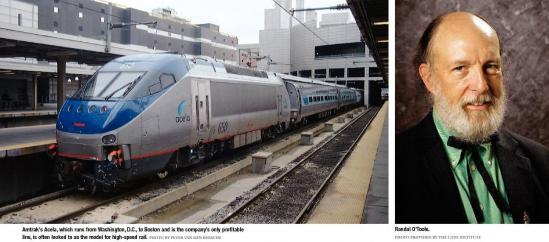
Not everyone agrees that trains should be a part of our nation’s transportation system, regardless of how fast they travel. Randal O’Toole, a senior fellow at the Cato Institute and the nation’s leading skeptic on taxpayer funded rail investments, says “passenger rail is a thing whose time has come and gone.”
O’Toole argues that building a high-speed system will be too expensive, do little to alleviate congestion on the roads and at the airports, and will be used mainly by the wealthy.
“We’re not protecting the environment, we’re not saving energy, we’re just creating a Disney-like toy for yuppies.”
Even a 200-mile-per-hour train won’t remove more than 3 or 4 percent of cars from the highways, he says. According to the most generous estimates, various high-speed projects around the country project that citizens will ride the trains anywhere from 30 to 300 miles per year, which is insignificant when you consider that Americans travel almost 19,000 miles a year, three-quarters of which are by automobile.
Meanwhile, cars are getting cleaner and more efficient every year and at $2.5 million per lane mile, highways are cheaper to build and they pay for themselves with gas taxes.
Once you factor in that some high-speed rail projects are calling for fare increases of as much as 50 percent over current Amtrak fares, “Unless you’re rich or someone is paying your way, you’re not going to take the high-speed train.”
Most of all, the burden on taxpayers is “grossly unfair,” he says. “We’re going to have a system being run for bankers, bureaucrats and lobbyists. We’re not protecting the environment, we’re not saving energy, we’re just creating a Disney-like toy for yuppies.”
His points are supported by National Bureau of Transportation statistics, which indicate that airlines, buses and autos comprise some 99.4 percent of all passenger travel in the U.S. Meanwhile, the U.S. taxpayer has sunk $40 billion into Amtrak over the past three decades.
If that weren’t enough to prevent highspeed rail from gaining steam, Obama’s
continued on page 14


