My favorite books to help negotiate the often bewildering items in Asian groceries are Asian Ingredients by Bruce Cost, The Indian Grocery Store Demystified, and The Asian Grocery Store Demystified, by Linda Bladholm. All contain information as well as helpful illustrations. Cost’s book also includes recipes.
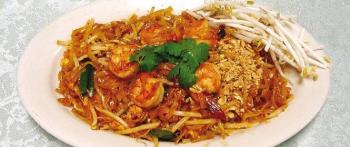
Pad Thai is one of the signature dishes of Thailand — in fact the name translates as “Thai noodles.” The ingredient list is long, but once everything is measured, the actual cooking time is quick.
PAD THAI
8 oz. dried flat rice stick noodles* 4 oz. extra-firm or pressed tofu*, cut into ½ “ cubes or strips ¾ c. reconstituted tamarind * ¼ c. light brown sugar 1 T. rice vinegar* 1/2 tsp. Thai chili powder* OR cayenne pepper, or more or less to taste 8 T. peanut or vegetable oil 2 large eggs 3 T. plus 1 tsp. fish sauce* (Three Crabs is my favorite brand) 1/3 c. chopped shallots* 1 T. minced garlic 8 oz. shrimp, peeled and deveined 3 T. chopped salted radish* (turnip), optional 2 T. dried shrimp* left whole or chopped as desired 2 c. bean sprouts* 1 c. chopped Chinese (garlic) chives* or green parts of scallions, sliced thinly 1/3 c. chopped unsalted dry roasted peanuts ¼ c. cilantro leaves*, optional lime wedges
Soak rice noodles in a large bowl of hot tap water 15-20 minutes until softened and pliable, but not completely tender. Drain and set aside.
Combine the tamarind, sugar, vinegar, 3 T. fish sauce, chili powder, 2 T. of the oil, and stir until the sugar is dissolved. Set aside. Beat the eggs with the remaining teaspoon of fish sauce and set aside.
Heat the remaining oil in a large wok or skillet (preferably non-stick) over high heat. Add the tofu and stir-fry, tossing gently, until the tofu cubes are golden and slightly crispy on the outside. Drain and set aside.
Pour off and reserve all the oil, leaving just a thin film of oil in the pan. Add the (fresh) shrimp. Stir-fry until just opaque and set aside.
Pour a teaspoon or so of the reserved oil into the wok or skillet and add the eggs. Cook until just barely set, then flip over and cook a few seconds longer until just firm. Remove the skillet from the heat. Transfer omelette to a cutting surface, cut into thin strips, and set aside.
Pour about 1T. of the reserved oil into the wok or skillet and return to the stove over medium heat. Add the garlic and shallots and, stirring constantly, cook until they just begin to turn golden brown. This will only take a minute or so. Immediately add the noodles, dried shrimp and preserved radish and toss to combine. Pour the tamarind mixture over the noodles, tossing constantly until the noodles are evenly coated. Increase heat to high and add the bean sprouts, reserved shrimp, tofu and omelette strips, still tossing constantly. Add half the peanuts and chives or scallions and continue to cook, still tossing constantly, until the noodles are tender, about 2 or 3 minutes longer. Add a little water or reserved oil if necessary. Transfer to a large platter and sprinkle the remaining peanuts, scallions and cilantro. Garnish with lime wedges and serve immediately.
Serves 4 -6
* Some of these ingredients can be found in the ethnic sections of grocery stores, but all are usually available at Little World Market, 2936 S. MacArthur Blvd., tel. 528-2745
The tamarind tree is native to Africa, although it’s been in India for so long that its scientific name, tamarindus indica, implies that India is its country of origin. India does use a lot of tart, slightly sweet tamarind in its regional cuisines, but it’s also common throughout the Middle East and the Mediterranean, as well as in South and Central America, particularly in Mexico. The brownish pods contain beans as well as a fibrous sticky mass from which comes its culinary use.
Tamarind can be purchased in several forms. There’s an almost black concentrate.
There are blocks of the paste — a compressed block of the paste and sometimes the seeds. The first just requires dissolving in hot water (1 T. to ¾ cup of hot water) the second involves soaking 2 T. seedless paste or 4 T. seeded in ¾ cup of hot water, then putting it through a strainer, pushing to get as many solids through as possible. I prefer a product that’s labeled “Concentrate Cooking Tamarind.” It’s actually reconstituted from the paste, and can be used as is. It’s usually in a white plastic (though the plastic is mostly obscured by the label) 16 oz. container with a blue lid.


