We welcome letters. Please include your full name, address and telephone number. We edit all letters. Send them to [email protected].
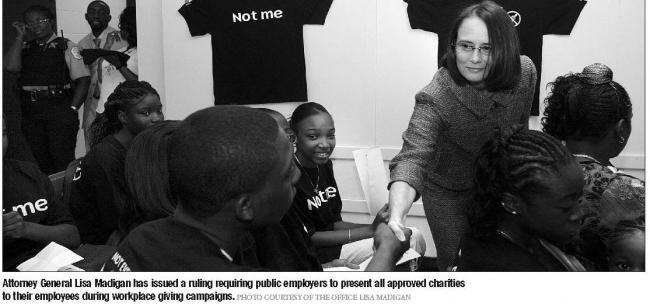
Workplace giving Your Feb. 26 article described disbanding the Sangamon County Combined Campaign [see “United Way changes where charity dollars go,” by Dusty Rhodes]. This action shows flagrant disregard for the fact that “government employers are bound by different rules than private employers.” Attorney General Lisa Madigan issued an opinion saying public employers are required to present all SECA (State of Illinois Employee Combined Appeal) approved charities and federations to their employees. The Combined Charities Campaign materials assure all charities equal access to government employees whose salaries are derived from taxes.
When the campaign manager stops providing “a booklet listing every nonprofit certified by the state of Illinois,” government workers cannot check the legitimacy of the charities in their own neighborhoods.
Individuals might unwittingly designate gifts to a for-profit day care, or a nonviolent trade association without a bank account. Does the campaign manager really inform the generous public worker that their designated charity is ineligible and promptly return their entire gift? Providing this booklet is an essential component for a workplace giving campaign.
The process of workplace giving has a very complex infrastructure. There are payroll clerks, check writers, mail carriers, bankers. Many hands process monies donated by public sector workers. When I read the description of the new forms with five lines or boxes, I am very concerned for the smaller charities written in that are unaffiliated with the campaign manager. I want assurance that every cent withheld for them arrives. The results of this kind of audit needs to be provided by every agency who processes workplace giving, if they wish strugglingyet-generous employees to contribute to this kind of campaign!
Sister Zelda Chicago
More choices I’m an agency supported by Community Shares of Illinois so I have a self-interest in the conversation about workplace giving [see “United Way,” IT, Feb. 26]. I’m also a commissioner on the Illinois Commission on Volunteerism and Service. At the Serve Illinois portal, people can choose from causes all over Illinois where they might volunteer. Each of these volunteer-based organizations requires a flow of operating dollars to provide leadership support to help those volunteers be effective in their service.
There are many important issues addressed by the many different nonprofit organizations in this state, not just those that the United Way picks as its priorities. With its monopoly on workplace fundraising, the United Way can either influence greater giving and volunteer service, or can reduce the choices that are available to potential volunteers and donors.
Since the people in these companies probably have as wide a range of charitable interests as there are nonprofits, the United Way reduces the number who give with strategies that limit choice. If corporate leaders become “heavy-handed” in encouraging employees to give to the United Way as part of the corporate giving strategy, they turn people off to charitable giving.
I would encourage the United Way and business leaders to create maps of the different sections of Illinois, showing the demographics of need, and pointing to the many different types of nonprofits who are working to meet those needs.
Encourage employees to give time, talent and dollars in the causes that are important to them, and encourage them to stay involved for many years.
In doing so we create greater involvement of citizens in solving the problems of Illinois, and this will benefit the organizations and issues prioritized by the United Way as well as other causes.
Dan Bassill, president Cabrini Connections Chicago
Overhaul disabilities system There is so much more to the story of the state’s policy on developmental disabilities than closing Howe Developmental Center or any other state institution [see “Advocates urge state to shut institution,” by Dusty Rhodes, IT, Feb. 19]. The Disability Service System in Illinois needs a total overhaul and everyone held accountable for the provision of the highest quality supports and services possible.
The system fails in honesty, integrity and accountability. Things that happen in the community are often ignored because it would not be in the state’s best interest to make the community look bad. The community has to continue to look better than the institutions or where would all the people from the institutions go? People with disabilities and their families deserve so much more than Illinois gives them now. I urge you to dig a little deeper... go beyond the statewide advocacy/provider organizations.
It’s in their best interest to follow the party line. Barbara Thomas Springfield


