planting an organic White House Garden, calling them “Liberal Limousine Elitists.” He said, “It’s irresponsible to tell people that you have to eat organic locally grown foods. That’s a serious public health concern, because not everyone can afford that. People are going to be eating fewer fruits and vegetables. Obesity rates will go up. Cancer rates are going to go up. I think that if we decide we’re only going to eat locally grown foods, we’re going to have a lot of starvation.”
Samantha Bee on TV’s “The Daily Show” wryly observed that Steir was accusing the White House garden of being “that rare public health threat that can simultaneously cause starvation and obesity.” ACSH is independent, nonprofit and tax-exempt, but, according to the Center for Science in the Public Interest, receives funding from a long list of corporate giants, including Exxon/Mobil, ConAgra, Dupont, Union Carbide, Dow, Monsanto and ADM.
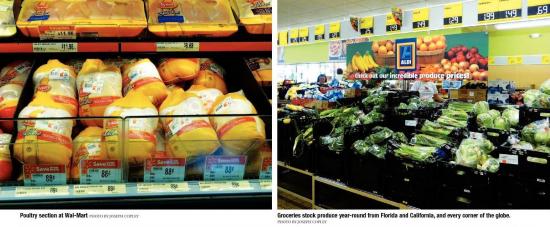
To an extent, the perception that sustainably grown food is necessarily more costly is mistaken. Brockman has for years done a midsummer cost comparison of vegetables from her brother Henry’s farm north of Bloomington-Normal with those in the local Jewel. Henry sells his produce at Chicago’s Greenmarket and to some of Chicago’s best restaurants, but the Brockmans have found that produce for participants in his CSA (Community Supported Agriculture, a program in which members pay for a share of the season’s produce, with weekly pickups/deliveries) usually costs less than grocery store equivalents — often just half as much. Atlanta, Ill., farmer Dave Bishop has even found that prices for his pastured beef and poultry compare favorably with his local Wal-Mart.
Many remain convinced that industrial agriculture is the only way enough food can be grown to feed a hungry world. They’re skeptical — even disbelieving — when told that sustainable farming, using methods both old and new, can actually produce more food per acre than conventional farming. But numbers provide the proof.
An acre of conventionally raised corn at today’s prices would fetch $602, although by the end of the year, it’s projected to cost $716.55 — and takes 50-plus gallons of fossil fuel to produce. In contrast, a local Springfield produce farmer using sustainable practices says he earns as much as $16,000 per acre. Locally, programs are currently available to help disadvantaged folks buy healthy food, such as the WIC program for women, infants and children (tel. 217-836-6946) and Senior Citizen Farmers’ Market coupons from the Area Agency on Aging, (tel. 217-787-9234).
Proponents of sustainable agriculture are passionate about and committed to making healthy, sustainably grown food available and affordable for everyone. They know it will take energy and effort. The Lumpkin Family Foundation, based in Mattoon, commissioned a study in 2004, “Feeding Ourselves: Strategies for a New Illinois Food System.” It identified objectives that must be met to move beyond the current industrial agriculture model.
Chief among them were the development of infrastructure that will allow products to be locally processed and marketed, including storage facilities where perishable products can be refrigerated and loads consolidated, transportation, and processing facilities for dairy, livestock and fresh produce. Knowledge, training and making farmland available and affordable to an expanded population of farmers are also crucial — areas that comprise much of the focus of The Illinois Stewardship Alliance and The Land Connection. Last, not least, is political will.
Eliminating the hidden costs of cheap food doesn’t necessarily mean that all food will become vastly more expensive. It will probably be a mixed bag — some foods costing more, some less, others staying the same. Farmers, processors and sellers will need support and creativity to develop cost-effective strategies.
Consumers will need to make educated choices about what and how they eat. “We will not be able to feed everyone on healthier food unless we change the incentive structure of American agriculture,” say Kenner and Pollan. But ultimately they believe that transforming our food system won’t be a choice, given its reliance on fossil fuel: “In the same way we’re going to have to run an industrial system without cheap fossil fuel in the next 50- 100 years, the same is true for agriculture.”
Julianne Glatz writes the weekly food column “Realcuisine” for Illinois Times. Contact her at [email protected].
Food Inc. premiered in major U.S. cities June 19th. It is not yet scheduled to be shown locally, although the lIllinois Stewardship Alliance is working towards a Springfield screening.


