
Years ago I worked for a catering company in Chicago that, in addition to standard wedding and corporate events, provided meals and hospitality for some of the biggest touring acts that came through the Windy City. We fed the crews touring with all kinds of acts, from The Dead and Fleetwood Mac to Jerry Seinfeld and Mariah Carey. My job was to help shop for, set up, and break down the dressing rooms and crew catering areas in venues we contracted with all over the city. It was hectic, stressful, fabulous work and I loved it.
During my first year with that company I did almost no cooking, even though that’s what I’d intended to do when I started out. The kitchen crew made the food. My task was to get it where it needed to go and make sure it looked and tasted good going out. All was well until the pastry chef broke her leg playing kickball. She was going to be out of commission for several weeks and the company was fully booked up for the next two months. I volunteered to fill in for her even though I’d never baked professionally before, and because my boss was truly desperate she agreed to let me have a go. Each day I’d come to work and prepare desserts for a dozen or more jobs, feeding sometimes hundreds of people in a single day. It didn’t always go well. I remember once getting an apple cobbler back from a corporate board meeting with a note exclaiming “raw!” stuck into the middle of an under-baked glob of dough. Eventually I figured a few things out, and I came to love the thrill of sending out a towering Mille Fuille layered high with raspberries, white chocolate mousse and crisp phyllo layers as much as I’d loved organizing dressing rooms and hospitality for a sold-out run of shows at the Chicago Theatre.
Poached fruit became one of
my standby dishes, and it’s something I love to serve to this day. I
liked to always keep a container in my pastry fridge of apples or pears
that had been simmered in mulled wine or honey-sweetened tea, ready to
transform a simple pound cake or basic yogurt bar. This versatile
preparation can be served whole, accompanied by a dollop of Greek yogurt
or ice cream. The poached fruit can also be sliced and used to top
tarts or fill cakes, and are even at home on salads or alongside a pork
chop. In addition to adding a polished finish to the dish, the reduced
poaching liquid makes a magical homemade soda when mixed with seltzer
and ice. The cooked fruit and syrup will keep for about a week in the
fridge.
Mulled Wine Poached Apples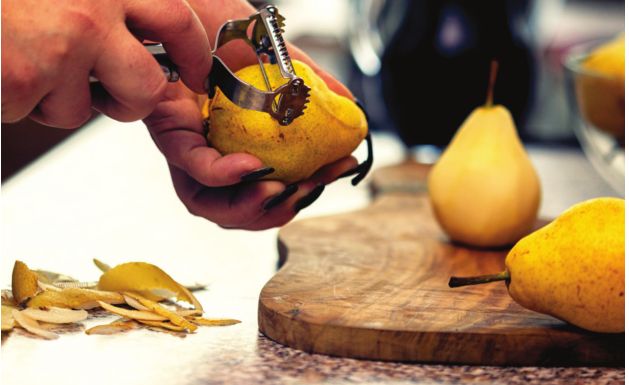
2 cups red wine
½- 3/4 cup sugar (raw preferred), honey, maple syrup or agave, to taste
1 three-inch cinnamon stick
1 teaspoon whole cloves
2-3 slices fresh ginger
2-3 star anise pods
1 orange
4 crispy apples, such as pink lady or Fuji, peeled and left whole
Place
the wine, sweetener of choice, and spices in a wide, nonreactive sauce
pan. Peel two three-inch strips of orange zest from the orange, taking
care to avoid the bitter white pith, and add them to the sauce pan.
Juice the orange and add it to the pan, then bring the mixture to a boil
over medium-high heat, stirring occasionally. Add the apples, return
the liquid to a boil, then cover and reduce heat to a gentle simmer.
Cook for 20-25 minutes, rotating and turning the apples a couple of
times so they cook evenly. They are done when they can be easily pierced
with a fork. Remove the apples with a slotted spoon and set aside.
Strain
out the solids, then return the poaching liquid to the pan. Simmer over
medium-high heat until it is reduced to about one cup. The apples can
be served warm or chilled. Store the apples together with the reduced
syrup, and reheat, if desired, over medium-low heat on the stove top or
in the microwave.
Earl Grey and Lavender Poached Pears
3 cups water
2 Earl Grey tea bags
1 tablespoon dried lavender flowers, in a tea ball or tied up in a coffee filter
½ cup honey or sugar, to taste
1 three-inch strip lemon peel
4 firm pears, peeled and left whole, stem intact if possible
Bring
the water to a boil. Add the tea bags and lavender and let steep for
five minutes. While the tea is steeping peel the pears and cut a small
slice off the bottom of the pear so that it will stand upright. Remove
the tea bags and lavender, add the honey or sugar and lemon peel, and
bring to a boil. Add the pears, return to a boil, then cover and reduce
heat to a gentle simmer. Cook for 15-20 minutes, until tender. Remove
the pears and the lemon peel with a slotted spoon and set aside.
Increase heat and cook the syrup until it is reduced to about ¾ cup.
Serve and store as directed above.
Ashley Meyer is a writer, cook, and the baker in residence at Custom Cup Coffee in downtown Springfield.


