A roundup report on veto session winners and losers
Following are brief reports on numerous bills voted up or down during the final week of the fall veto session.
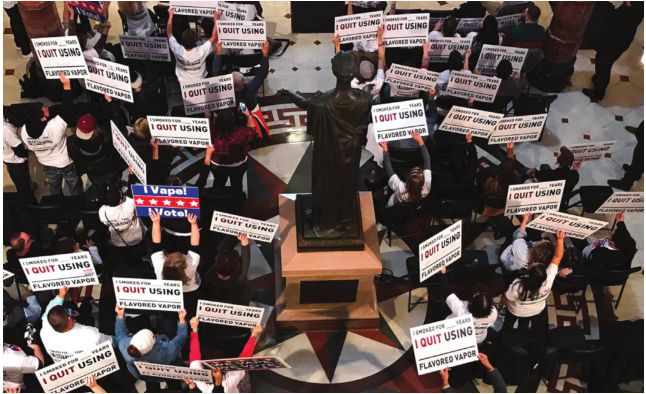
TOBACCO BILLS: Bills aimed at curbing where Illinoisans can use electronic smoking devices and with what flavorings were halted until the spring session of the General Assembly.
One bill would loop electronic cigarettes into the Smoke Free Illinois Act. The other would ban flavored cartridges and pods used in such devices.
Thursday, Nov. 14, was the last scheduled day of the fall veto session, which lawmakers used this year to clean up new laws and pass new bills before they return to Springfield in January.
Indian Creek Democratic Sen. Terry Link is the sponsor of Senate Bill 1864, which would include vapes, e-cigars, e-hookahs and other such devices in the existing prohibition on smoking in public places, areas of employment, and within 15 feet of the entrance to a public building. There is an exception for tobacco stores and vape shops.
The Illinois Sheriffs’ Association opposes the measure if jails are included in the ban. Executive Director Jim Kaitschuk said although not every county jail official allows vapes, “many do.”
He said jails allow vaping because many people who are jailed have substance abuse issues, or smoke cigarettes. Vaping is allowed to prevent forcing inmates to quit “cold-turkey.”
While the attempt to ban flavored electronic smoking products in Illinois is being done legislatively, other states – including Michigan, New York, Massachusetts and Rhode Island – have enacted bans of some form through executive order.
PENSION CONSOLIDATION: Democratic Gov. J.B. Pritzker thanked lawmakers Thursday, Nov. 14, for passing legislation to address an issue that has eluded the General Assembly for nearly seven decades – consolidating hundreds of suburban and downstate police and firefighter pensions into two unified systems.
“The first was in 1947, fully 18 years before I was born,” Pritzker said during a news conference moments after the Senate passed the bill. “That year, the Commission on Public Employees Pensions issued a report that said, ‘In no phase of the pension problem is there such emphatic agreement on the necessity for corrective legislation as in the field of downstate policemen and firemen funds.’”
That year, a bill was
introduced to consolidate what were then 133 suburban and downstate
pension funds, but it never came out of committee, Pritzker said.
In the years since that passed, the number of pension funds swelled to 649, and their financial problems have ballooned as well.
But
supporters of Senate Bill 1300, the legislation now headed to
Pritzker’s desk, say the consolidation of those funds into just two –
one for police officers and one for firefighters – will go a long way
toward putting the funds on a path to stability and relieve pressure on
local governments throughout the state to raise property taxes to fund
those pension systems.
CHICAGO CASINO: Illinois
lawmakers adjourned the fall veto session, without voting on a bill to
clear the way for development of a Chicago casino, despite last-minute
efforts to get one through the House.
Instead,
they passed a measure that makes only technical changes to the massive
gambling expansion bill they passed this spring. That bill adds measures
dealing with fingerprinting and other issues that the Illinois Gaming
Board said were needed in order to process applications for all the new
casinos authorized by that bill, as well as sports wagering.
Without
that technical bill, its supporters said, those new gambling venues
could not go forward, and the state would never see the revenue that has
already been earmarked for large parts of the $45 billion public works
package, or “capital bill,” that was also approved in the spring
session.
But the
failure to act on the larger casino bill angered many Chicago-area
lawmakers who accused their downstate colleagues of engaging in
“regionalism.”
“You
know what else is going to jeopardize the capital bill?” Rep. Kelly
Cassidy, D-Chicago, asked on the House floor. “Not having a Chicago
casino.” Proponents of the casino said they will resume their efforts
when the General Assembly reconvenes Jan. 28 for the start of the 2020
session.
ETHICS REFORM: A
pair of ethics reform bills passed both chambers Thursday, Nov. 14,
despite claims from Republicans that the measures were watered down,
partisan and diversionary.
While
most House Republicans voted in favor of a resolution creating an
ethics reform commission, which passed 111-4, and a bill to require
greater lobbyist disclosure, which passed 110-5, they bombarded
Democrats with criticism during floor debate.
Many
Republicans listed ethics bills they filed as early as January and as
late as this week, many of which had not received a committee hearing or
even been assigned to committee.
“Clearly,
this is a last-ditch effort to appear to be doing something on ethics,
which I applaud that we’re finally going to do something on ethics,”
Rep. Grant Wehrli, R-Naperville, said while questioning whether the new
commission would actually deliver results.
The
commission’s role would be to study ethics reforms and report their
recommendations on specific pieces of legislation to lawmakers, who
would have the ultimate authority to enact the measures.
MARIJUANA LEGALIZATION: A
cleanup bill written to ensure a smooth rollout of the legalization of
adult-use marijuana in January passed both chambers of the Illinois
General Assembly on Nov. 14.
Sen.
Heather Steans, a Chicago Democrat who sponsored both the original
legalization bill and the follow-up Senate Bill 1557, made clear that
public consumption of cannabis will be allowed only at locations that
have no food and drink.
“No restaurants, no bars, it can only be in a dispensary or retail tobacco store,” she said.
Those facilities will have to seek waivers from the Smoke Free Illinois Act from their local governments.
The
bill also clarifies a “revolving door” provision of the law by
prohibiting future members of the General Assembly and their families
from having a direct financial ownership interest in a cannabis business
until two years after that lawmaker leaves public office.
“This
amendment adds ethics language to conform with a two-year revolving
door prohibition on members and family having ownership interest that
currently exist under gaming law,” said Rep. Celina Villanueva, a
Chicago Democrat who carried Senate Bill 1557 in the House.
Villanueva
said lawmakers who were in the chamber during the passage of the
original cannabis bill and their spouses “currently have a lifetime ban
on being able to have a stakeholder ownership” in the cannabis industry.
The new language change applies the two-year ban to future lawmakers
and their immediate family members.
The bill passed the House 90-20 and the Senate 41-6.
INSULIN PRICE CAP: A
cap on prescription insulin costs for some health insurance plans is
headed to Gov. J.B. Pritzker, who said Nov. 14 he looks forward to
signing the measure.
Supporters of the bill
gathered at the Statehouse Nov. 14 to celebrate the passage of Senate
Bill 667 and make clear the legislation was only part of a larger effort
to hold prescription drug manufacturers and insurance companies
accountable.
“It’s
time to fix this broken system. It’s time to stop the tweaks. It’s time
to stop the half measures. It’s time to stop passing the buck. That will
not lower drug prices,” said William McNary, co-director of Citizen
Action Illinois. “We need policies that will hold drug companies
accountable and make medicines affordable and take away the
corporation’s power to put profits over people’s health.”
McNary said drug companies have artificially run up the price of insulin.
The
bill will not affect the price drug manufacturers set for insulin,
however. Rather, it caps, at $100, the out-of-pocket price insurers can
charge for the drug for those who have insurance regulated by the state.
This includes those purchasing their insurance on the marketplace, and
state employee insurance plans, among others. The bill takes effect in
January 2021.
The
bill’s House sponsor, Rep. Will Guzzardi, D-Chicago, said it would not
apply to plans offered by large employers governed by the federal
Employee Retirement Income Security Act because the state cannot preempt
federal law.
It is estimated to affect approximately 20 percent, or 260,000, of the state’s 1.3 million insulin users.
While
McNary called the Illinois bill a “significant step,” he said federal
action is still needed to address rising prescription drug prices across
the board, and Guzzardi agreed.
COLLEGE ATHLETES PAY: House
Bill 3904, allowing college athletes to be paid for the use of their
name and likeness, was one of the most publicized efforts that stalled
during the veto session.
Hillside
Democratic Rep. Emanuel “Chris” Welch, who successfully moved the bill
out of the House with strong bipartisan support in the first week of
veto session, said he was “very disappointed” the measure failed to gain
traction in the Senate.
Welch,
a former baseball player at Northwestern University, said he looks
forward “to continuing our fight in January of next year to do the right
thing, get this bill signed into law, and give college athletes the
opportunity to receive the compensation that they deserve.”
“It’s
unacceptable that the NCAA, collegiate athletic conferences and
universities are earning billions of dollars every year, while student
athletes are prohibited from earning a few extra bucks from working at a
meet-andgreet at a local business,” he said in a statement.
“I would like to thank Governor Pritzker and all the stakeholders who worked so hard to pass this bill out of the House.”
TAX BREAKS: Legislation
reinstating and retroactively applying a tax break for aircraft parts
cleared the Senate on Thursday, Nov. 14, overwhelmingly and without
controversy despite the governor’s promise to veto the measure.
Supporters
from both parties said the bill would protect Illinois’ competitiveness
and maintain jobs. But Democratic Gov. J.B. Pritzker, in public
comments Nov. 11, promised a veto if it reached his desk because it
“would forgive $50 million of taxes that are owed by people who are in
this private jet industry.”
During
Senate debate Thursday, Rachelle Crowe, a Democrat from Glen Carbon,
said the sales tax exemption was on the books for years before expiring
and lapsed without any regulatory or official bodies noticing. Repair
companies, therefore, neglected to collect the tax from jet owners who
had work done on their aircrafts during that period.
The
bill is retroactive because it would be “absurd,” Crowe said, to think
companies would go back to their customers to collect that sales tax
years later.
Several
senators, including Cahokia Democrat Christopher Belt, spoke of the
“devastating” effects of not reinstating the tax break, including loss
of jobs.
Republican
Sen. Chapin Rose, from Mahomet, said it is “ludicrous” for Pritzker to
consider vetoing a piece of legislation that, for his district, is about
“jobs and the future economic vitality of the region.”
House
Bill 3902 was approved by the Senate on a 48-1 vote, with the only no
vote coming from newly appointed Sen. Patrick Joyce, D-Essex. Two
members voted present. The House passed the measure Oct. 30.
DAYLIGHT SAVING TIME: A
measure that would change Illinois law – but not federal law – when it
comes to daylight saving time passed the Senate but stalled in a House
committee last week.
As
written, Senate Bill 533 calls for setting clocks ahead one hour to
daylight saving time on Sunday, March 8, 2020, then leaving the state on
Central Daylight Time permanently.
But
state Sen. Andy Manar, D-Bunker Hill, said it would not have any actual
effect on the state’s time zones unless the federal government took
further action. Thus, even if it does find momentum in the House come
January, existing laws will still apply unless a timekeeping change is
made nationally.
Capitol
News Illinois is a nonprofit news service operated by the Illinois
Press Foundation that provides coverage of state government to
newspapers throughout Illinois. The mission of Capitol News Illinois is
to provide credible and unbiased coverage of state government to the
more than 400 daily and weekly newspapers that are members of the
Illinois Press Association.


