
Springfield School District 186 faces challenges familiar to many urban school districts.
Academic achievement at district high schools lags behind state averages. Parents are voting with their feet as they choose to live outside the district or enroll kids in private schools. Segregation remains and demographic trends are ominous. During the past 15 years, white enrollment in Springfield schools has declined by about 30% while the district has lost population. In 2018, 111,300 people lived within the district, according to the U.S. Census Bureau, 7,100 fewer people than in 2000.
Three former administrators didn’t mince words during a presentation last month at Citizens Club: The district needs to change its ways. The focus was on high schools, particularly Lanphier, which has the district’s lowest graduation rates and worst test scores. Close it down, critics say, along with Springfield High School, where students get the best test scores and graduate at the highest rate.
Two high schools, some say, would be better than three. The district could get a more even racial mix at its high schools, proponents say, which might boost academic achievement.
It’s not a new idea. Jack Pfeiffer, the district’s director of adult education from 1961 until 1992, has been pitching it for years. The Citizens Club gathering was one of his biggest stages. Reaction was swift.
Three days after the confab at the Hoogland Center for the Performing Arts, the school board unanimously passed a resolution declaring support for the existing plan that calls for renovating Lanphier and Springfield High as part of a 10-year spending plan that will cost nearly $200 million. Michael Zimmers, board president, says that proponents of two high schools are peddling inaccuracies.
“I think when you get up and speak publicly to groups like that, you have got to have your facts straight,” Zimmers told fellow board members prior to the Oct. 21 vote reaffirming support of the plan that would retain the district’s three high schools.
Test results? Overrated, Zimmers says.
Calls for two high schools are misguided and based on misinformation and outdated data, he insists, and Lanphier is not a failing school. “We all know that Lanphier kids are going to college like anybody else’s kids – 70% of those kids are going on to higher education,” the board president said during last month’s board meeting.
Zimmers’ figures don’t square with numbers from the Illinois State Board of Education, which last week reported that 47% of Lanphier graduates this year enrolled in either two-year colleges or four-year schools within 16 months of getting high school diplomas, down from 65% percent in 2015.
In an interview, Zimmers explained that his numbers included students who enrolled in technical schools, not just colleges. He added that the numbers, compiled by the district, came from what Lanphier students said they planned to do after graduation, not what they actually did. “Whether they actually attended, I can’t tell you,” he said.
Nearly 70 percent of Lanphier students in the class of 2017 who went to two-year schools took remedial courses after getting their high school diplomas. The graduation rate in 2019 was far below both district-wide and state rates, and the state downgraded Lanphier from “underperforming” to “lowest performing.”
It’s the worst-possible rating in a grading system that bestows “commendable” status on such schools as Harvard Park Elementary School, where not a single student exceeded expectations in tests measuring academic proficiency, and Southeast High School, where test scores and graduation rates lag both district and statewide averages.
“The fact that Southeast High School is commendable takes your breath away,” says Thomas Kerins, a former district assistant superintendent who was in charge of school improvement and testing from 1997 until 2002. Kerins, who blasted the district’s
academic performance during the Citizens Club gathering, also headed testing programs for the state board of education from 1985 until 1995, and he evaluated testing programs for the U.S. Department of Education from 2004 until 2014.
At Lanphier, Kerins says, academic achievement hasn’t improved despite a $5.2 million federal grant bestowed in 2011 and spent over three years with the aim of improving performance. “What difference has it made over the long haul?” he asks.
Kerins doesn’t necessarily favor new buildings that result in school consolidation – indeed, he says, academic performance might suffer in the short term as teachers and administrators who’ve never before worked together get used to each other: “That’s not how we teach physics.” The point, Kerins says, is that the district has a problem with academics that it should recognize and address. “I worry that just putting kids in a new building may be the same as putting over $5 million into an existing school,” he says. “Something else has to be going on. Something else needs to be done.”
Just as the school board is sticking to its guns by voting support for the spending plan, Pfeiffer is sticking to his.
“I love District 186,” Pfeiffer says. “But someone has to say the king doesn’t have any clothes.”
Changing
plans The Springfield school district has never wanted for ideas when
it comes to building, remodeling and demolishing schools. The current
plan is different than previous pitches, both in scope and cost.
In
1994, voters rejected a property tax increase to fund a $19.5 million
plan to build a new elementary school on the west side, construct a gym
at Southeast High School and add an auditorium to Lanphier. Voters in
2002 again said no to a property tax hike to pay for expansions and
renovations at four elementary schools; three elementary schools would
have closed. In 2009, the school board approved a $230 million proposal
that included plans for two new high schools, one to replace Lanphier at
its current site, the other to replace Springfield High School with a
new school on Koke Mill Road, but the plan fizzled when voters rejected a
sales-tax increase.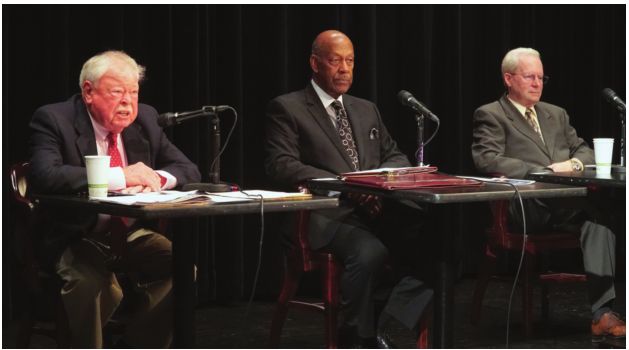
The
newest plan, financed by a sales-tax increase approved by voters last
year, has something in it for every school except for Matheny-Withrow
Elementary School, which was built in 2013, and Lakeview and Hazel Dell
elementary schools, which are slated for closure and replacement with a
new school. Owen Marsh Elementary School, also, would be replaced with a
new building on the site of the existing school. Improvements to
existing schools range from security upgrades to new roofs to expanded
cafeterias to new wings for classrooms to hold students who are now
taught in mobile structures.
All
told, the district, which wants to start work next year, plans to spend
about $200 million over the next decade or so, with $57.2 million
earmarked for elementary schools and $20.7 million for middle schools.
The biggest chunk of money, nearly $112 million, would be spent at the
district’s three high schools. Southeast High School would get a
renovated auditorium, a field house and new locker rooms at a cost of
$20.1 million. Both Springfield High School and Lanphier High School
would be completely renovated.
The
$48 million price tag for Lanphier includes money for a new field
house, new classrooms, a performing arts center and new turf on the
athletic field. Springfield High School would get new and larger
classrooms, a field house and new rehearsal space for band and choral
groups at a cost of $43.8 million. Athletic fields for high school and
middle school students would be built on land at Koke Mill and Hedley
roads where the district once planned to build a new high school.
It
is, the district says, a solid blueprint, and Springfield voters,
tightfisted in the past, easily approved the tax hike to pay for it.
Boosters have argued that better buildings promote academic achievement.
Experts are divided: Some researchers say yes, others no.
“It
is an open question whether capital improvements will lead to improved
student achievement,” wrote authors of a 2008 study, published by the
National Bureau of Economic Research, who studied California schools and
found some evidence that spending on buildings might have a slight
effect on academic performance, but far less than spending to reduce
class sizes. “(D)irect evidence regarding the effects of investments in
school facilities (on academic performance) is in extremely short
supply.”
The effect on housing markets was more pronounced, according to the research team that included economists from Princeton University, George
Washington University and the University of Pennsylvania. Home values
increase when school districts invest in buildings, the researchers
reported, and not because kids bring home better report cards. For every
$1 spent on school facilities, researchers reported, homebuyers,
despite property tax increases, were willing to spend $1.50 on houses,
and so districts likely are under-investing in facilities, considering
the effect on housing markets.
“We
find that passage of a bond measure causes housing prices in the
district to rise by about six percent,” researchers reported. “This
effect persists for at least a decade. … Parents may value new
playgrounds or athletic facilities for the recreational opportunities
they provide; enhanced safety from a remodeled entrance or drop-off
area; and improved child health from asbestos abatement and the
replacement of drafty temporary classrooms, even if these do not
contribute to academic achievement.”
The
researchers found little evidence that spending on schools changes
income or racial characteristics of homebuyers. Nonetheless, Pfeiffer
and others say that spending on schools in Springfield can break down
both racial and socio-economic barriers and, perhaps, improve academic
performance.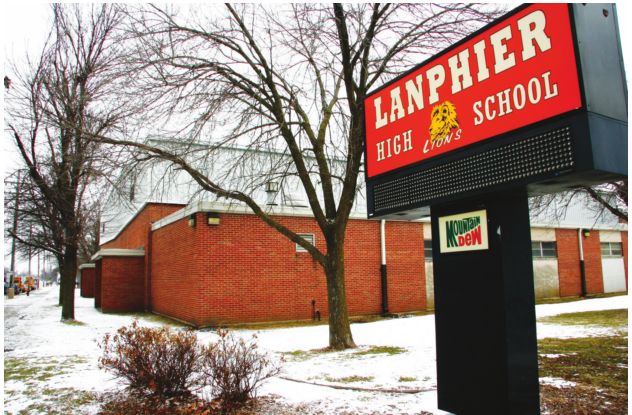
“You
can’t say they’re dumb kids” Pfeiffer says the district should replace
Springfield High and Lanphier with two new high schools, one on the
north side of town, the other on the south. Make them mirror images of
each other to save on architectural expenses, he says.
The
existing Southeast could become an academy focusing on math, science
and foreign languages, Pfeiffer suggests, while the current Springfield
High School building could be transformed into a fine arts academy and
home to district administrative offices. By shifting high school
attendance areas to a north-south configuration, racial and
socio-economic mixes inside schools would change for the better, he
says.
“Boundary lines
have resulted in segregation,” Pfeiffer told the Citizens Club audience.
“We don’t think that was done purposefully. We’re making the charge
that they are segregated, and we need to change that.”
Springfield
High School, where 53% of students are white and 28% are black, is the
district’s least-diverse high school. At Lanphier, 49% of the student
body is white and 38% is black; 51% of the Southeast student body is
black and 37% is white. Economic disparities are at least as big as
racial ones. More than 63% of Lanphier students come from low-income
households. At Southeast, more than 56% of students are considered low
income; 32% of Springfield High School students are low income.
Graduation
rates are slightly better at Springfield High School, where 82% of kids
graduate in four years, than at Southeast, where 79% of kids graduate
on time. Lanphier, where 59% of kids graduate in four years, trails
badly. Lanphier’s graduation rate released last week by the Illinois
State Board of Education was 14% lower than in 2019 and 40% lower than a
decade ago.
Test results released last week by the state aren’t pretty.
At
Lanphier, 11% of SAT scores in English and language arts met or
exceeded thresholds demarking proficiency; 15% of math scores met or
exceeded proficiency thresholds. Twenty percent of Southeast SAT scores
in English and language arts were at or above levels considered
proficient, 14% of
math scores met or exceeded proficiency thresholds. Thirty-five percent
of SAT scores in English and language arts received by Springfield High
School students met or exceeded proficiency targets, surpassing the
state average. In math, 36% of Springfield High School SAT scores met or
exceeded proficiency targets, one percentage point better than the
state average.
“There has to be a reason for that,” Pfeiffer says. “You can’t say they’re dumb kids or that teachers aren’t doing their jobs.”
Allan
Woodson, a former teacher and administrator in the Springfield school
district, joined Pfeiffer at Citizens Club, arguing in favor of two high
schools. “Fresh paint and new windows on old buildings will not solve
this problem,” Woodson told the audience. “Merely remodeling these three
buildings is going to perpetuate the perception and the reality of
low-performing grade 9 through 12 instructional settings continuing to
exist, in large part due to current enrollment boundaries.”
In
an interview, Woodson said that neither he nor others who argue for two
high schools have all the answers, but he knows one thing: Academic
performance is lacking, and money from the sales-tax hike should be seen
as an opportunity to try new things. He acknowledges that there is no
guarantee that academics would improve in new schools with balanced
racial and socioeconomic student bodies.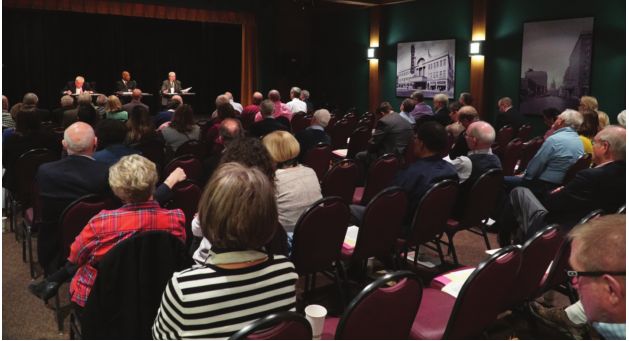
“I
do feel that if we continue on the road that we are on right now, we
are not going to see better performance,” Woodson says. “The worst thing
that can happen is, we have the kids doing the same, but they’d be in
better buildings.”
The
plan for two high schools is as much conceptual as concrete. Pfeiffer
says the district has land for new schools to replace Lanphier and
Springfield High School, but he hasn’t identified sites. The two new
high schools he proposes each would have room for 1,500 students, but
the district has more than 3,800 high school students.
When
someone in the Citizens Club audience pointed out that the proposed
high schools wouldn’t have sufficient space, Pfeiffer said that
Southeast could be converted to a freshman-only school for all the
district’s ninth grade students.
While
Pfeiffer hasn’t said just where two new high schools would be built, he
has ideas for the district’s existing property. The district should
sell the Koke Mill site once envisioned for a new high school and now
slated for athletic fields, he says. State Environmental Protection
Agency headquarters must be relocated to make room for a railroad
consolidation project that will widen a nearby rail corridor, Pfeiffer
notes, and so Lanphier could become the EPA’s new home.
Railroad
relocation, Pfeiffer says, could help pay to replace Lanphier. The rail
project, which will enlarge the rail corridor to make room for trains
that now run along Third Street, will harm Lanphier, he says: Rail cars
carrying hazardous materials could derail and kill or injure kids, and
vibration and noise from trains make learning tough. The district,
therefore, should be compensated, Pfeiffer says, just as business owners
near the project have been paid by the government for harm to their
businesses.
Pfeiffer
paints a zero-sum picture in which the district could get two new high
schools without spending any more money than currently planned. Each new
school, he figures, would cost $60 million, not including land, which
would total $8 million more than the district plans to spend on existing
high schools. By selling the Koke Mill property, collecting money through
the railroad project and a few other adjustments, he says, the district
could get new high schools instead of remodeled ones.
There
are plenty of doubters. Jim O’Shea, president of Harold O’Shea Builders
that is building a new middle school in Decatur, questioned costs at
the Citizens Club event, saying that new high schools would cost
significantly more than $60 million apiece. The district, Pfeiffer
responded, could close as many as eight elementary schools and sell land
– after all, he notes, the district once pondered closing a half-dozen
or so elementary schools. All told, Pfeiffer said, the district has a
dozen or so unneeded properties that could fetch as much as $160
million.
Kevin Seals,
chief environmental scientist for Hanson Professional Services, the
engineering firm that designed the railroad relocation project, says
there isn’t a pot of money to compensate the district for impacts the
project might have on Lanphier. A 2012 study prepared by the state and
federal departments of transportation to satisfy requirements that
impacts on minority communities be evaluated found no issues with
Lanphier – Seals says there aren’t any census blocks near the high
school where minorities predominate. In any case, he says, trains
already run near Lanphier, and improvements to crossings will increase
safety while ending the requirement that locomotives blast horns when
approaching streets. “The project, really, is increasing safety and
livability issues,” Seals says.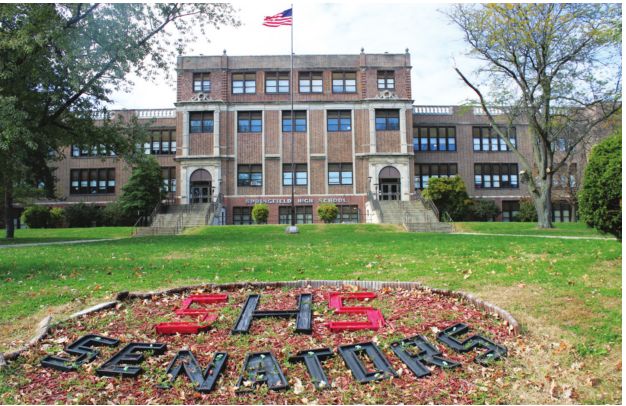
Woodson
says the district could build one new high school on the northwest area
of town, keep Southeast High School open and so have a two-high-school
district without building a second school.
“We’re
not making the kind of progress that we should have made at this point
in time – there’s no point in us continuing to use the same kinds of
strategies in the same kinds of structures if we’re not going to show
improvement,” he told the Citizens Club audience. “At the end of the
day, we can spend less money and get a bigger bang for our buck and
hopefully improve our academics and hopefully improve the interaction
between our races and our cultures by looking at something different.”
But school board members say it’s too late.
There
wouldn’t be enough money to improve elementary and middle schools if
the district builds two high schools, they say, and the plan pitched to
voters is the one they’re sticking with.
“We
went to the voters last November for the sales tax and two new high
schools were not in the plan,” Zimmers said at the October school board
meeting. “The thing is, we can’t go back to voters now and say ‘We were
kidding, we’re going to do nothing with your elementary schools and
middle schools, we’re going to build two new high schools and be done
with it. That’s bad business, and I don’t think anybody up here is in
favor of that.”
School
board vice president Scott McFarland, who represents north end
neighborhoods, said he doubts Pfeiffer’s math. He says two new high
schools could cost more than $200 million, but it’s not just a question
of money and keeping promises to voters. Closing Lanphier would hurt the
north end, he said. “Lanphier is an anchor,” he said. “If you took that
away, there’d be nothing there.”
It is, McFarland says, time to move on.
“They’ve been pressing the board on this idea since 2013,” he said. “We’re moving forward.”
Contact Bruce Rushton at [email protected].