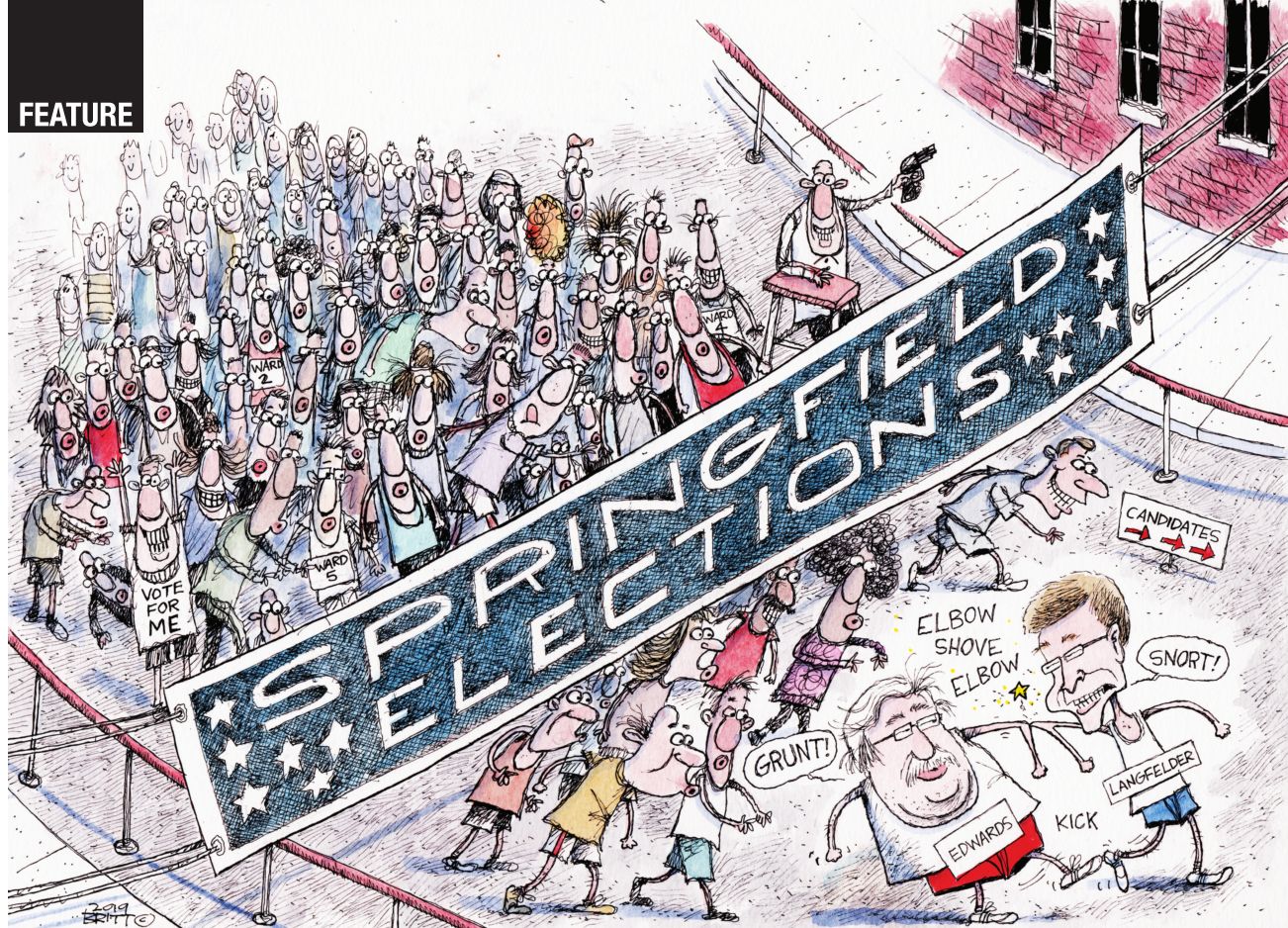
A crowded field for municipal races
If you think there are a lot of politicians on the make in Springfield, you’d be right.
Thirty-two candidates are vying for 13 municipal offices in the upcoming April 2 municipal election. Three citywide races – for mayor, city clerk and treasurer – each have two candidates apiece. Twenty-six candidates, the most in at least two decades, are running for city council, where just two of 10 races are uncontested.
“It’s a weird time – it really is,” says Brad Schaive, Laborers Local 477 business manager.
Ward 4 Ald. John Fulgenzi, who is facing three opponents, says he’s baffled by so many candidates. “I didn’t think I was doing that bad a job,” Fulgenzi says.
Despite the number of candidates, there will be no primary election, which is triggered when five candidates seek the same seat. The city clerk and the treasurer’s offices are essentially administrative posts, with the clerk keeping track of records and the treasurer keeping track of money. And so the mayor’s office and the city council is where the power lies and where just-plain-voters, as opposed to insiders, likely will be focusing attention.
“I don’t think he can win”
Mayor Jim Langfelder, the wise guys say, is a prohibitive favorite.
He’s affable, quick to smile and son of the late Ossie Langfelder, who served two terms as mayor before losing the 1995 mayoral primary. The mayor says and does seemingly unpopular things – his push for tax increases is a case in point – that haven’t seemed to dent his popularity. In 2015, he won his first mayoral term easily. Before that, he ran unopposed in two of his three campaigns for treasurer after winning his first term as treasurer by a wide margin.
During his first term as mayor, Langfelder has sometimes governed as if there were no consequences, angering organized labor, for example, after unions helped put him in office four years ago. He didn’t blink when police officers in 2017 declared that they had no confidence in police chief Kenny Winslow. Nearly 90 percent of officers who cast ballots said they had no confidence in the chief, but Langfelder’s support for Winslow hasn’t wavered.
Langfelder, a Democrat, also has been reluctant to endorse candidates, casting himself a nonpartisan politician – municipal races are officially nonpartisan, but parties have traditionally played
significant roles. He didn’t endorse J.B. Pritzker in the governor’s
race. He endorsed Betsy Dirksen Londrigan in the Democratic
congressional primary last year, but he didn’t lend his name to
Londrigan in the general election, which U.S. Rep. Rodney Davis,
R-Taylorville, won in a squeaker. Such reticence might help explain why
some Democrats are less than enthusiastic about the mayor.
The
mayor’s distance from from partisan politics is a departure from 1995,
when Langfelder lambasted fellow Democrats for not supporting his
father’s bid for a third term as mayor. Instead, local Democrats
supported another candidate, Michael Curran, who ended up losing to
Republican Karen Hasara in the general election. “If you’re like me, it
felt like someone ripped your heart out,” Langfelder told party members,
according to a 1995 story in the State Journal-Register, which
reported that the future mayor also told committeemen during the party
meeting that they should sign oaths vowing not to campaign for
Republicans and resign if they go back on their word.
On
the other side is Frank Edwards, who got walloped in his 2015 bid for
city treasurer by Misty Buscher, who had never before run for public
office. Edwards, by contrast, is a former city fire chief who won three
terms as an alderman and rose to the mayor’s office for four months in
2011 after the unexpected death of Mayor Tim Davlin, who committed
suicide within months of the mayoral election. In 2009, he had an
ever-so-brief run for governor, dropping out before the Republican
primary.
Edwards
attributes his 2015 defeat to not working hard enough. He says he won’t
make the same mistake this time. Langfelder, he insists, is vulnerable,
and he intends to make crime, taxes, economic development, utility rates
and population loss issues in his campaign. No one issue, he predicted,
will decide the contest. Rather, he said, a combination of things,
including the city’s recent purchase of the Sonrise Donut Shop sign
absent a clear plan for it, gives him a chance.
“Every
time something like that happens, it’s a chink in your armor,” Edwards
said. “If you get enough chinks in your armor, you’re vulnerable. … If
it gets into he’s a nice guy and I’m a nice guy, I lose – I know that.
If it comes down to issues-oriented leadership, he loses.”
That
Edwards is the lone challenger suggests that other potential candidates
thought Langfelder couldn’t be beaten. State Rep. Tim Butler,
R-Springfield, last fall acknowledged that he was considering a run, but
he didn’t try. Butch Elzea, a Republican businessman with name
recognition, also considered a run, but didn’t pull the trigger.
Sangamon County board member Tony DelGiorno, a Democrat, last fall
commissioned a poll aimed at determining who might have a chance of
unseating the mayor. The results have not been publicly released.
DelGiorno, who included his name in the poll, told State Journal-Register political writer Bernard Schoenburg that people feel the city isn’t “moving forward the way we should.”
Gail Simpson, a Democrat who’s running for the Ward 2 aldermanic seat, disagrees.
“I
believe he needs another chance,” Simpson says. “Maybe people feel,
like I do, that Langfelder hasn’t done a terrible job. He’s been open.
He’s been accessible. He’s been out in the community.”
At
times, the mayor sounds like a second term is a done deal, saying that
he’s planning on more individual meetings with aldermen, who’ve
criticized him for a lack of communication.

“I
think, going into the next term, I’ll probably try to do more
one-on-one meetings than I have with aldermen,” he says. Then again, he
says he won’t sit back.
“I’m not going to let the foot off the pedal,” he says. “We’re going to campaign as hard as ever.”
In
addition to proven popularity, there also is history. Mike Houston, who
finished third in the 2015 primary, is the only Springfield mayor since
1963 who hasn’t won two consecutive terms (Houston, however, won
successive terms when he served as mayor from 1979 to 1987).
Houston wouldn’t bet on Edwards. “I don’t think he can win,” the former mayor says.
Ward
2 Ald. Herman Senor, who is facing three opponents, said that Edwards, a
fellow Republican, has a chance. But the alderman sounded like a
football analyst assessing Cal Tech’s chances against Notre Dame.
“He’s
on the ballot, so there obviously is a chance for him,” Senor said. “It
goes back to how hard we as candidates work for our seats. So, yeah, he
has a chance.”
Wars of the wards
Theories differ on why so many people are running for city council.
On the one hand, it could be that people aren’t satisfied with city government.
“I
think, genuinely, people are looking at the representation and saying
perhaps we can do better – we need to do better in terms of what’s
happening with the city or in terms of what’s happening overall,”
Simpson posits.
Then
again, there are just two mayoral candidates, which suggests
satisfaction with Langfelder, who has more to say about the city’s
direction than anyone. Questions of plant-a-candidate have risen, thanks
to a November story by Schoenburg, who reported that the husband of
deputy mayor Bonnie Drew collected signatures on petitions to run
candidates against Ward 1 Ald. Chuck Redpath and Ward 6 Ald. Kristin
DiCenso. In Redpath’s case, he’s facing the Rev. T. Ray McJunkins, whom
he beat easily in 2015. DiCenso will face political newcomer Elizabeth
Jones. Bonnie Drew has denied any involvement with her husband’s
political activities, as did the mayor.
“I think there might have been some people recruited to run,” allows Schaive.
The
plot thickened when Anna Koeppel, a Democratic committee member,
unsuccessfully challenged Jones’ petitions, claiming that election dates
on documents were wrong and that Jones should be disqualified due to an
unpaid parking ticket. Koeppel is employed by the Laborers’
International Union of North America. Schaive, who heads the local
laborers union that supports DiCenso, who is a Republican, says he
played no role. “I have nothing to do with that whatsoever,” Schaive
said. “She (Koeppel) is a Democratic precinct committeeman. I’ve never
been to a precinct committeeman meeting, Republican or Democrat. I had
no discussions with her about that.”
Langfelder has an ally in Ward 7 Ald.
Joe
McMenamin, who’s been targeted by unions and whose campaign for a third
term may be the most interesting in the city. He says the mayor has
done an “acceptable” job and deserves another term. He’s blunt about
Edwards’ chances.
“It would be the upset of the half-century,” the alderman says.
If
Langfelder has coattails, McMenamin is grabbing them in his race
against Brad Carlson, a Capital Township trustee and chief of staff at
the state Department of Natural Resources. “I’m very pleased to have a
close relationship and close connection with Mayor Langfelder and the
department directors,” the alderman says. His colleagues on the council,
not so much.
McMenamin’s
relationship with other aldermen is strained to the point that council
members last year considered removing aldermen considered disruptive
from meetings if two-thirds of the council voted to have them taken out.
McMenamin – who’s exchanged sharp words with his colleagues for
accepting campaign contributions from political parties, labor and
vendors who do business with the city – isn’t backing down.
“The
question of who owns the candidate is extraordinarily important,” says
McMenamin, who boasts that he doesn’t take money from political parties,
unions or entities that do business with the city. “It’s a question of
character. Some aldermen are unwilling to vote in the city’s interest.”
What about Langfelder, who accepted union help during the 2015 campaign? That’s different, according to McMenamin.
“I’m
impressed that when Brad Schaive and the laborers (union) gave 20 grand
to Jim Langfelder, they acted like they owned him,” McMenamin says.
“Jim Langfelder has basically been a strong enough mayor to say no to
Brad Schaive on some issues, and I respect that.”
Schaive,
who’s had run-ins with Langfelder over city contracts that he feels
were either illegal or didn’t sufficiently benefit union members, paints
McMenamin as disingenuous for not taking the mayor to task for
accepting contributions from companies that do business with the city.
He makes no apologies for unions giving money to city politicians.
“That’s part of the political process,” Schaive says. “I personally
believe that every person, when you follow the law, you have a right to
be part of the political process.”
Houston
calls Ward 7 the most fascinating of the council contests, in part
because McMenamin has never had just one opponent and has never won a
majority of the vote in his three-way contests. Can he prevail in a
one-on-one race? “I think it will be a very competitive race,” Houston
says.
Carlson, who
enjoys support from unions, says McMenamin can’t be effective. “If he
can’t sit down with either business or labor or the other nine aldermen,
he’s doing somewhat a disservice to the residents of Ward 7,” says
Carlson, a Republican who calls himself a bipartisan candidate.
McMenamin
has blasted other aldermen for gathering at Saputo’s restaurant in 2017
to accept campaign contributions from unions and developers. There were
enough council members present to constitute a quorum, but aldermen who
attended the gathering said they discussed no city business and so
there was no violation of the state Open Meetings Act.
Was
the gathering appropriate? “That’s tough for me to answer,” Carlson
responds. “What happened there was legal, it was lawful – it’s all
(contributions were) reported on the state elections board website.”
What about the Open Meetings Act? “We’ve got to take them (aldermen) on
their word,” Carlson says.
Carlson
sees himself as the underdog – that, he says, is usually the case in a
oneon-one race against an incumbent. In any case, Ward 7 traditionally
has high turnouts for municipal elections. In 2015, it had, with 44
percent of voters casting ballots, the second-highest turnout of any
ward in the city, trailing only Ward 10, which had a 45 percent turnout.
And so running a campaign in Ward 7 could prove more expensive than in
other wards, where candidates will have fewer mailers to mail and fewer
voters to sway, presuming they concentrate on voters who’ve cast ballots
in past municipal elections.
The
flip side, when it comes to turnout, is Ward 2, where voters
historically have skipped municipal elections. Shawn Gregory, an
aldermanic candidate in Ward 2, says he’s hoping east side voters buck
history. “If we have a big turnout, you’ll talk to me again as an
alderman,” Gregory says. “I hope to inspire more than 1,800 people to
get involved in their community.”
Twenty
percent of registered voters in Ward 2 cast ballots in the 2015 general
election, dead last for turnout among the city’s 10 wards. Citywide
turnout was 34 percent. Gregory, a political newcomer, casts himself as
the fresh face in a four-candidate field that includes Senor, the
incumbent, Simpson, who was succeeded by Senor on the city council after
two terms as an alderman, and Tom Shafer, who’s run unsuccessfully for
several offices, including Springfield School District 186 board, the
Sangamon County Board, Sangamon County coroner and the Lincoln Land
Community College board of trustees.
Simpson
and Senor have accomplished little during their combined 12 years on
the city council, Gregory says. While low turnouts can favor incumbents,
Senor, a Republican who lost a bid for state representative last fall,
says he’s hoping that high turnouts for the November general election
will carry over to the Ward 2 aldermanic race. Low turnouts in the past
might be attributable to transportation issues and older folks not being
able to make it to the polls, he said.
“Who knows why people don’t want to participate?” Senor said. “You can take the horse to water, but you can’t make it drink.”
With
four candidates in the race, Senor says he doesn’t expect to win a
majority, but 36 or 37 percent is a reasonable target. Experience, he
says, counts, and while every candidate says that drawing new business
to Ward 2 is important, it isn’t easy.
“I’ve
been here for three and three-quarters years and finally got myself
established,” Senor says. “I kind of think before I act. Some of these
things take some thinking.”
Simpson,
who gave up her aldermanic seat in 2015 to run for mayor, said she
decided to run for her old seat in part because Senor, the incumbent,
was running for the legislature. “Nobody, including myself, could have
waited for the result of the state race,” she says. She said she chose
to run for mayor four years ago out of frustration that the city wasn’t
paying sufficient attention to Ward 2, and east side residents share her
frustration and have grown cynical about city politics and government.
“I had people say to me, ‘What difference does it make?’” Simpson said.
“They’re not going to vote because they don’t see change.”
The
Ward 5 in the city’s north end also pits a former alderman against an
incumbent, with a Capital Township trustee thrown into the mix. Thanks
to the growing popularity of early voting, the race essentially will be
over by election day, predicts LaKeisha Purchase, who in 2017 became the
first Democrat to win a seat on the township board in 40 years.
Purchase
rejects the notion that she and Sam Cahnman, a fellow Democrat, will
split votes and hand the election to incumbent Andrew Proctor, who
easily beat Cahnman four years ago. Municipal races, she says, hinge on
the person, not the party, and there may be some truth to that. After
all, Senor, a Republican, handily won the Ward 2 race in 2015 even as
Langfelder, a Democrat, carried the ward by a wide margin. Still,
Purchase acknowledges she’s heard the talk.
“I’ve
had multiple people come to me and say ‘You’re probably going to lose
because Sam’s in the race and there’s two Democrats,” Purchase says.
Cahnman, an attorney, has baggage.
His
loss four years ago came after he was censured by the Illinois Supreme
Court for misrepresenting how he had obtained a copy of a judge’s work
calendar. In 2002, he was temporarily banned from the county jail after
guards reported seeing him kiss and embrace a prisoner. In 2009, he was
arrested for allegedly soliciting sex from police officers posing as
prostitutes, but was acquitted of a misdemeanor charge. In 2011, a woman
called police, saying she woke up without her underwear after going to
Cahnman’s apartment and drinking wine; no charges were filed. Two years
ago, his law license was suspended for 90 days after the state Supreme
Court found that he had represented Calvin Christian III in traffic
cases without disclosing his representation to the city council. At the
time, Christian was suing the city for failing to produce disciplinary
records of officers who’d cited him for traffic offenses. It might not
matter – after all, Cahnman has won past elections despite unsavory
headlines.
Cahnman says math is in his favor.
“Theoretically,
if I get the same number of votes I got four years ago, that would be
enough to win a three-way race,” he says. A precinct committeeman
campaign last spring also bodes well, he said. Initially, he said he was
disappointed that he drew opposition, but he got 70 percent of the
vote.
Proctor, who has won labor’s support, says he’s focused on his campaign, not the opposition.
“I’m not going to speculate on the motives of the other two candidates,” Proctor said.
Contact Bruce Rushton at [email protected].


