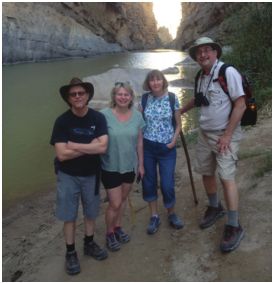
Left to right: Mexico, Rio Grande, Texas
When I get in discussions about whether we need a wall on the U.S.-Mexican border stretching from the Pacific to the Gulf of Mexico, my opposition to the Trump Wall is often misunderstood as being against enforcing immigration laws or having border security.
Yet I think we need border security and enforcement of immigration laws. What I am against is spending $5 billion on something that will not work rather than on fixing the real problem. Let me explain.
Look at the photo above. This is Santa Elena Canyon with Mexico on the left, Texas on the right and the Rio Grande in the middle. Except for the half mile you can hike into the canyon, the Rio Grande goes wall to wall with 1,500-foot cliffs going for 13 miles. No one is going to climb down one side and up the other. A wall in this area or the narrow canyons on similar parts of the Texas border would be a waste of money.
But even if you could make a solid wall from sea to shining sea, would it work? Illegal immigration probably would just move from illegal land crossing to sea traffic in the Gulf and Pacific coast.
The only thing that may stem the ongoing stream of illegal immigrants from Central America is if there is enough opportunity in these countries so inhabitants have the ability to make a decent life for their families. In many of these countries youth who have no hope of rising out of poverty become easy recruiting targets for gangs and criminal cartels that offer them a way out of poverty or they can flee north.
Currently
to encourage economic development the U.S. Agency for International
Development sends $290 million in development aid to Mexico, $257
million to Guatemala, $181 million to Honduras and $118 million to El
Salvador. Yet this has not been enough to impact conditions to stem the
tide of refugees especially from the last three countries.
The
Trump administration response has been to threaten to cut aid to
Guatemala, Honduras and El Salvador and to demand $5 billion for the
wall in FY2012. (Ultimate cost estimates $21- 70 billion.) The cut in
aid would likely make a bad situation worse by increasing the pressure
for people to flee north.
One can’t help but wonder if a more rational, nuanced approach would be to increase the economic development aid to the region.
The
Senate has come up with a bipartisan $1.6 billion border security
package. Increasing development aid to Guatemala, Honduras and El
Salvador from the current $0.556 billion might do more to stem the
pressure on our borders than spending $5 billion on a wall. The U.S.
could double or triple economic development aid to these countries along
with the Senate compromise border security package and it would still
cost much less than $5 billion for a wall.
Any
increase in aid to these countries would need to be accompanied by the
realization that as their economies grow, it will be important to not
hamper them with tariffs that prevent them from finding an outlet for
their products. For increased development aid to work, the U.S. needs to
be tough with any corrupt strongmen in these countries who may be
skimming aid money off the top.
It
is critical for people to write our U.S. senators and representatives
to support both the bipartisan Senate border security compromise
proposal and an increase in development aid as the true solution to our
immigration crisis.
Dr. Soltys of Springfield is a retired physician who teaches on a volunteer basis at SIU School of Medicine.


