Walk through the cemetery, listen to the dead
Where are Elmer, Herman, Bert, Tom, and Charley All, all are sleeping on the hill One passed in a fever, One was burned in a mine, One was killed in a brawl, One died in a jail, One fell from a bridge, toiling for children and wife- All, all are sleeping, sleeping, sleeping on the hill
So wrote Edgar Lee Masters in his 1915 Spoon River Anthology, a collection of poems of deceased people speaking from the grave.
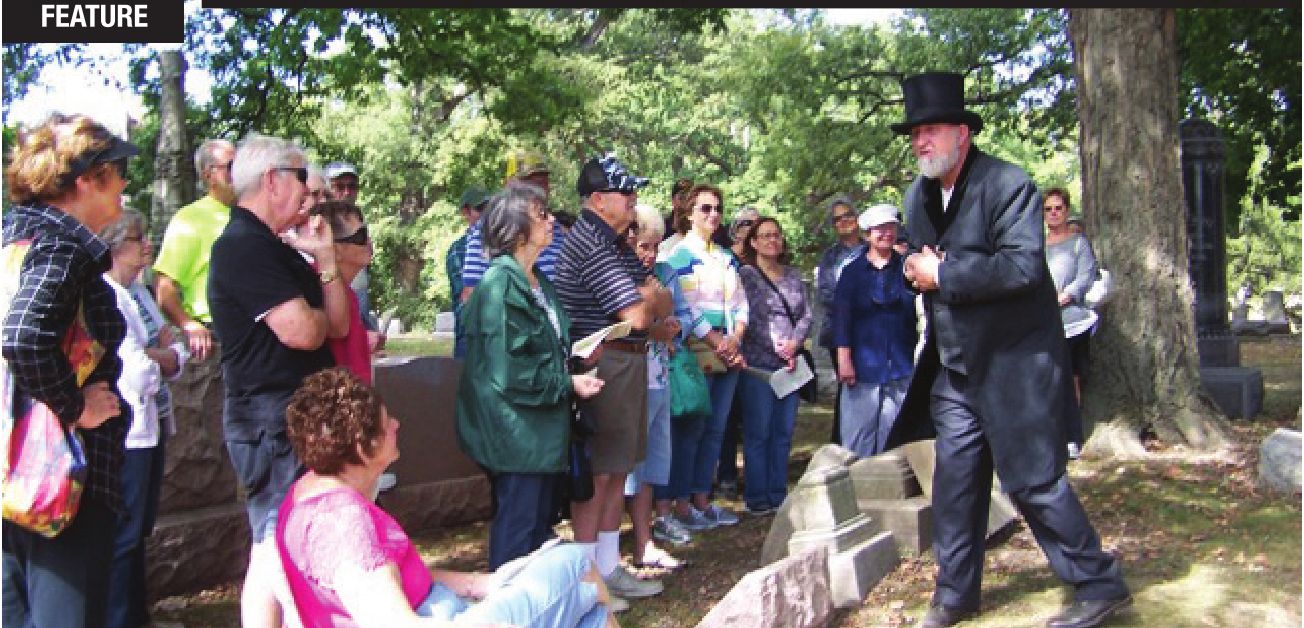
On Sunday, Oct. 14, we have a chance to hear from our early settlers who are “sleeping on the hill” at Oak Ridge Cemetery, a beautiful, hilly cemetery with majestic old trees. Costumed actors will be portraying seven important Springfield and Sangamon County leaders/settlers, all who came to this area around the time Illinois became the 21 st state. “Echoes of Yesteryear: A Walk through Oak Ridge Cemetery,” sponsored by the Sangamon County Historical Society (SCHS), and cosponsored by Oak Ridge Cemetery, celebrates our early history and adds to the many bicentennial celebrations throughout the year.
Where are Moses, John and John, Catharine, Carrie, Martha and Catharine?
All, all are sleeping on the hill.
Mary Alice Davis serves as the event chair, a position she has held since 2015 because, she says, “I love it.” The Sangamon County Historical Society held an annual cemetery walk from 1996-2008. When Davis became the president of the society in 2014, she had an interest in reviving the event, and the walks resumed in 2015.
“Some people think a cemetery is depressing,” Davis says, “but it’s not. Long ago people would go to a cemetery to picnic and walk around. It is a beautiful place.” Indeed, it was customary in the late 19 th and early 20 th centuries for people to gather in cemeteries, as they were the first public parks. Women with parasols promenaded through the cemetery; families would picnic next to graves as a way to convene with their loved ones and celebrate both those deceased and those living.
The seven people who will be portrayed have interesting stories. During the Sunday presentations the actors will speak in first person to expand on the life of the character being portrayed. Some will share highlights of the person’s life, while others will focus on the time when the person settled in the area. Each portrayal will be around 5-7 minutes and offer interesting historical facts about how our county developed from the involvement of these settlers. Davis says, “The actors are the real stars of the show with their presentations.”
Moses Broadwell (1764-1827) was a Revolutionary War veteran who settled near what is now Pleasant Plains in 1820, hoping to create “a plase of buisnis” (his spelling). After purchasing acreage, he developed Sangamo Town, a shipping port that rivaled Springfield and had 250 residents. He built the first brick house in Sangamon County, now known as Clayville’s Broadwell Inn. Sangamo Town languished after 20 years due to the flourishing of Springfield and New Salem. Moses will be portrayed by Dennis Darling, a Springfield singer and entertainer, who recently performed in Big River at the Hoogland. Darling says, “This is my first year portraying a character at the event, and I enjoyed going to the cemetery walk in the past. I have become more interested in history.”
Jerry Smith, active in both the Sangamon County Historical Society as its treasurer and the Clayville Historic Site as a board member, is a descendent of Moses Broadwell, who was his great-great-great-great grandfather. Smith grew up in Springfield but worked in the hotel industry all over the country; after retiring he moved back to the area. “It was about the time the Pleasant Plains Society
was working on some restoration of Clayville. Our family farm was near
Clayville and so it was natural for me to get involved.”
John Kelley (1783-1823)
is credited with building the first cabin in the area in 1819, before
Springfield was even a town. His brothers, Elisha and John, joined him;
in all nine cabins made up the Kelley settlement where judges, lawyers
and others stayed. John’s cabin, which would have stood at Second and
Jefferson, is considered the first Sangamon County courthouse. The
family graves, which were located near what is now the Department of
Revenue building, were later moved to Oak Ridge. Kelley will be
portrayed by Patrick Foster, an attorney with the Illinois Commerce
Commission. Foster says, “I have a degree in history, and I prepare by
going through files at the Sangamon Valley Collection. That helps me
gain further insight into the person and the era.”
John Todd Stuart (1807-1885)
arrived in Springfield in 1828. A cousin to Mary Todd, he served in the
Black Hawk War in the same battalion as Abraham Lincoln. Later, he and
Lincoln became law partners. Stuart served three terms in the Illinois
General Assembly, served as a U.S. congressman, and helped with
investments for the Illinois Watch Company that operated out of
Springfield. He also became the president of the Lincoln National
Monument Association which built and opened the Lincoln Tomb. Stuart
will be portrayed by Dennis Rendleman, himself a lawyer serving as the
Ethics Counsel for the American Bar Association. He portrayed Stuart in
last year’s cemetery walk; this year Rendleman plans to focus on
Stuart’s views of what he saw in Springfield upon his arrival. “In doing
research I found a book covering 150 years of law from the 1800s to
1970s; as an attorney I felt a connection to Stuart who started a law
practice that is now known as Brown, Hay and Stephens.”
 About the cemetery walk
Oak
Ridge Cemetery 1441 Monument Avenue Sunday, Oct. 14, Noon-4 p.m. with
the last tour beginning at 3:15. (Rain date Sunday, Oct. 21) The walk is
free; donations suggested. Parking will be available below the hill of
Lincoln’s Tomb. Shuttles will transport people in groups to the
gravesites.
Each portrayal lasts around 5-7 minutes and then groups will move to the next gravesite.
Total walk is around one mile and will take around 90 minutes.
Refreshments will be offered by the African American History Museum.
Sangamon County Historical Society books will be available for purchase.
The Staab family will have the Lincoln hearse on display.
Catharine Bergen Jones (1816-1915)
lived to be 98 years old and earned the right to vote when she was 97,
voting in support of liquor prohibition in 1914. It was possible for her
to vote even though the amendment to allow women the right to vote was
not enacted until 1920. In 1913 Illinois Gov. Edward Dunne signed into
law the right for women to vote for president. Illinois was the first
state east of the Mississippi to do so. Her family came to Springfield
in 1828; her father served as the pastor of the Presbyterian Church. As a
young girl in 1825, she met Marquis de Lafayette at an event
commemorating the 13 colonies; she was one of the 13 girls, all dressed
in white robes adorned with flowers and evergreen, who recited a poem
for the occasion.
Portraying Jones
will be Linda Schneider, office administrator, University of Illinois
Springfield provost’s office, who has been active in community theater
since 1975.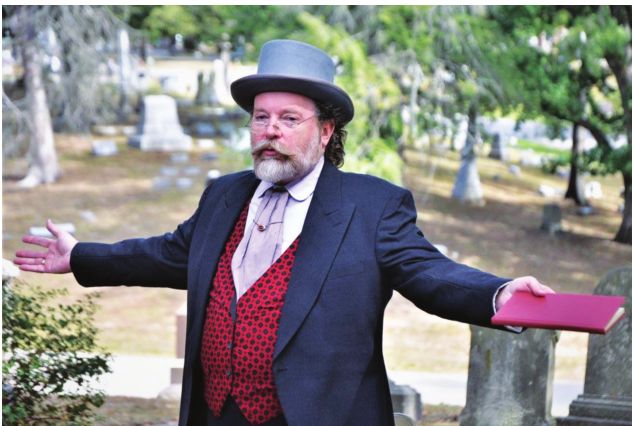
Aunt Carrie (1824-1914)
is the simple engraving on her tombstone, but she was really Caroline
Cushman Lathrop Post. She is officially listed as the purchaser of a
home at Sixth Street and Black Avenue in 1872, the home where she lived
until 1887. Her son, C.W. Post, and his wife moved into the home where
their daughter, Marjorie Meriweather Post, was born. In 1895 the home
became the King’s Daughters Home which housed elderly women in need.
Carrie’s son, C.W Post, would go on to fame as the founder of Post
cereals, and Marjorie later created General Foods. Marjorie built a home
called Hillwood, in Washington, D.C., now open as a museum showcasing
her many collections of china, glass and paintings. In 1924 she also
built Mar-a-Lago, which is a 126-room, 62,500-square-foot house now used
by President Trump. Post who will be portrayed by Tracy Petro, clinical
research coordinator for Clinical Radiology at Memorial. Petro says, “I
prepare by researching and reading the script over and over. I
discovered that Marjorie’s home Mar-a-Lago has the Post crest inscribed
with the word Integrity and that Trump was removing it and replacing it
with his last name.”
Martha Hicklin (1838-1914)
came to Springfield in 1860 and throughout her life was active in
Springfield. She served as vice president of the Illinois State Colored
Historical Society and was involved with the Illinois State Historical
Society, the Women’s Christian Temperance Union and the Lincoln Colored
Home. Her husband, Hezkiah, was a barber and was the first black person
to hold public office with the Sangamon County Board of Supervisors.
Her son became the first African-American city council member. Hicklin will be portrayed by Roni Betts, who
moved here with her husband after they both retired from Paramount
Pictures in California, where she worked in the finance department. She
has portrayed other early African-American women from Springfield and
with her background in finance feels a connection to Martha who served
as treasurer of the Lincoln Colored Home. “I will be highlighting
Martha’s life but also connecting it to the African-American life in the
1800s,” says Betts.
 Catharine Lindsay (1848-1922)
was the mother of Springfield poet Vachel Lindsay. She and her husband
bought the home at 603 S. Fifth Street in 1878. The previous owners had
been Ann Todd (sister of Mary Todd Lincoln) and her husband, Clark
Smith. Vachel Lindsay arranged a contest for the design of a Springfield
flag and the Springfield Art Association sponsored the contest in 1917.
Catharine Lindsay (1848-1922)
was the mother of Springfield poet Vachel Lindsay. She and her husband
bought the home at 603 S. Fifth Street in 1878. The previous owners had
been Ann Todd (sister of Mary Todd Lincoln) and her husband, Clark
Smith. Vachel Lindsay arranged a contest for the design of a Springfield
flag and the Springfield Art Association sponsored the contest in 1917.
That design is
still used on the flag that flies on the Municipal Building. The
Springfield Art Association recently exhibited Vachel Lindsay’s works,
including the flag. Mary Disseler, who has done some community theater,
will be portraying Catharine Lindsay. She says, “A big part of
authenticity is correct clothing so I have decided to wear a dress with a
bustle from the 1880s, which would have been the type that Catharine
wore.”
Planning for
the cemetery walk starts at least a year ahead of the scheduled date. A
theme must be chosen and then characters who fit the theme are selected.
The committee
walks the site several times, looking at spacing and flow. Davis says,
“We can’t be too close together, so one actor can be heard without
interfering with another actor. And we can’t be too far apart, so people
can walk the event.”
Mike Kienzler, the only employee of the SCHS, researches and writes
the scripts. “It is fun and interesting. There is so much online,
especially with all that we have on Lincoln and so the area’s history
includes many profiles of people. It is sometimes hard to trim down the
script because there is so much,” Kienzler explains. He also updates
SangamonLink, the online collection of Sangamon County history produced
by the SCHS.
Actors
need to be found, and that role falls to Linda Schneider. “This acting
takes a different skill. You become a storyteller. So I think about
people I know who are actors and consider who might be an appropriate
person to portray the character chosen. In addition, it really involves
stamina. The actors are working nonstop for three or four hours,”
Schneider explains.
Actors
also need to determine their clothing based on the character being
portrayed. Sometimes that means choosing a year or decade as the
timeframe for the portrayal. Schneider says, “If a woman is portraying
someone from the early 1800s, she might not wear a hoop skirt, since
that was worn later in the century.” Schneider says, though, “The people
who come to the event suspend their disbelief. They are there to hear
the story, and feel we are timeless. They don’t really comment if our
outfit doesn’t fit exactly with the time period. We try to create a
flavor of the historical era.”
The
Sangamon County Historical Society was established in 1961 with the
mission to preserve and promote the history of Sangamon County. The
society offers educational programs and tours and hosts monthly programs
on topics of local history. A basic membership is $30 for a year and
can be purchased at www.sangamonhistory.org or by calling 217-525-1961.
As
people walk between the gravesites to listen to the actors, it provides
the opportunity to enjoy the beauty of Oak Ridge Cemetery. Tall,
majestic trees branch out over graves and paved roads, offering shade
and beauty. (See sidebar). Many do not realize that Oak Ridge Cemetery
is the second most visited cemetery in the United States; the first is
Arlington National Cemetery near Washington, D.C.
Cinda
Ackerman Klickna loves learning about Illinois history and that of our
area. In 1997 her students at Southeast High School researched the names
on graves at Taylor Cemetery located at Lake Sangchris and wrote the
feature for the Illinois Times.
 Oak Ridge’s trees
Although
the many historical and important trees in the Oak Ridge Cemetery are
not on Sunday’s tour, people may want to go on their own to see trees
that have been marked as important. Over 100 trees in the cemetery have
been designated, each marked with a stone which is flush to the ground. A
QR code on the stone can be accessed with a smartphone. Oak Ridge has
annual tree tours and lists important trees for each event. For its
bicentennial tree tour that was held Sept. 9, 10 trees were featured,
all located in the north part of the cemetery: a butternut hickory, red
maple, Hawkins oak, black maple, shagbark hickory, Lea’s hybrid oak,
European pedunculate oak, rock chestnut oak, European hornbeam and
persimmon. The featured persimmon tree is believed to be the oldest
specimen of persimmon in the cemetery and is located near the John
Kelley grave.