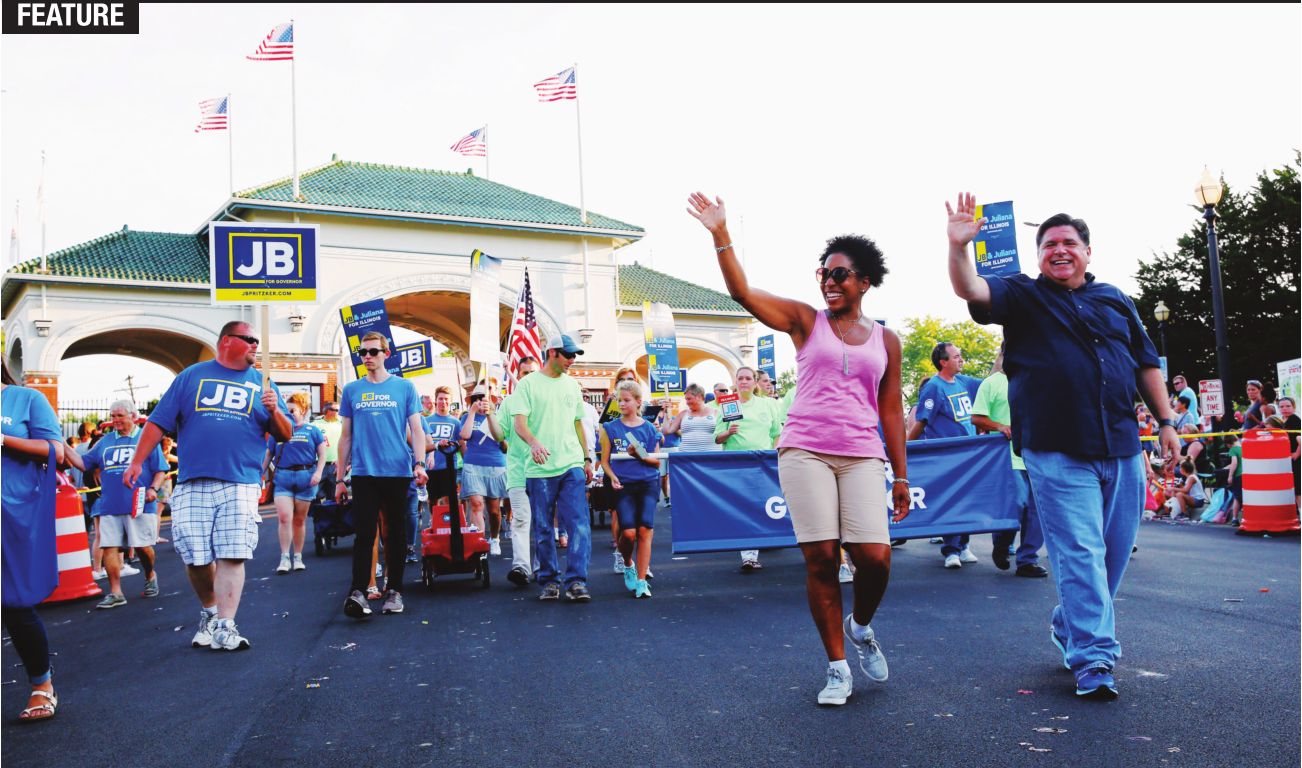
J.B. Pritzker, Democrat for governor, reflects on Bruce Rauner, learning from failure and plans to change Illinois
Jay Robert “J.B.” Pritzker, D-Chicago, lives by the mantra that the “the early bird catches the worm.” “I’m a guy who gets up pretty early in the morning, and my staff hates it because I’m texting and sending emails at 4:30 a.m., but you can get a lot done at the quiet dawn of the morning,” the 53-year-old businessman said in a one-on-one interview with Illinois Times, held earlier this month in Chicago.
Since April 2017, Pritzker has mounted an ambitious bid to unseat Gov. Bruce Rauner in the Nov. 6 general election. For nearly an hour, Pritzker offered candid insights on his campaign, meeting voters and overcoming his election loss in his previous bid for public office. Pritzker responded to attacks from his opponent, while detailing his own plans to transform Illinois if elected.
Despite the labor-intensive campaign, Pritzker relishes his daily schedule, noting the significance of meeting voters personally. “To me, I think voters want to know who you are and they want to feel you in real life, so my days have been full,” he said. “I haven’t taken very much time off at all, and we’ve been at this for about, I guess since I’ve started seriously thinking about looking at running, I’d say 20 months. I announced on April 6, 2017, and here we are, going into September 2018.”
Though he is known as a businessman, politics has long been a passion of Pritzker’s. From an early age, Pritzker recalls campaigning on behalf of Democratic candidates with his mother, Sue. “I didn’t quite know enough as to why we were knocking on doors, but I was with my mother and it was a good feeling to be with her and what she was doing seemed important,” he said. “My parents were extraordinarily important in setting my values and setting me up in a direction where I would fight for progressive values, working families, children and especially those who are powerless.”
Over time, Pritzker has become a formidable behind-the-scenes player in the Democratic Party. In the late 1980s, he served as a legislative aide to U.S. Sen. Alan J. Dixon. In 2008, he was the national cochairman of Hillary Clinton’s presidential campaign, eventually helping to align Clinton with Barack Obama after he defeated her for the Democratic nomination and went on to win that year’s election.
Pritzker created Democratic Leadership for the 21st Century, a national organization with the purpose of attracting voters under the age of 40 to the Democratic Party.
“Almost every election, even long before I was running for anything, I knocked on doors for candidates, made phone calls or phone-banked for candidates that I thought were important to help get elected,” he said. “Of course, I was financially supportive as well as giving up my time, because I think both of those facets are extraordinarily important if you want to elect good people to public office.”
In
1998, Pritzker campaigned for public office for the first time, running
for the vacant Illinois Ninth District congressional seat, a bid that
ultimately proved unsuccessful. “I believed back then when I was running
that when you put your ideas out there and you’re passionate about
them, people would be drawn to your candidacy just on the ideas
themselves,” Pritzker said in retrospect. “While I got a lot of support
from people who believed in me and my ideas, I really didn’t have much
of an organization put together. I hoped that by forcing effort and
ideas, people would engage with my campaign.”
Despite
the defeat, Pritzker said that he was grateful for the experience,
believing that the lessons learned would be applicable in the future. “I
learned honestly that when you try and don’t succeed in something, you
have to examine everything about it and ask ‘What could I have done
better?’ he said. “I just think, in life, when you try and don’t
succeed, it’s just a learning experience for the next time.”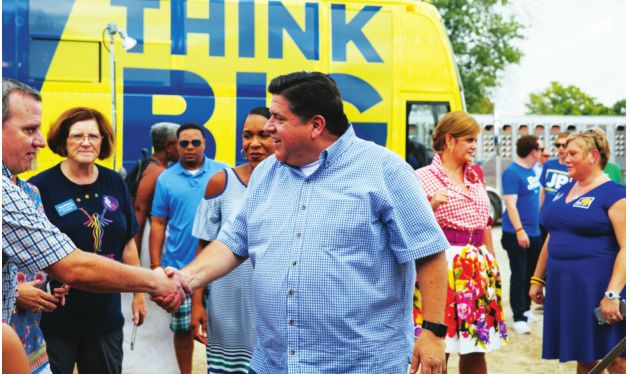
According
to the Aug. 21 NBC News/ Marist poll, Pritzker leads Rauner by 16
percentage points, 46-30. Despite the double-digit lead, Pritzker says
he places little faith in polls. “Honestly, I pay no attention to
the polls, and I am running this race like we’re five points behind,”
he said. “The polling numbers show that I’m still going like I was 20
months ago. I’m getting up early in the morning, I’m starting early, and
doing everything that I can to touch voters and make sure people know
what I stand for.”
According
to the poll, Pritzker leads Rauner in central and southern Illinois
counties by 10 points. If the lead holds in November, it will buck trend
as a Democratic candidate could win a slew of traditionally Republican
counties. “Central and southern Illinois are critically important areas
for Democrats. Maybe more to the point, Republicans have forgotten
central and southern Illinois,” Pritzker said. “Jobs are not being
created there by the current governor. We need to expand health care and
make sure every child gets a quality education in central and southern
Illinois. Every part of this state shares the same basic set of values.
We’re fighting for working families and making sure that we’re expanding
health care services available to everybody.”
Pritzker
faces continued attacks from Rauner. Recent Rauner TV spots claim
Pritzker will raise taxes if elected governor. In response, Pritzker
claims that the governor mischaracterizes what he wants to do with
taxes. “I want to make taxes more fair,” he said. “That means lowering
taxes for people in the middle and lower-middle class, because they’re
paying the same rate as wealthy people in the state.”
Pritzker
elaborated on the imbalanced tax structure experienced in different
income brackets. He suggests that wealthy Illinoisans such as himself
and Rauner should pay a higher rate. “It’s not right that someone who’s a
child care worker or someone who’s a construction worker pays the same
tax rate as someone who’s the CEO of a major corporation,” he said. “I
want to change the system so we can give a break to the middle income
levels and lower income levels and raise taxes on Bruce Rauner, myself
and others who are wealthy, so that we can pay for our schools and
balance our budget.”
Pritzker related the story
of Emily, a construction worker from Monroe County. A single mother of
two, Emily spends a third of her earned income on child care. In 2015,
Rauner implemented restraints to the Child Care Assistance Program
(CCAP), a decision that child-care advocates say resulted in reducing
state funding by 90 percent. Because of the CCAP cuts, Emily often
struggles to afford quality child care while maintaining her job.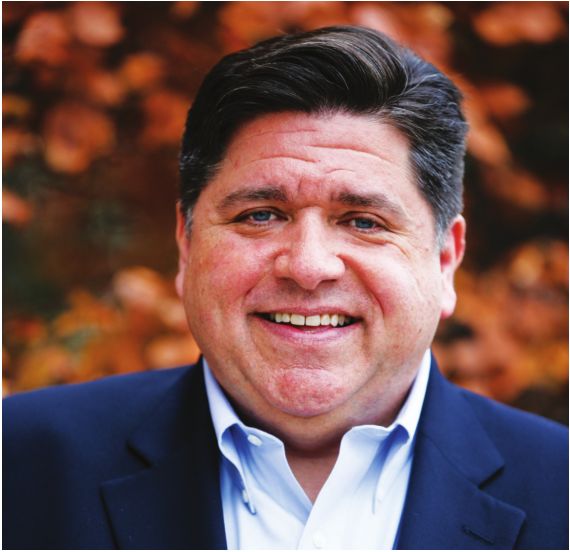
“Bruce
Rauner cut child care assistance for people like Emily, and my view is
we have to make it easy for people who want to hold a job, and make it
easy for people who want to get quality child care,” Pritzker said.
“That’s why I put out a plan to address that issue, so people like Emily
can rely on state funding.”
Last
month, Rauner signed two bills designed to increase stability for the
thousands of Illinois families on CCAP by curbing future drastic cuts.
However, Pritzker believes that the plight faced by Emily is proof that
the damage caused by those cuts is irreversible. “When you have to quit
your job, you don’t get child care, and often people have to quit their
jobs so they can take care of the kids,” he said. “In Emily’s story and
stories just like hers, it’s particularly the kids who suffer when Bruce
Rauner fails to do his job, and that motivates me to want to beat him
and change the system.”
Regardless
of the outcome in November, Pritzker said that the journey of running
for governor is something he will cherish for the rest of his life. “I’m
honored to be the Democratic nominee for governor. Win or lose, I have
learned a lot,” he said. “I have met amazing people in this state, and
they are good, decent, hard-working people who are striving to make a
better life, and who care about their community.”
Pritzker
concluded that the affirmations he’s received from voters throughout
the campaign stimulates his drive to bring optimism if elected. “We live
in a state where people actually care about each other, and they want
to solve problems and work together to get things done,” he said. “I’m
energized by that, and I know that as governor, I can get a lot done to
help the state get back on the right track.”
Alex
Camp is a master’s degree graduate in Public Aff airs Reporting from
University of Illinois Springfi eld. He is currently a freelance
journalist. Contact him at [email protected].


