From New Year’s Day to Taco Daze, from music to theater to history, the town is on a roll
Everything old is new again
in Jacksonville, even the annual New Year’s Day celebration in the west
central Illinois city of nearly 19,000.
“I
would say it started in the 1970s. It was in the early 1980s when I
started doing it, then it slowly progressed, and all of a sudden the
other bars recognized the fact and started doing it too,” said Danny
Kindred, the owner of Don’s Place in downtown Jacksonville.
Kindred
was referring to the scores of daytime revelers who roam the downtown
area on the first day of the year, visiting establishments for free
food, entertainment and activities.
“New
Year’s Day is bigger than New Year’s Eve any more,” Kindred said. “The
young kids come out for New Year’s Eve, while it’s the older generation
coming out for New Year’s Day. I’ll see people that I haven’t seen all
year long that are out moving around on January 1.
“I
think it’s unique to Jacksonville right now,” Kindred said. “It’s a
great community. The people bond together and come out and enjoy
themselves.”
People
have also come out and enjoyed themselves at the new First Friday
events in downtown Jacksonville which are held, as the name implies, on
the first Friday of every month. They resume again in March and will run
through December, according to organizer Andy Mitchell of Our Town
Books.
“It’s an
attempt to create a downtown scene, to have as many businesses and
places in and around the downtown area involved so people can get out
and walk around,” Mitchell said. “We offer something cultural, a little
art, music and refreshments.”
Another
downtown Jacksonville scene has been created every Thursday for four
decades. The line forms early for the weekly Taco Daze at Bahan’s
Tavern.
“It all
started about 40 years ago when Mark Frech thought it would be a good
idea to serve tacos here,” said Bahan’s owner Rob Vidakovich.
Is it the ambience? The tradition? The price?
What keeps people coming back for the same food every week for 40 years?
“It’s my secret recipe,” Vidakovich said. “In fact it’s so secret that I sometimes forget it.”
Downtown
Jacksonville is on a roll, and a large portion of the credit goes to
the local Main Street program. They’ve garnered enough online votes to
secure the Levitt AMP Concert Series the past two years, a summer-long
free Friday night music festival that will continue in 2018 whether or
not they once again secure the Levitt AMP grant. The Artisan Fair and
Craft Brew Festival in August combined handmade wares and home and
micro-brewed beers, and the Pumpkin Festival in October brought more
families downtown. Free Wi-Fi service keeps people connected while they
are there.
“Our team of hardworking volunteers are always looking to develop
the next unique event that, like our current events, will attract
thousands to the square on a regular basis regardless of age, race, or
cultural background,” said Jacksonville Main Street event coordinator
Kristin Jenkins. “We have several events in the planning stages that are
sure to delight downtown guests of all ages.”
Judy Tighe is the executive director of Jacksonville Main Street.
“Of
course everything Jacksonville Main Street does is to make downtown
better, from helping to save and reuse buildings to creating murals and
public art to promotions to attract people,” Tighe said. “Our new
web-based features help finding great things downtown even easier.”
Jacksonville
was founded in 1825 and is proud of its heritage, including direct ties
to Abraham Lincoln, Stephen A. Douglas and the Underground Railroad, to
name just a few.
But it has embraced novel ways to interpret that history, effectively bridging the past and present.
One
of the newest community endeavors has been developed by first-year
Illinois College history students. It uses the Clio app to interpret the
city’s heritage, including its one-of-a-kind Walldog Murals scattered
throughout downtown.
“My
goal is to have students apply historical research to a project that
benefits the community,” said Illinois College professor Jenny
Barker-Devine. “Often we think in terms of just writing essays, but
using Clio can help the students connect to Jacksonville and they have
an opportunity to leave a positive mark on the community.”
The finished Jacksonville Clio app project should be ready for public use by mid- December.
“The
project forces students to think about how the community uses history
as a means for economic development and, I hope, will help them to see
that understanding history can be useful in a variety of professional
settings,” Barker-Devine said. “You can see this on the Walldog tour,
where students review the histories featured in the murals, but then add
information about the businesses they might patronize while users of
the app are out and about.”
The
Clio app will also feature the numerous “Looking for Lincoln” heritage
tourism program sites in the city, supplementing the promotion these
places already receive locally and statewide. The “Looking for Lincoln”
sites include, among others, the home of Civil War hero General Benjamin
Grierson, the residence of Governor Joseph Duncan, the home of
Lincoln’s secret Civil War envoy James Jaquess, and the oldest existing
college building still in active use, Illinois College’s Beecher Hall.
The
circa 1824 Woodlawn Farm just east of Jacksonville, a verified
Underground Railroad site, is also promoted traditionally and
electronically, and
will be open on Feb. 24 to commemorate African-American History Month.
Tours may be scheduled at other times.
Newer
interpretation of Jacksonville’s history is on the horizon. Development
is underway for the Jacksonville Area Museum, which will feature
exhibits and programs on the Morgan County area’s unique culture and
history. A construction project is preparing the Old Post Office
building in downtown Jacksonville as a museum space, and once complete
the local Heritage Cultural Center Board will use solicited private
funds to finish the exhibit space and other public areas. A public
opening is anticipated within a few years.

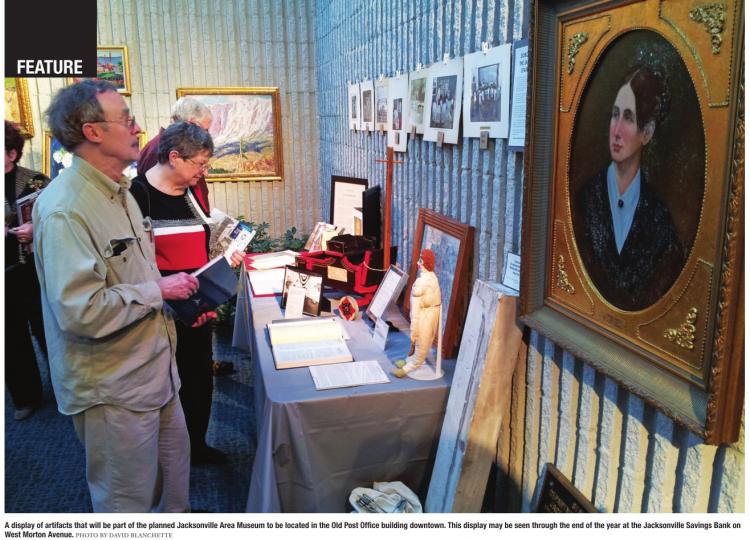
Meanwhile,
artifacts that will be shown in the museum are being loaned for public
display elsewhere, including a current “The Way We Were” exhibit that
may be viewed through the end of the year at the Jacksonville Savings
Bank on West Morton Avenue.
“A
strong, hardworking group has emerged with good ideas to help bring a
city museum plan to the forefront and we look forward to that happening
soon,” said Jacksonville Mayor Andy Ezard, who noted that another local
attraction is also being planned.
“A
performing arts center is also in the works downtown as a venue for
music and arts events,” Ezard said. “There is a strong fundraising
effort underway and they’ve hit their benchmarks along the way. We are
all cheering for that to happen and hopefully within a few years that
will become a reality.”
An
energetic and creative arts scene thrives in Jacksonville. Local
playwright and director Ken Bradbury has produced a number of successful
shows that often tie in to what has or is happening in Jacksonville,
including The Boy From Fishhook about the Guinness Book of World Records’ “world’s largest man,” Robert Earl Hughes.
“I think that nearly every community has performers; it’s the
audience that makes theater thrive or die,” Bradbury said. “Jacksonville
has always had a vibrant audience base for things cultural, and even
though that demographic is aging they guarantee good attendance in
Jacksonville.
“With
only a strip of tedious interstate between us, Jacksonville and
Springfield are in effect one theater community. Actors move freely from
one town to another to perform, and when you add New Salem into the
mix, then you have an abundance of performing opportunities,” Bradbury
said. “There have been nights when a patron had a choice of four theater
productions running simultaneously between the two cities. How many
areas our size have that?” Springfield theater veteran Aasne Daniels has
taken an active role in Jacksonville theater and is currently involved
with several local productions.
“My
colleagues and I are very excited about the theater program at Illinois
College,” Daniels said. “It is small, but we are a passionate bunch and
we manage to pull off some pretty imaginative, heartfelt productions.
“This year our theme is ‘small town, big heart,’ and we just closed Middletown, by Will Eno, a quirky reimagining of Thorton Wilder’s Our Town,” Daniels said. “I’m excited for spring semester, when I will be directing the musical The Robber Bridegroom, a delightfully silly Bluegrass romp.”
Playhouse
on the Square is another theater venue in Jacksonville, an intimate,
50-seat multipurpose performance space in a renovated downtown
commercial building.

The
David Strawn Art Gallery downtown currently has a photography exhibit
by Springfield’s David Brodsky, and they have a “magic realism” show in
January, a watercolor artist in February, Springfield photographer Jim
Hill in March, more watercolors in April, and pastels by Springfield’s
Sue Scaife in May.
Kelly Gross has been the director of the Strawn Art Gallery for 26 years.
“Every
time we have an opening, between 100 and 150 people attend, and we have
a gallery talk where the artists talks about what inspires them and we
take questions from those who attend,” Gross said. “I know we have a lot
of people who come from all over the Midwest for these openings, and
it’s really exciting to see that many people.”
Recreation
is serious business in Jacksonville, and nowhere is that more evident
than at Lenz Field & Sports Complex, LLC, a six-field artificial
turf baseball facility that hosts 1,000 youth teams from around the
Midwest each year.
“There
is no dirt on any of my fields, so the playability is great,” said
owner and developer Tom Lenz. “I was one of the first guys in the
Midwest to do youth turf fields. Now there are a lot of them, but my
complex stands up against anybody else’s. We have full-time maintenance
and office guys
that work 12 months a year. It’s one thing to build it nice, but it’s
another thing to keep it nice.”
Lenz
was the head baseball coach at MacMurray College in Jacksonville for
four years and always had a love for baseball. In 2007 Lenz tried to
develop more youth baseball opportunities with a local organization and
when that didn’t work, he went out on his own.
“I
just had one field in 2007-2008, then I bought more land in 2009, and
now have six fields,” Lenz said. “The economic impact for Jacksonville
is amazing.”
Four-legged
recreation has some new and expanded opportunities as well. The city
and the Jacksonville Parks Foundation last year opened the Jacksonville
PetSafe Dog Park, which was made possible by a $100,000 first prize in
the nationwide PetSafe Bark for Your Park Contest.
The
park is located on a city-owned, sevenacre parcel of land on
Jacksonville’s southeast side and was designed by the University of
Illinois’ Office of Recreation and Park Resources. It features newly
cleared and fenced grounds, parking and
benches. Additional development of the dog park will come after more
fundraising, according to Bark Park Initiative Committee Chair Abbi
Stevens.
Another
Jacksonville park is where you will find one of the city’s signature
products, a Big Eli Ferris Wheel. The wheel is located in Community Park
at the city’s busiest intersection of Main and Morton and is operated
several times per year by the Jacksonville Rotary Club.
Eli
Bridge Company manufactures Big Eli Wheels, Scramblers, the new
Spidermania and other amusement rides and has been doing so at their
factory just north of downtown since being founded by W.E. Sullivan in
1906. Current president and CEO Patty Sullivan is the founder’s
great-granddaughter and carries on the family tradition of creating
rides that nearly everyone has experienced at carnivals and fairs.
Other unique establishments abound in the Morgan County seat.
Annabel
Lee’s Tea Room features homemade food and desserts and is located in a
historic building along with an antique store and shopping
boutique. Mulligans downtown is known for their Irish Nachos, and
Schiraz serves food and drinks in an old bank building where you can
still see the vault upstairs. Soap Co. Coffee Shop was mentioned on
onlyinyourstate.com as one of the top 10 coffee shops in Illinois.
SafeCo
donuts and bakery along West Morton Avenue, with four donuts in the
phone number (243-0000), provides sugary morning fare to local diners
and to most Qikn-EZ convenience stores in central Illinois.
Farther
down the road on East Morton, Primrose and Lace is the kind of gift
shop you want to visit if you’re tired of gift shops.
There
is no shortage of food in the community once known as Elm City before
Dutch Elm Disease removed Jacksonville’s signature street canopies.
Leo’s Pizza serves more than 100 pizzas a night and has been doing it
since 1978.
“I would
say that about 75 percent of our customers have been coming for 38
years,” said Antonia Alfano, Leo’s co-owner along with her siblings.
“It’s all homemade, the crust and everything. My dad brought the recipe
back from Italy with him.”
“We
really care about this business, it’s our passion, our baby,” Alfano
said. “I eat, sleep and dream Leo’s Pizza. We want to do good and we are
very proud of it.”

Lonzerotti’s, an iconic restaurant in a restored train station, is another institution that’s part of Jacksonville culture.
“Every
little ingredient that we put together makes a difference in the end
product,” said Head Chef Richie Frederick. “We also buy as much locally
as we can, we have our own garden, we compost.”
“People
come for our lasagna, our meatballs, some of our chicken dishes have
been around a long time and are very popular, like Piccata and Marsala,”
Frederick said. “Plus you can watch the trains go by as you eat.”
Classic
cars, steam power and quilts are three of the major reasons that
Jacksonville’s population spikes with visitors during certain times of
the year.
Cruise
Night in September is one of the largest such events in Illinois. The
car show is held during the day in Community Park with the cruise that
evening along Morton Avenue.
September
also features the Annual Fall Festival Days and Steam Show at
Prairieland Heritage Museum. Antique agriculture is on full display with
horse, steam and early gasoline-powered implements and demonstrations,
activities and traditional food.
The
River Country Quilt Show in July is popular not only due to the number
and variety of quilts on display, but because visitors get to select the
winners.
“The top
vote-getters in each category are awarded the prize,” said Quilt Show
publicity director Barbara Suelter. “I think that’s one of the things
that is really nice about it because anyone can enter the show.”
“The
whole area is quilting territory, and many of our entries and visitors
come from area towns rather than just Jacksonville,” Suelter said. “It’s
a central Illinois event rather than just a Jacksonville event.”
But the quilt show is more than just a display of the sewing arts.
“We
always have a charity quilt, and in the Jacksonville area the quilters
are very generous with their time and efforts,” said quilt show
co-organizer Sue Fox, owner of the Times Square Sewing Complex in
Jacksonville. “This past year we got to donate $5,000 toward the Honor
Flight because of our quilt show.”
If you think this proliferation of events and attractions makes it easier to promote the community, you would be correct.
“What
I love about Jacksonville, and something that many people may not
realize, is that Jacksonville is a very diverse community,” said
Jacksonville Area Visitors and Convention Bureau Executive Director
Brittany Henry. “There are just so many things that our organization can
use to market and entice people to come and visit.”
Henry also noted that
Jacksonville was the childhood home of heavyweight boxing champion Ken
Norton and boasts a popular West Side Historic Walking Tour featuring 19
residences from 1834 to the mid 20 th century.
Henry
said visitors to the Jacksonville area in 2016 contributed $50.28
million to the local economy, a 6.9 percent increase, and $1.05 million
in local tax revenue, an 11.8 percent increase over 2015. The tourism
industry created or supported 310 jobs in Jacksonville last year, she
added.
Mayor Ezard joins Henry in extolling the community’s benefits.
“What
has kept me in Jacksonville over the years, besides being born and
raised here, is that it has all of the amenities of a big town with a
small-town appeal,” Ezard said. “We have good restaurants, solid
shopping, a very vibrant arts scene, MacMurray and Illinois College, a
lot of history. We have a lot to offer for a city of under 20,000.”
Ezard
said the good relationship with Illinois School for the Deaf and the
Illinois School for the Visually Impaired is a positive economic factor
for the community.
“These
state-operated facilities continue to do awesome work and they are not
duplicated elsewhere in the state,” Ezard said. “They are truly a gem
that we are fortunate to have.”
Jacksonville lost one major state-operated facility several years ago
due to budget cuts. The Jacksonville Developmental Center buildings
adjacent to the city’s Community Park now sit idle, and Ezard said it
will take demolition funds from the state before Jacksonville could
begin thinking about possible future uses for the huge tract of land.

But
solving problems is not new to what Ezard calls a “can-do” community.
When massive flash flooding inundated the city’s water plant, the city
began building a new one on higher ground while alleviating some of the
causes of the flooding. Children with disabilities needed accessible
playgrounds, so local service clubs stepped in and installed two such
areas in Community Park. Visitors and citizens asked for even more
recreational opportunities, and the city responded with improvements to
local parks and the development of a new trail at Lake Jacksonville
south of town. Even the Nichols Park public swimming pool is scheduled
for a major overhaul.
“We
have some extraordinary service clubs that really work hand-in-hand
with the city. We all have a good rapport, we are all rooting for each
other, it’s a very community-oriented effort,” Ezard said. “Jacksonville
has a very hometown friendly appeal with hardworking people and it’s a
pleasure to live and work here. That’s the charm of Jacksonville, the
people.”
David Blanchette is a freelance writer from Jacksonville and is also the co-owner of Studio 131 Photography in Springfield.