Tell me if you’ve heard
this one – a teenage girl, feeling lost and misunderstood, goes to a new
high school where her feelings of isolation are assuaged a bit when she
meets and becomes friends with a fellow outsider. Over the course of
the school year she meets her first love, finds herself attracted to the
resident bad boy, and abandons her friend in favor of someone in a
higher social strata. During this time, our heroine dreams of going to a
faraway college so that she can escape from her domineering,
disapproving mother.
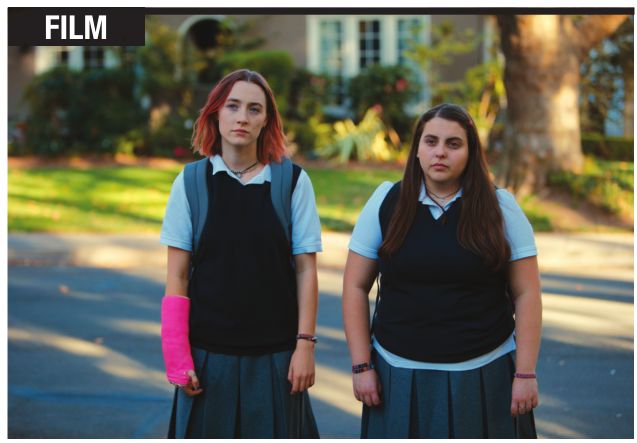
There’s nothing new story-wise where Greta Gerwig’s directorial debut Lady Bird is
concerned, yet the magic of the film is that somehow it seems that we
are seeing it, if not for the first time, with a sense of discovery.
There’s a light about the titular character, whose given name is
Christine, that we hope isn’t crushed by circumstance, self-doubt or one
bad decision. We see the passion, the potential and the curiosity
within her and end up hoping and praying that this vital young woman
gets her chance.
The empathy we feel toward Lady Bird is
due in large part to the ebullient performance of Saoirse Ronan. The
similarities between Christine and her character Eilis in Brooklyn are
obvious, but the actress’ approach to each role couldn’t be more
different. Being quiet and reserved is not part of Lady Bird’s makeup,
and Ronan brings a ferocity to the part that’s indicative of an
impulsive woman her age that acts without thinking and ultimately comes
to regret her actions. The actress is real in every moment of the movie,
never more so than when she’s begging her mother, Marion, for her
forgiveness over something she should never have to apologize for.
As the domineering
matriarch of the McPherson clan, Laurie Metcalf brings a realism to the
role that’s spot on. You’ve met women like Marion before – always a bit
frantic, ever the martyr, nothing out of her mouth but complaints or
passive-aggressive criticism – the kind of woman who means well but
leaves misery, which she’s happy to have caused, in her wake. The
actress inhabits the role like a second skin, and it’s to her credit
that Marion doesn’t come off as a one-note villain but rather a woman
who had her own hopes and dreams. She does want Lady Bird to succeed,
but on her terms, not her daughter’s – which proves to be her fatal
flaw.
There are so
many moments of pure delight as well as bracing reality in this movie
due to Gerwig’s witty script and subtle direction. This is never more
evident than in the work of Tracy Letts in the role of Lady Bird’s put
upon father, Larry. Out of work and browbeaten by Marion, he knows
exactly what his role is in the family and dutifully retreats most of
the time. That he stands up when his daughter needs him most is one of
the film’s most satisfying moments.
There’s
never a scene that feels calculated or rushed, never a line reading
that seems less than honest or heartfelt. These characters and their
lives have a lived-in feel to them that prevents the film from seeming
like just another coming-of-age story. Everyone involved put a bit of
their soul into their work and it shows, all of which contributes to
making Lady Bird one of the best films of 2017.
For a review of Three Billboards outside Ebbing, Missouri, go to the Cinemascoping blog at http:// illinoistimes.com.