Communal reading as tells a city’s story to itself
Unless we are blessed with
snow, December hereabouts can be a grim month, which might have been one
of the reasons that Vachel Lindsay decided to shuffle off this mortal
coil on the fifth of that month back in 1931. Which melancholy
reflection started a chain of thought that took me (mentally at least)
to the famed whaling port of New Bedford, Massachusetts.
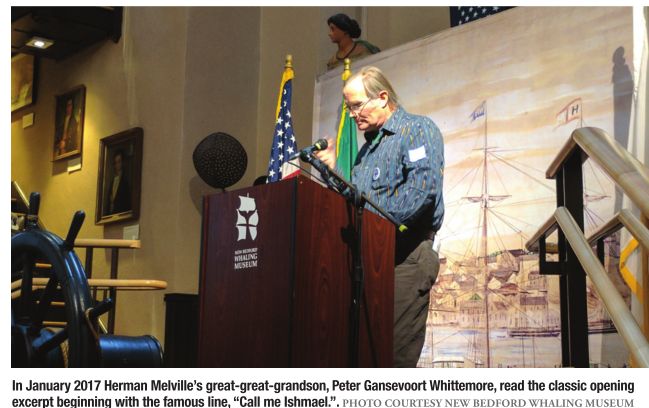
Every
January, the whaling museum in New Bedford hosts a Moby-Dick Marathon,
during which guest speakers and local volunteers take brief turns
reading aloud every word of Herman Melville’s 1851 novel. The mass
reading attracts fans of Melville, fans of whaling and patriotic New
Bedfordians, who are spared the necessity of reading for themselves a
novel that is more than 200,000 words long, rather a lot of which are
about knots. Grown-up fun.
People
reading together is not itself especially novel. On a cold February day
in 2011, hundreds of Springfieldians gathered at the old depot on 10th
Street to recite, in unison, Lincoln’s farewell to Springfield. The
intention was not, as in the blab schools of old, for the reciters to
learn the address, but to get themselves into the Guinness Book of World Records.
Such
silliness was not edifying, although it did suggest to the rest of us
why Lincoln might have wanted to leave town in the first place. (See “’A
neat and appropriate address,’” Feb. 24, 2011.) The New Bedfordians
began their gag as a promotion too, but it’s easy to see how communal
readings might achieve higher ends, even if they are inadvertent to the
noble purpose of museum promotion. Communal readings affirm the value of
the work, but the experience of reading and listening to the work also
binds the listeners to the work, to each other, and to the community
which (in the case of the New Bedfordians) figures as a setting for both
the work and the art.
Is
there a book about the Springfield area that might make work such
miracles? Lincoln’s letters seems a likely choice, as is the Autobiography of Peter Cartwright. So are the three chronicles of pioneer life (in Pike, Tazewell and Montgomery County) written by Burland, Farnham
and Tillson, respectively; the last could be read at New Salem,
assuming Ebenezer Rauner doesn’t sell it to a downmarket motel chain.
Then there are curiosities such as Marshall Kirkman’s historical novel, The Romance of Gilbert Holmes (1901);
young Holmes is on the run from villainy and danger in central Illinois
during the 1830s and emerges unscathed from enough wrecks, attacks,
murders and explosions to exhaust a comic book hero.
Or – and here we get back at last to Vachel Lindsay – Springfield might gather to read City of Discontent by
Mark Harris, the fictionalized biography of the poet. Lindsay chased
his own whale, in a manner of speaking, and like Ahab died in the
chasing. Springfield was both the villain and lover in that strange
story, which is not a history of Springfield or even of Lindsay,
although it comes very much closer to the former than the latter.
City of Discontent offers a moving coda and characters more genteel than Moby-Dick but
in their way nearly as dauntless – Willis Spaulding (see “Idealistic
thoughts,” Dec. 29, 2016) progressive editor V.Y. Dallman, Susan Wilcox
(Springfield High
School’s Athena), George and Maydie Lee (Spaulding’s sister), socialist
Duncan McDonald (see “Radical fellows,” Sept. 5, 2013) of the United
Mine Workers and of course, the poet himself.
Here’s a sample:
Through
the open window comes the Springfield smell, an odor Vachel has known
nowhere but here, an unnamable and unidentifiable smell, the odor of no
single thing, the compound of a hundred or a thousand objects. . . . It
is an admixture which in a laboratory might be analyzed and found to be
so much coal and so much corn and so much Brewery and so much railroad
and thus and thus many people, proportionately, and nowhere but in the
Springfield air are the proportions identical. . . . It assures him he
is home again, and here he would like to remain and . . . walk among the
people he knows and has always known, and stroll on Fifth Street and on
Capitol Avenue, and stand by Willis and fight for a lake and public
water, and stand by Duncan and fight for Duncan’s right to be heard.
I
can easily imagine his townspeople gathering (at his house, perhaps) to
make their own tramp through Harris’ book. It could be fun, and a way
to meet people you didn’t suspect existed in Springfield, and learn
about the artistic life and the progressive-era reformers whom he saw as
civic saviors. Spaulding, Dallman, et al didn’t do all they wanted –
reformers never do, which is why we keep needing them – but they did a
lot, even in a Springfield that was in many ways more benighted than
today’s. And that is something worth knowing.
Editor’s note
The
furor over sexual harassment has led to what is being called a “day of
reckoning,” with wrongdoers being held to account for their
transgressions. The reaction to past abuse, sometimes long past, is now
happening with lightning speed. By rapidly changing the culture that has
tolerated harassment, women are becoming empowered to change the
culture in other ways. They are reckoning the course to a future of
endless possibilities. –Fletcher Farrar, editor and CEO


