As the city’s overflow shelter opens for the winter, the homeless ask whether more can be done
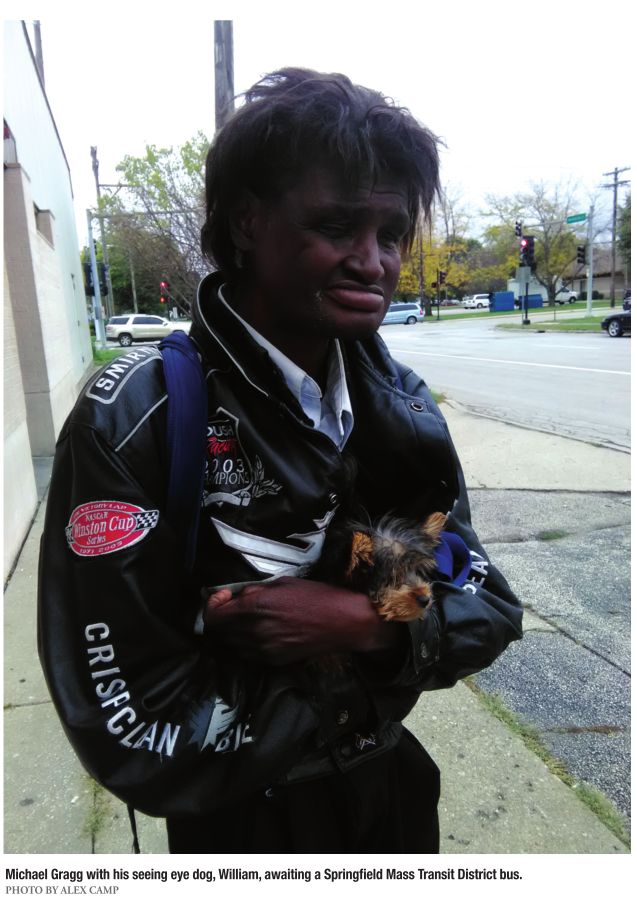
Sitting quietly inside an empty McDonald’s, Tracey and Michael Gragg ponder how they’ll find shelter for the night.
Married
for 18 years, the Graggs have been homeless for the last two. Michael’s
faltering physical condition has heightened the couple’s hardships.
Currently he is blind, has hypertension, kidney failure and Stage 5
renal failure. “We’ve been trying ever since then to find somewhere to
live, and with my husband’s failing health, it seems like every two
weeks we’re going to the hospital,” Gragg said. “At first, it was every
six months, now it’s more and more frequently. He’s given up because
he’s tired of being homeless and he told me that ‘I want to die. I’m
just tired of doing this and I don’t care.’ And that’s what it’s been
like. It’s an everyday struggle.”
According
to the Department of Housing and Urban Development, the number of
homeless people statewide has declined by nearly 20 percent since 2010.
Douglas Yul Holt, president and CEO of Searchlight, a social service
agency based in Springfield assisting homeless people, summed up the
impact of Springfield’s outreach towards homelessness in the last
several years. “The city of Springfield has been so generous and helpful
to the social services when we need
them,” he said in an interview. “A lot of people come here because the
homeless network has made it easy for them to take a step back and get
on with their lives. In some cases, you’ll see some guys who just got
out of prison in Chicago and they come to Springfield. This is because
it’s easier for them to make it and rebuild their lives here than it is
up in Chicago.”

However,
the budget crisis that crippled the state for two years has worsened
matters for the homeless community and service agencies supporting them.
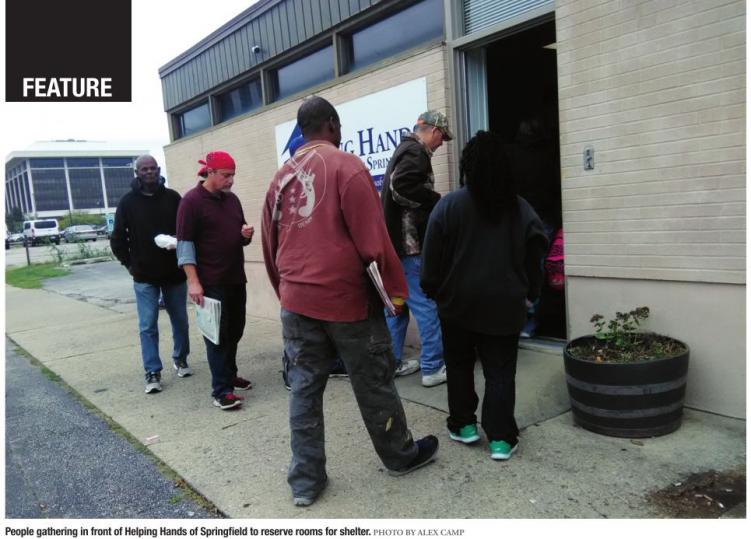
Helping Hands of Springfield, located at 1023 E. Washington St., is an
organization designed to combat homelessness and help those without a
place to live to build lives through providing resources and shelter.
Though
the state now has a budget, Holt said that the damage from the twoyear
state budget impasse made more people homeless. “Just because we have a
budget, it does not mean that it will be enough financially to make up
for what is already damaged,” he said. “You got people who lost their
jobs, there were people who lost their houses, and you had a lot of
families that deteriorated as a result. When you add what’s going on
around the country with natural disasters, when we do have the national
budget, we’re going to have resources pulled away that would’ve gone in
our state budget.”

Holt
said more men were left without shelter than women. “The biggest
problem facing our organization is that there are more men out on the
streets. This is not to take anything away from women and children, but
we don’t have a shelter in this city that strictly houses single men,”
Holt said. “I know a man who came here from Texas after Hurricane Harvey
with his wife and three children, and he ended up on the streets while
they found shelter. What we’re trying to do is fill the gap to make sure
all kinds of homeless people are sheltered.”
In May, the Salvation Army dropped its plans to open a homeless shelter, two years after it discontinued its
shelter operation, which had 52 beds for homeless men. Dana Wilford, a
local homeless man, was disappointed when the decision was made. “When
the Salvation Army decided not to open a shelter, it was tough. But once
the Warming Center opens up, that’s a little closure for the people on
the street,” Wilford said. “If the shelter could stay open year-round
like it is in Chicago, that would be a whole different story, because
we’re trying to help people to try and get better, not wallow in their
situation. But overall, it’s great just having a place for people to go
other than a parking garage, out in the street or sleeping under
buildings.”
Helping
Hands opened its emergency shelter this week. On Nov. 12, the Overnight
Warming Center, formerly named Springfield Overflow Shelter, located at
1015 E. Madison St., began serving as a shelter in addition to Helping
Hands. The Overnight Warming Center will be open 6 p.m. to 7 a.m. seven
days a week through March. It provides up to 60 homeless adults with
food and shelter every night during the winter season. Approved by Mayor
James Langfelder to use the same building as last year, the city of
Springfield made updates and repairs to the Warming Center in time for the opening.
Juan
Huerta, community relations director for the city of Springfield, is
working with Helping Hands to coordinate the Warming Center. With winter
on the horizon, Huerta acknowledged the sense of urgency in helping the
homeless.
“We are
working with a host of other agencies to get the word out to the
homeless community. As it stands now, we have room for 60 citizens every
night,” Huerta said. “Last year, dealing with bad weather, we only had
around 40 or so clients. There were only a few times when we housed 60.”
This time, however, Huerta says that the Warming Center will be better
prepared to house more clients. “Since we have the location and the
financial resources provided by the city, we’ll be promoting the Warming
Center to let people know that there is a place for people to go, stay
and have a meal every night,” he said.
Though
the Warming Center is offering to house the local homeless community,
the Graggs are an exception. On April 17 they filed a lawsuit against
Helping Hands before the Sangamon County District Court. According to
the complaint, the couple alleged that Helping Hands violated Title 3 of
the Americans with Disabilities Act (ADA), which prohibits
discrimination based on disabilities in employment, government
facilities and public housing. The former director “refused to let us in
there, because of his kidney, and she said they’re not a medical
facility,” Gragg said. “They are operating on the basis that, ‘Your
kidney is failing.’ My husband is not asking for anyone to dress him,
he’s just got to go to dialysis three days a week, that’s it.”
As
of Nov. 12, the Graggs’ lawsuit against Helping Hands was dismissed in
court. The couple is currently attempting to take the lawsuit to city
court as a result. “I researched the laws. I know the laws when it goes
down to evictions, and I know enough to know that you can’t do that,”
Gragg said.
This is
not the first time the Graggs have had an issue with Helping Hands. “The
year before, my husband had a certified seeing-eye dog, and when we
took him to the shelter, they threw him out because of the guide dog,”
Tracey remembered. “By ADA law, they’re required to accept seeing-eye
dogs. If you have a no-pet policy, there’s nothing required by law to
say you must allow a pet at the shelter, but there’s a difference
between a pet and a seeing-eye dog. A seeing-eye dog is trained
exclusively to guide a person, whether they’re blind or suffer from
mental illness.”
Through
the financial assistance of Huerta and the city’s community relations
department, the Graggs were able to secure an apartment during the
summer. However, the couple says that an
unruly landlord and unkempt conditions forced the couple to leave the
residence shortly thereafter. Back on the streets, the Graggs quickly
faced the prospect of being homeless with potentially tragic
consequences. “It got so bad I stopped taking my antidepressants, which
eventually caused me to attempt suicide,” Tracey said. “The
tranquilizers have a side effect that says that you can attempt suicide
on them, and they still gave them to me,” she added. After receiving
medical treatment, Tracey said she had another breakdown. “I was taking
the medicine prescribed to me and I don’t know how it happened, but I
attempted suicide again,” she said. “I don’t remember anything, and ever
since then I’ve had brain damage.”
Dana
Wilford, who is homeless, believes that the city can do a better job in
addressing the needs for the homeless. “This is the capital. The city
should have something that can allow us to come in. They have the
finances to do it. I can see the buildings that they
tore down to make more parking lots,” he said. “There are a lot of
places that they can build, but for the buildings that are already
there, it can be somewhere that we can reestablish. It may take a take a
million dollars to facilitate that, but until it gets done, situations
will only get worse.”
Wilford
said new shelters could be a place where homeless people can sustain
themselves to the point of seeking employment. “We should have a shelter
that could house people and get it organized in a way that people are
trying to maintain themselves,” he said. “For me, I’m trying to get a
job but I’m maintained throughout the year. I’m making my money which
means I don’t have to ask nobody for anything.”
Alex
Camp is a master’s degree graduate in Public Aff airs Reporting from
University of Illinois Springfi eld. He is currently a freelance
journalist. Contact him at [email protected].


