How a Springfield group transformed itself by intermittent fasting
In the guidebook for
Narcotics Anonymous there is a paragraph which begins: “We have a
disease; progressive, incurable and fatal.” The paragraph ends with the
sentence: “Insanity is repeating the same mistakes and expecting
different results.” Though this is in reference to drug abuse and
chemical dependence, these statements could be equally applied to the
epidemics of obesity, heart disease and diabetes that are running amok
in our culture. But happily, if the root causes are confronted early
enough, these diseases can absolutely be cured.
It is no mere coincidence that the prevalence of most of the non-communicable diseases of modern society
closely parallels the industrialization of our food sources. For
example, the Centers for Disease Control reported an 800 percent
increase in diabetes from 1960 to the present. The World Health
Organization reported that obesity rates have doubled worldwide since
1980. These dramatic increases coincide with a surge in what the FDA
calls “caloric sweeteners” – sucrose, from sugar cane and beets, and
high-fructose corn syrup. The only time in our history that saw
decreases in diabetes mortality was during World War I, when there were
sugar shortages and government rationing.
Despite all the popular
dieting strategies espoused over the last half century, the problem just
keeps getting worse. Modern medicine and the pharmaceutical industry
have failed to address the root causes and instead have focused on
developing new drugs, which merely slow down our demise and allow us to
function in our diseased state.
At
the risk of sounding like a conspiracy theorist, I contend that we have
all been duped by bad advice and faulty science – fueled by greed and
funded by the food and pharmaceutical industries.
From a Darwinian perspective, the ability to store fuel gave us a survival advantage during times when finding
food was hit and miss. We developed hormonal mechanisms (insulin) to
turn food that wasn’t needed at the moment into a storable form for
later use when food was not available. With the industrialization of our
food sources (i.e. processed foods), finding our next meal became
predictable and convenient. Our beliefs on what constitutes proper
nutrition have come from flawed, biased sources motivated by profit. We
have been cunningly marketed to by the food industry and have become
addicted to these products.
The story of how the sugar industry funded scientific research and spent millions on PR campaigns to downplay
negative health effects of its product sounds very much like the story
of collusion by the tobacco industry. Similar stories abound throughout
the processed food industry. For example, the assertion that “breakfast
is the most important meal of the day” did not have its origin in
tradition or science. According to Heather Arndt Anderson, a plant
ecologist and food writer and author of Breakfast: A History, it
was actually socially and morally frowned upon to eat breakfast until
about the 17th century. In 1917, the self-proclaimed “oldest health
magazine in the world,” Good Health, wrote “in many ways, the
breakfast is the most important meal of the day, because it is the meal
that gets the day started.” None other than Dr. John Harvey Kellogg, the
inventor of flaked breakfast cereal,
edited the magazine. Thirty-five years later, what had its origins as
“health food” morphed into what is essentially highly profitable
sugarcoated breakfast candy.
Arising
from the long-term deleterious health effects of processed foods is the
highly profitable weight loss industry, which market research firm
Market Data Enterprises
estimated in 2013 to have reached $66 billion: “The U.S. weight loss
market promises to be as dynamic as ever.” It estimated that 108 million
dieters in the U.S. make 4 to 5 dieting attempts per year. It also
predicted that two newly approved diet drugs would add an additional
$200 million to the $450 million U.S. obesity drug market.
Despite
all these efforts, we have not been able to buy a solution to the
problem. Even trusted “objective” sources such as the U.S. Department of
Agriculture and FDA have been influenced by the sugar industry.
Meanwhile obesity, heart disease and diabetes rates keep rising.
“We must stop prescribing medicine for the disease of food consumption!”
Dr. Diane Hillard-Sembell
According
to CrossFit Instinct trainer Mike Suhadolnik of Springfield: “Everybody
knows obesity is a health tsunami in the making. Nobody is addressing
the root cause. Especially nobody without commercial interests.”
Suhadolnik was trained as a mathematician and taught at the college
level. He said that in mathematics there is “a ton of problem solving.”
He looked at the escalating health problems in our society and saw a
major problem needing to be solved. At age 74, he “wanted to continue to
grow. Do something that needed to be done. Something meaningful that I
could believe in without reservations.”
Suhadolnik became aware of the impressive results coming out of the clinic of Toronto nephrologist Jason Fung, author of The Obesity Code. Fung
attributed obesity to the development of insulin resistance and
advocated a specific diet and a protocol of intermittent fasting
[confining eating to a certain number of hours of a 24-hour day, with no
eating during the other hours]. Suhadolnik was not able to find any
other outside objective clinical studies replicating and confirming Dr.
Fung’s results. He decided to conduct his own trial. “We had a group of
dedicated participants in our CrossFit Longevity program whose trust I
had earned. They were always interested in new ideas for their health
improvement.”
The time was right. Springfield
physician Craig Backs, a member of CrossFit Instinct’s Longevity group,
had just acquired a device that non-invasively measured skeletal muscle
mass and body fat, specifically the potentially deadly “visceral fat”
that forms around our vital organs. The device, known as an InBody,
could perform these analyses in less than five minutes.
Suhadolnik now had a means
of accurately measuring the effects of intermittent fasting. He set up a
90-day intermittent program that included assessments at day 1, 30, 60
and 90. He knew that compliance throughout a 90-day program would be a
challenge. “Something would have to be done to hold the participants
responsible. After all, they were human beings.” The key would be to
send an informative motivational text message to the participants every
morning.
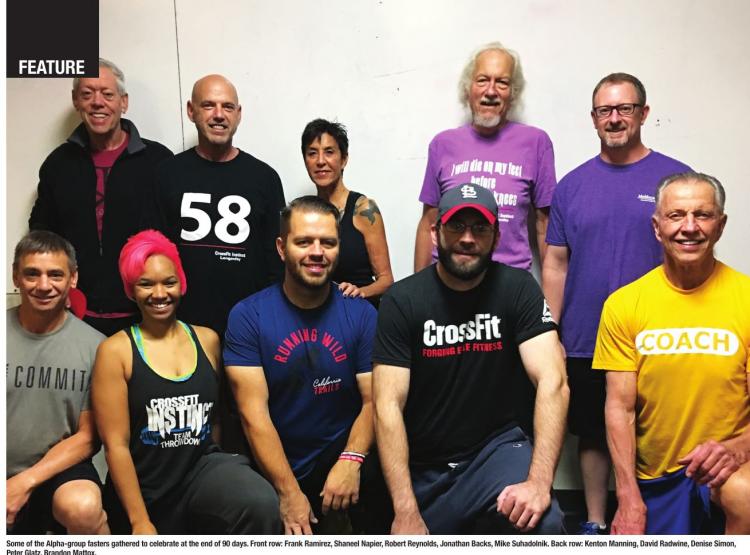
On July 22,
20 individuals made a 90-day commitment to participate in an
intermittent fasting regimen study. The protocol not only dictated what
to eat, but when to eat. These were the guidelines:
• No sugar or processed foods
• Balanced meals: 30 percent protein, 30 percent healthy fats, 40 percent non-starchy carbohydrates
• Drink at least 128 ounces of water throughout the day
• Restrict eating to 8 hours or less and fast for 16 hours or more
• No snacking between meals
• No foods within 2 hours of bedtime
• Work out 4-6 days a week to build skeletal muscle mass through varied highintensity functional movements
One of the participants was
Dr. Diane Hillard-Sembell, a sports medicine physician and orthopedic
surgeon. In addition to treating athletic injuries, Dr. Hillard- Sembell
performs total joint replacement surgeries. She finds that a high
percentage of patients requiring total joint replacement surgeries are
obese and diabetic or prediabetic. She writes: “In some ways I have
become like a nutritionist trying to counsel so many. Most physicians
received very little nutrition training. Jason Fung, M.D., has
eloquently explained how traditional approaches have been unsuccessful
in weight loss and how our constant state of being ‘fed’ leads to
insulin resistance. We must stop prescribing medication for the disease
of food consumption! Insulin resistance and resulting inflammation are
the root cause of so many of our modern-day diseases. The young athlete
seeking elite performance, the parent, coach and grandparent can all
benefit from eliminating sugar and processed foods, consuming lean
proteins and healthy fats, avoiding eating for at least two hours before
bedtime, and allowing a minimum of a 12-hour interval without eating to
allow the stored glucose to be utilized.”

The
impact on the lives of the participants has been dramatic. Lori Fragier
is a 66-year-old retiree and grandmother of eight who has exercised
most of her life. “My thought has always been I could eat what I want as
long as I work out,” she says. “Well, that’s simply not true. You can’t
exercise enough to compensate for a bad diet.” After attending an
informational seminar hosted by Suhadolnik she decided to participate in
the fasting study, using an 8-hour eating window and 16 hours of
fasting every 24 hours. Lori: “After listening and hearing all the
benefits, I thought, ‘I can do this!’ So on Aug. 30, 2017, I began.
Since then I have lost over 25 pounds, I’m down three dress sizes and,
more importantly, my visceral fat is well within an acceptable level. My
plan is to continue 8/16 as my way of life.”
Denise
Simon, 70 years old, found the changes to be difficult, but. “For me it
was necessary. I was a serious sugar addict; my weight was increasing
and my energy decreasing. I wanted to get my life back, to look better,
feel confident and be healthy. Intermittent fasting was a new concept
for me but from day one of my commitment to convert my lifestyle both
mentally and physically, I felt great. Coming totally off of sugar was
difficult but after two weeks I felt strong. I lost a significant amount
of weight, but that by itself doesn’t compare to the improvement in my
health. My visceral fat level decreased to a very low level and I have a
bounce in my step.”
Frank
Ramirez, 58, of Springfield, had already made dietary changes in the
past year that allowed him to go off his insulin. “When I was approached
to join the intermittent fasting group, I was reluctant. I had already
modified my food choices to control my diabetes 2 that I
was diagnosed with in late October of 2016. After a little
investigation I decided to join. I now eat in an eight-hour period that
enables my immune system to heal itself. I use exercise along with
meditative time to help change my behavioral eating habits. I am seeing a
reduction of body fat and weight while increasing muscle mass. Today I
am on my way to optimal health.”
Musician
Robert Reynolds, 38, almost gets teary-eyed when he tells his story:
“When I started at CrossFit Instinct in 2014, I was almost 335 pounds.
Initially a significant amount of weight came off rather quickly.
However, it seemed like there was this wall that I just couldn’t get
past. Oh, the dreaded plateau. What I would eventually discover was that
the real culprit here was my nutrition. My thinking was that I could
just outwork my unhealthy lifestyle in the gym. I was wrong. Coach
Suhadolnik introduced the concept of 8/16 intermittent fasting to me. So
with the new program in place, I started quickly seeing results. This
year I have lost over 70 pounds, come down three pants sizes and, from
what I’ve been told, look like a completely different person. I began
this journey shortly after my daughter was born. More than anything else
in this world I want to be there for her for as long as possible. And
so while this journey had its share of challenges, I have been able to
stay on course because of the promise I made to my little girl.”

Walt
Lynn of Springfield is a 66-year-old CPA who lives by the numbers. “In
business you manage for what you can measure. Each of us has goals we
are committing to and moving towards in our lives. My numbers keep
improving with the InBody and blood work that our resident
CrossFit doctor – Dr. Backs is a gift! – is monitoring. I am amazed at
my progress in the 90-day fast.” To Lynn, the benefits go beyond the
physical into the realm of the spiritual. “There are other pieces to
this puzzle. There is a community and tribe that works beside you each
day to improve individual health in our CrossFit box. We share our
stories and start to understand our possibilities. It is a gift we are
giving to ourselves to make our lives better as well as having a
productive impact for our families and the world. It seems your purpose
in life is mentally and spiritually clearer with fasting.”
These
are a few of the success stories coming out of the study. I personally
have progressed from pre-diabetic, dangerous visceral fat levels to a
“healthy” state. I’ve been able to quit taking the blood pressure
medications that I’ve depended on for 30 years. I’ve slimmed down from a
size extralarge to a medium. Most importantly, I have made lifestyle
changes that will allow me to enjoy an active, vigorous life in my
golden years. As I watched my peers struggle with chronic health issues,
I recalled the line from a Robert Browning poem, “Grow old along with
me; the best is yet to be.” I used to think: “What a cruel joke!” I know
differently now.
Contact Peter Glatz at [email protected].
A
public informational seminar presenting the experiences of the fasting
group will be held on Tuesday, Nov. 21, at 6 p.m. at Springfi eld Clinic
at 900 N. First St. Free parking is available in the adjoining parking
garage to the north. Enter into the fi rst fl oor and turn left into the
fi rst hallway to the media room.


