While attending one of
Urbana’s Prairie Fruits Farm and Creamery’s Farm To Table Dinners, I
asked owner Leslie Cooperband if I could “stage” (work as an unpaid
apprentice) for one of their events. Guest chefs, often from Chicago,
would come down to the farm to create amazing meals, eaten communally
outdoors. I was hoping my participation would lead to opportunities to
stage at some of Chicago’s finer restaurants. I was a bit disappointed
when she told me I could work the Cucurbit dinner. Cucurbit? I wasn’t
even sure what cucurbits were – and instead of a big-name celebrity chef
from Chicago, the meal would be prepared by the house chef. The special
guest was a farmer from the Great Pumpkin Patch near Arthur.
Learning that cucurbits were pumpkins, squash, gourds and
cucumbers did not do much to ignite my enthusiasm. However, shortly into
the work experience, I realized a whole new culinary world was opening
up to me. I found out that the special guest, Great Pumpkin Patch owner
Mac Condill, was perhaps the world’s greatest authority on cucurbits and
was a major player in preserving agricultural diversity as a
seed-saver. His knowledge, passion and engaging personality quickly won
me over.
We prepared
appetizers with thin slices of pickled squash. We made butternut squash
soup with miso. We roasted crescent-shaped slices of thin-skinned
delicata squash. We barbequed whole kabocha squashes in embers. Squash
even formed the basis for dessert: “A selection of Prairie Fruits Farm
Cheese with Squash Preserves and Squash
Membrillo, Squash Seed Cracker.” I enjoyed helping to prepare the farm
dinner so much I volunteered to help Prairie Fruits Farm cater a special
dinner event the next day at the Great Pumpkin Patch near Arthur.
Prairie
Fruits Farm allowed me to camp overnight in Bertha Bus outside the goat
barn. After being on my feet for two days chopping and slicing, the
cool September night on the prairie quickly lulled me into a deep
slumber. I was awakened at sunrise by the sounds of roosters crowing and
babies crying. It took a moment to figure out where I was and that the
“crying babies” were actually goats.
I
was up before the kitchen staff arrived so I checked the prep list and
picked cherry tomatoes and edible flowers from the kitchen garden and
made a frittata for the morning crew.
After
everyone arrived we finished lastminute prep and loaded my bus with
tubs of food and headed out to Amish Country. As Bertha Bus neared its
destination we encountered Amish horse-drawn buggies. When I arrived at
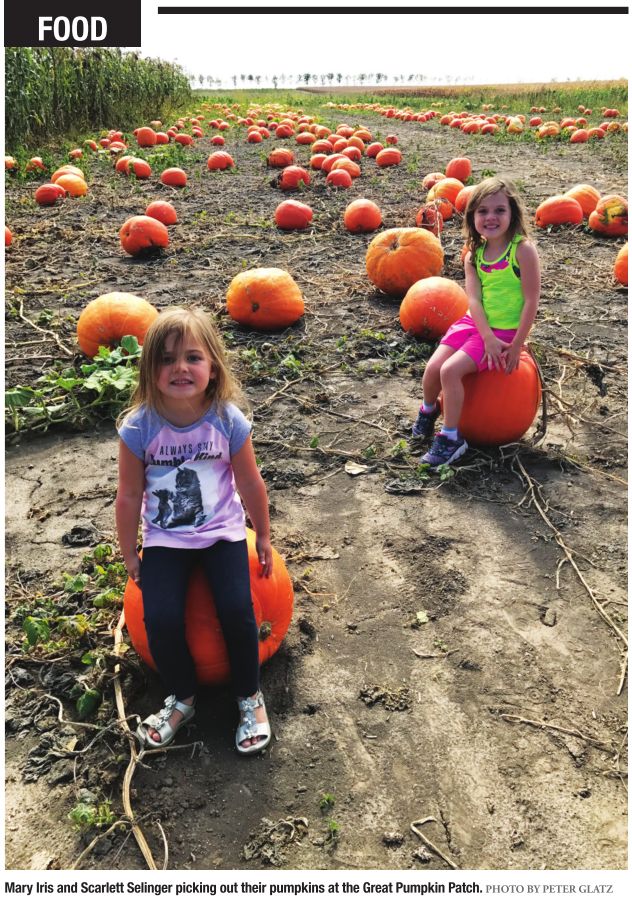
the Great Pumpkin Patch I felt like I was at a homespun version of
“Disneyland on the Prairie.”
In
1859, Frank McDonald, an immigrant from Scotland, came to east central
Illinois near Arthur to purchase land through the Homestead Act and
started a family farm that has been in the family for six generations.
In 1967, his great-granddaughter, Mary Beth, married Bruce Condill and
after serving together for a year in the Peace Corps in Uganda, Mary
Beth and Bruce returned to the family homestead in 1971 to begin their
family.
In 1977, Mary
Beth planted a few pumpkin seeds in their children’s garden. Now, 29
years later, their son Mac owns The Great Pumpkin Patch and is growing
63 acres of pumpkins, squash and gourds. It has become a major
agritourism destination with over 60,000 visitors a year. The farm was
featured in the October 2005 edition of Martha Stewart Living and
Mac appeared on Martha’s show. In 2009, he convinced the Obama White
House that it needed an outdoor Halloween display and drove a U Haul
trailer loaded with pumpkins down Pennsylvania Avenue. After having his
load inspected by bomb-sniffing dogs, Mac and his family erected a
towering pumpkin display on the White House lawn and helped the Obamas
pass out treats to 2,000 trick-or-treaters.
The plant family Cucurbitaceae is
one of the most diverse on the planet with more than 2,000 varieties.
The Great Pumpkin patch grows over 400 varieties of cucurbits from over
30 countries. And I wanted to try them all! As I loaded my wagon with
over $60 worth of exotic squash and pumpkins I felt a bit of guilt. I
was always critical of my wife’s tendency to buy more produce at farmers
markets than we could ever consume. What was I going to do with over 30
pounds of warty multicolored squash?
Fortunately
winter squash keeps well for three months or more if stored in a
basement where circulation is good and the air is cool and dry. The
higher the temperature, the greater the weight loss due to respiration
and water loss.
Caution
should be exercised when cutting up large winter squash. It takes
considerable force to cut through the hard skin and your fingers will be
at risk of dismemberment. The preferred method is to lift the squash
over your head and drop it to the floor over newspapers; it will break
apart into large chunks.
The
following recipe may leave you with extra squash left over. Place the
extra chunks, cut side down on a baking sheet in a 400-degree oven and
bake for 25-45 minutes, or until tender. Scoop out cooked meat and blend
until smooth, adding a little water until you reach your desired
consistency. Freeze in plastic containers or zip-top freezer bags.
CURRIED WINTER SQUASH AND APPLE BISQUE
• 1 large winter squash
• 3-4 tart apples such as Jonathan or Granny Smith
• 6 cups chicken stock, plus additional if needed
• 1 ½ cup thinly sliced onions
• 1 tablespoon minced ginger
• 1 tablespoon coconut oil
• 1 cup coconut milk
• 1 tablespoon curry powder
• Kosher or sea salt and freshly ground pepper to taste
Peel
the squash and scoop out the seeds. Cut into 1-inch chunks. You should
have about 6 cups. Winter squash vary a lot in size, so if you have
less, cut back proportionately on the other ingredients. Peel and core
the apples and cut into chunks.
In
a large Dutch oven, heat the coconut oil over medium heat. Add the
onions and ginger, stir to coat and cover the pan. Sweat the onions and
ginger until they are softened, about 5 minutes. Add the squash and
apples and pour in the chicken stock. Bring the mixture to a boil,
reduce the heat to a simmer, cover the pan and cook for 20-30 minutes,
or until the squash and apples are completely cooked.
Purée
the mixture with a hand held blender, food processor, blender or food
mill. Cool the mixture before using the blender or food processor – hot
ingredients can “explode” in them.
Return
the mixture to the pan whisk in the coconut milk and curry powder.
Season to taste with the salt and freshly ground pepper.
This recipe freezes well. Serves 6-8.
Contact Peter Glatz at [email protected].