HISTORY | Scott Faingold
“You, as individuals, are
very significant to the success of a project like this,” said Floyd
Mansberger of Fever River Research, addressing a group at Union Baptist
Church Sept. 18. The project being discussed was an architectural survey
to create a record of the African-American experience in the
Springfield area beginning with the city’s initial settlement.
Mansberger explained to the assembled group that the personal knowledge
of community members would help identify significant people, places and
events worthy of inclusion in the study.
Mansberger
and Fever River, working in partnership with the Springfield and
Central Illinois African-American History Museum, have been tasked by
the city to take a close look at a large area on the greater east side
of Springfield ranging from Clear Lake Avenue to South Grand and from
Tenth Street to Wirth Avenue. Although they have conducted a wide range
of cultural resource management, architectural history and historical
archaeology projects for the city since opening their offices in 1985 –
including surveys of the west side capital area, Enos Park and
Aristocracy Hill – the current project, encompassing approximately 43
acres and containing 1,369 buildings, is their largest yet, according to
Mansberger.
Due to
the daunting size of the area, Mansberger said that the project will be
in the form of what he called a “windshield survey.” “We’re not going to
inventory every building out there, we’re going to do a drive-through
looking for the more significant buildings, the buildings that we feel
have both historical significance and architectural integrity.”
According to Mansberger,
the National Park Service and the National Register system recognize
significance of historic properties based on four different criteria:
social history (events that contribute to our collective past); notable
people; the architecture itself (specific architectural style or type of
construction method) and archaeology. “Even if there’s a building that
doesn’t just stand up and say, ‘Hey, I’m significant!’ there is often
material under the ground that can contribute to our understanding of
that event or that person or place,” Mansberger explained.
The
process involves finding a building associated with a particular event
or person. There is a wide range of historical resources which come into
play, including atlases, public records, contemporary newspapers,
published histories, historic photograph collections, building surveys
of the landscapes and oral histories. Mansberger said that federal
census records can be extremely helpful, as can city directories. “The
Springfield city directory from 1876 has a seven-page inventory of the
African-American community in the city,” he said. “Another one wasn’t
published until 1926, but it went into great detail over the length of
50 or 60 pages.”
Some of the treasures that have come to light so far include the Negro Motorist Tourist Book which
was published between1936 and 1964 and provided vital safety and
lodging information for black families traveling across the United
States during the era of Jim Crow, including a recommendation for
Springfield’s Dudley Hotel. “Some of these places that are still
standing may not look like much but they may have
integrity or significance to our collective history,” said Mansberger,
mentioning establishments like the Boston Richie moving company and the
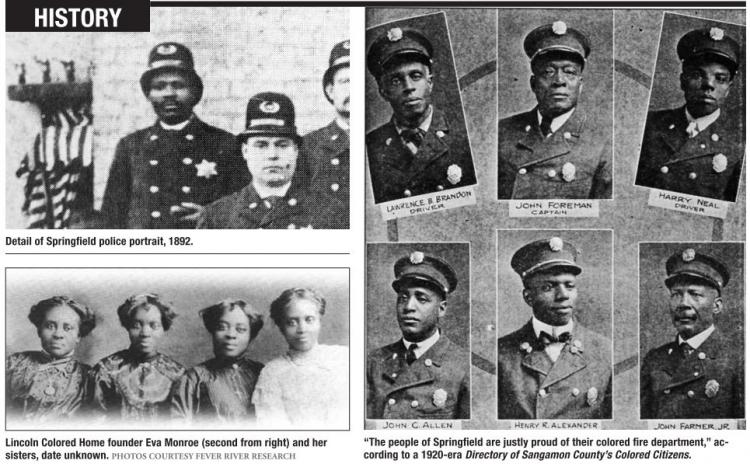
Lincoln Colored Home, established by Eva Carroll Monroe, who also
established the Springfield Colored Women’s Club. During the
presentation, several of the community members at the meeting provided
insight and context for some of the slides Mansberger projected. One
woman even pointed out her aunt in a group photo of several youths taken
in the 1920s.
The
National Register of Historic Places, a federal program, along with the
National Parks Service and the former Historic Preservation Agency (now
part of the state Department of Natural Resources) are all providing
support for the project, which has long-term ambitions beyond the east
side of town. (The city is providing $9,240 worth of funding in addition
to a $20,560 heritage grant from IDNR.) “We’re going to look at
African-American settlement in all of Springfield, develop that history
and context and specifically look at buildings in particular
neighborhoods,” said Mansberger. “That way, it can be built upon over
the years so the project can include buildings in other parts of the
city.”
If you would
like to share information with the project regarding events, people and
places significant to the African-American community in Springfield,
Floyd Mansberger can be reached via email at [email protected] or by telephone at 217-341-8138.
Contact Scott Faingold at [email protected].