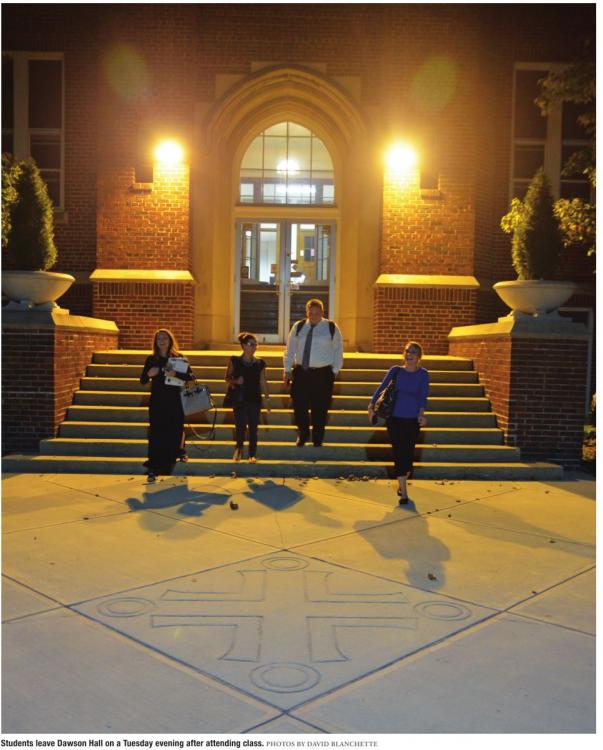
Bram Stoker would have liked this school.
“Just drive by at night,” said Benedictine University Springfield Campus Director Janet Kirby.
“It
has taken time for the community to understand that we are still here,
we are teaching students, we are alive and creating great stories.”
Kirby
was among the 25 of Benedictine’s 100 employees who survived following
the announcement three years ago this month that the university would
end its undergraduate program for traditional students with primarily
daytime classes and focus instead on nontraditional, or adult, students
who are served mainly with night classes.
“I’m
comfortable that we have made that transition. We really do serve adult
students now,” Kirby said. “We can serve a lot more, and we are going
to be working to build enrollment” from the 240 students now taking
courses through the institution’s School of Graduate and Adult
Professional Education, she said.
That
adult education emphasis means Benedictine has a focused curriculum.
The school offers bachelor’s degrees in Management, Psychology, Criminal
Justice and Nursing; master’s degrees in Business Administration and
Management and Organization Behavior; a Master of Education in Reading
and Literacy; and a Ph.D. program in Organization Development.
“The academic offerings are solid as a rock.
We
understand what it takes for adult students to be successful,” said
Kirby, the recipient of a master’s degree and a PhD from Benedictine.
“We have small classes and we have a lot of support.”
That
support is vital because many of the students have not been in college
for some time or have never been to college. The new adult education
format means there is no formal academic year, although students may
sometimes have to wait for the class they want to be scheduled.
“As
soon as we have enough students to fill a group, which is 10 to 15, we
will create a calendar and within approximately 30 days classes will
begin,” Kirby said. “That marketdriven process means that students
aren’t held up by waiting for a traditional semester to begin. Once
someone makes an application the adviser is in communication with them
and helps keep them prepared.”
This
nontraditional higher education approach for nontraditional students
seems to be working for Elizabeth Coe, a Springfield teacher pursuing
her Master’s of Education degree at Benedictine. She and her classmates
attend one four-hour night class per week and do eight to 12 hours a
week of hands-on and online work outside of the classroom.
“I
think the adult education format works great,” Coe said. “It does put a
little more pressure on the student, but since I recently graduated
from college four years ago, I’m sort of used to it.”
Springfield
first grade teacher Ashly Borders is also pursuing her Reading
Specialist master’s degree at Benedictine. She has no ties to the way
things used to be on campus, and thinks the current adult education
format is ideal.
“I am a parent, it’s just
one night a week, and that helps because I don’t have to worry about
scheduling,” Borders said. “The stuff we cover fits right in with what I
am teaching in the classroom.”
“I
couldn’t get this type of program anywhere else that’s close by, and at
the bigger universities tuition is so high,” Borders said. “My daughter
just started preschool this year so she’s like, ‘Oh, mommy’s going to
school just like me.’” Coe, Borders and their fellow Reading Master’s
students gathered one recent Tuesday evening in their Dawson Hall
classroom. Many used laptops, some took written notes, and all were
identified by colorful nameplates of the type you might find in the
classrooms where they all teach during the day. The instructor, a fellow
teacher, spoke to them as experienced equals.
Upstairs,
more than a dozen people, some in sweats and a few who had obviously
come from work, received orientation for an upcoming Master’s in
Business Administration course that would start before month’s end.
Their number had reached critical mass to get the class scheduled, and
now the nearly year and a half journey toward an MBA was about to begin.
The
campus lot and North Fifth Street were filled with parked cars. Lights
glowed from campus buildings and shadows danced as students moved
through hallways. Bookand-satchel-laden students hit the exit doors and
headed into the evening after their marathon class sessions concluded.
“It’s
mostly adults, so it’s really career- and goal-oriented,” said
undergraduate psychology student Cassandra Winters of Springfield. “You
have mostly like-minded people, whereas in a traditional college you
might have someone who’s not sure what they want to do and they could be
a distraction. But here, everybody has a plan and a goal.”

“My
sister was going here first and she told me about it. She told me how
quickly she got her degree and how nice the teachers and students were,”
Winters said. “You have a lot of support. If somebody is missing
they’ll call, if people get discouraged you encourage each other.”

The October surprise
That
encouragement was needed in a different way during October 2014 when
Benedictine announced the layoffs of three-quarters of its staff and an
abrupt, fiscal-driven change in direction for the institution.
“It felt like a part of you was being cut off.
It
was really sad, there were a lot of tears shed by faculty,
administrators and students. It was a pretty hard blow,” said
Springfield Campus Director Kirby. “But I had written my doctoral
dissertation on this place, so I knew the financial challenges.
“Change
is disruptive. But as you get through disruption, you end up in a
better spot,” Kirby said. “I think we are a great example of that.”
Amy
Lakin is the Director of Student Academic Support Services and Design
and has been at Benedictine since 1997. She was a tenured professor
there when the October 2014 surprise came.
“I was absolutely heartbroken,” Lakin said.
“It was like going to a funeral every day. It was really, really hard.”
“I
had been teaching full time for 15 years and I really thought that’s
all that I would ever do. After the announcement I thought I would turn
into a cranky, middle-aged person who hates her job,” said Lakin, who
was offered the option to make the lateral move into her current
position. “But I absolutely love my job, and I honestly didn’t think I
would ever be able to say that again. I am fortunate to really like what
I do, and I know I make a difference with what I do.”
Lakin’s
job is to make sure that students have access to resources that help
them to be academically successful. Her work crosses Benedictine’s four
campuses in Lisle, Naperville and Springfield, Illinois; Mesa, Arizona,
and at numerous academic partner locations. An estimated 2,300 students
on all Benedictine campuses benefit from her efforts.
“From
time to time I do miss teaching undergraduates. There is a certain
energy you get from a classroom full of 19-year-olds,” Lakin said. “But I
don’t miss grading at all, and I don’t miss having to be their second
mom.”
“This is a different beast. Traditional programs and adult programs are two completely different worlds,” Lakin said.
Professor
of Education Pat Braun has experienced both different worlds as well.
She too was caught up in the Benedictine transition.
“We
were all panicking. Students were upset, so the professors had to
pretend and go, ‘Oh yes, I knew what was going on,’” Braun said. “But it
was pretty much a surprise, and people don’t like surprises in October
when the semester has started.”
Braun
taught undergraduates prior to the change and currently teaches in the
Master of Education in Reading and Literacy program.
“It’s
a totally different population because now my only students are already
teaching. They need to have two years of experience teaching as a
licensed teacher in Illinois in order to finish this program,” Braun
said. “There’s really no other place for central Illinois teachers to go
for a master’s in Reading.”

Adjunct
Professor Mickey Elliott is in her first year at Benedictine. She
doesn’t know what teaching was like at the school before the transition,
but feels the students in her classes benefit from the nontraditional
format.
“Most of my
students are moms too, so they come straight from school and go to 8:30
at night,” Elliott said. “I am amazed at the pace of it. As they are
teaching all day, they are putting in a lot of reading and different
projects with kids during this five-week course.”
“The
new standards demand that a teacher teaching reading or working with
adults needs to have their Reading Specialist degree or their master’s
degree in
reading,” Elliott said. “So when I found out that Benedictine had it, I
was just blurting it out everywhere. We are filling a huge, huge gap in
this part of the state.”
Seeing
the Benedictine campus only gives you half of the story. The
Springfield branch campus serves an area roughly bordered by Peoria,
Danville, Decatur, Litchfield and Jacksonville. The school has
partnerships with the Springfield Urban League, Memorial Health System,
Unity Point Health in Peoria and the Peoria Regional Office of Education
in Edwards. It has site agreements with Lincoln Land Community College
in Litchfield and Richland Community College in Decatur, and would like
to serve Jacksonville with educational programming.
The
Tuesday night Bachelor of Science in Nursing class at the Memorial
Center for Learning and Innovation gives easy access for nurses already
working at the hospital, who can attain the advanced degree in 12 to 14
months.
“I very much
wish I had something like this when I was getting my degree,” said
Valerie Ellinger of Taylorville, who coordinates and teaches in
Benedictine’s Bachelor of Science in Nursing program. “When I was
working toward my bachelor’s degree in nursing I had to travel all the
way to the Alton area to get it.”
“These
people are working nurses, and they are able to work during the day or
the night, depending on what shift they have, and then they can come to
class,” Ellinger said. “They are also able to do their class work at any
time during the day because you post assignments on the internet.”
Leslie
McKnight is a professor in the Benedictine MBA program at the Unity
Point Health campus in Peoria. She also teaches at Bradley University in
the undergraduate Management and Leadership Program.
“I
do prefer the adult learners because you can come to them with more
practical approaches and they can share their workplace experiences,”
McKnight said. “They are managing home, family, work and school, so it
is a different dynamic.”
“Many
adult students are either middle managers or entrepreneurs, they are on
a track for CEO or key positions, so they need to have the academic and
practitioner skill sets for those levels,” McKnight said. “Benedictine
is working with our largest employers in Peoria and seeing what their
educational goals are for their employees and then creating a curriculum
that can benefit the organization and the employee.”
One
employee who benefits from the arrangement is Blake Long, an MBA
student at the Unity Point Health campus where he also works full time.
“There
are other courses here in Peoria that require weekend classes or
classes during the week and that’s really hard to balance when you have a
career,” Long said. “It would have been more expensive and
time-consuming to go for this degree through a traditional approach. I
could not have just quit work for a couple of years to enroll in a
full-time program.”
“It’s
an accelerated format with a large workload. So you go to work all day
and you go to class on Tuesday nights, and the other evenings and the
weekends you have studying to do, homework to do and group work to
complete,” Long said. “It’s definitely not something you can take
lightly, and you have to be really committed.”
Springfield
campus faculty member Mark Clayton, who teaches in the undergraduate
Management program, likes the classroom dynamic when the students are
working adults.
“The
students grasp it a lot quicker than if you have a typical undergraduate
program where people don’t have that working experience,” Clayton said.
“It’s funny to see some of the banter back and forth, these students
have been together a while, you can tell they are comfortable learning
with each other, they do not withhold any type of creative thought
process.”
“They are
really trying to apply not only what we are learning in the classroom
but using their professional experience as well,” Clayton said.
Benedictine
is part of a statewide trend toward more market-focused higher
education. The Illinois Board of Higher Education reports that online
and “blended” – or combination on-campus and online – enrollments are
increasing at Illinois’ higher education institutions. Illinois colleges
and universities reported 363,168 enrollments in online and blended
courses during the spring 2017 term, a one percent increase from the
previous year. Blended courses accounted for 46,409 enrollments, or
12.65 percent of all enrollments for spring 2017.
The lonely campus
The curriculum may be nontraditional, but
the Benedictine campus is another story. Remarkably intact historic
buildings make up the campus, and some are being used for adult
education classes or administrative purposes, including Dawson/Weaver, Brinkerhoff, Becker and Angela Hall.

Other
historic buildings sit idle. Dockson Plaza will be sold. Mueller,
Hanlon and Mueth Halls are viewed by the university as good, marketable
commercial real estate. The Eighth Street Gym was sold and now hosts a
number of sporting events.
“The
old Ursuline Hall, Chapel and Conservatory were already in not great
shape when Benedictine came to town,” Kirby said. “We are hoping to come
up with ways to refurbish some of those spaces and use them. In fact
there are things being discussed right now with the arts community and
the mayor’s office that are really new. We’ve been included in the
proposed North End TIF District so that might create some opportunity.”
“We
can’t promise anything, but we definitely know the value they have for
the community and we’d love to be able to partner with people to
refurbish and restore those buildings,” Kirby said. “Demolition is not
even a conversation at this point. Preservation is very expensive, but
so is tearing down buildings, and we have no plan to do that.”
Meanwhile, the modern issue of parking means the historic Benedictine campus has come to life again, if mainly after dark.
“Some
people are used to being able to just pull up and park, but on class
nights you have to be a little more strategic on where you are parking,”
said Benedictine Student Advocate Scott Raper. “When we start to have
people park in our lot over here across the street again, that’s a good
sign.”
Raper’s job is
to serve as a resource when students have issues with an instructor or a
specific class, if they have something going on in their personal
lives, or if they have suggestions or ideas regarding what Benedictine
could do better. Raper was a survivor of the October 2014 surprise.

“There
was a lot of negativity, the communication wasn’t very good to the
community as to what was going on at this campus,” Raper said. “We’ve
worked very, very hard to let people know that hey, we’re still here,
this campus is open, this is what we’re doing here, and I think we are
just starting to turn that corner.”
David Blanchette is a freelance writer from Jacksonville and the co-owner of Studio 131 Photography in Springfield.


