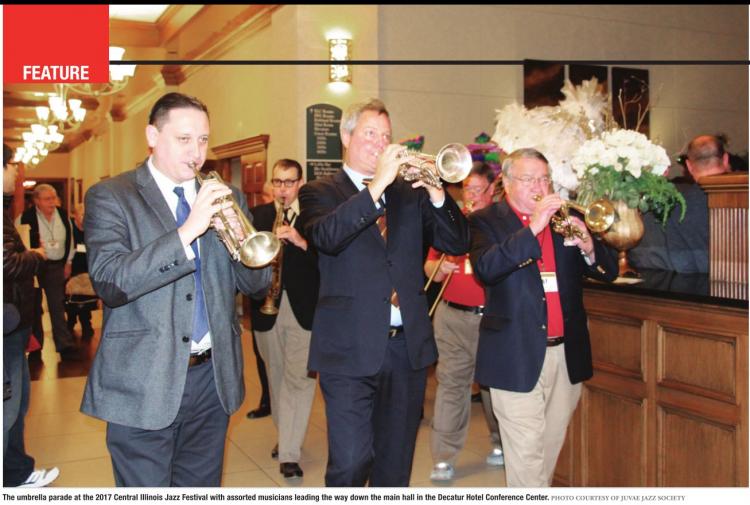
Once upon a time, before
hip-hop, rap, hot country and even rock in all its formats, jazz ruled
as the cool and popular music of the day. Considered a justifiably
fitting style for an expanding and thriving nation in the 1920s, the era
even acquired the nickname of “The Jazz Age.” In the years following
the slow and serious time of the Great Depression and World War II,
various forms of jazz again dominated the common fancy, until rock ’n’
roll, a sibling of jazz as the other child of the blues, usurped the
crown of popular music for good.
During
this new birth of jazz, from the 1950s and into the mid-1960s, big band
and bebop, swinging singers and cool cats came to Springfield and
central Illinois. The Lake Club (now buried forever, ghosts and all,
somewhere beneath the new Stanford Avenue extension near Fox Bridge
Road) was a national landmark for vocal and jazz groups. The Glade Room
in the old St. Nicholas Hotel hosted many top names in the jazz world,
with late-night jams becoming the basis of local legendary tales.
Later on, other venues,
like Norb Andy’s on Capitol Street across from the Leland Hotel and the
Tack Room in Decatur, became well known for local, live, jazz
experiences.
Springfield
can even lay claim as the birthplace of a few jazz greats. Barrett
Deems, “the world’s fastest drummer” and longtime performer in Louis
Armstrong’s band, was born in town (1914) and spent most of his life
either in Chicago or Springfield. The cool, sultry singer, Shirley
Luster, better known worldwide by her stage name of June Christy from
her work with the Stan Kenton Orchestra and many other groups, was born
in Springfield (1925), and began her singing career as a young girl in
Decatur. Ten-time Grammy award winner Bobby McFerrin, who met his wife
here in Springfield circa 1975 and attended Sangamon State University
(now University of Illinois Springfield) before he had the huge hit,
“Don’t Worry, Be Happy,” got his start as a jazz vocalist and is still
identified stylistically as a jazz performer.
Pause for rebooting But those heady days when jazz was a big thing are
faded memories, as venues and musicians around the country struggle to
keep the music a viable genre as audiences age and interest from a
younger generation is lacking. An example comes from a local jazz
festival that began some 40 years ago with enthusiasm and excitement,
formed from a committed group enthralled with jazz and swing music.
Since the first Central Illinois Jazz Festival was held in the winter of
1976, the CIJF continued at the same venue (originally the Holiday Inn
on Route 36 near Decatur and now the Decatur Conference Center Hotel),
for 42 straight years, including February this year.
Now,
due to circumstances including diminishing audience turnouts, increased
production costs and changes in social media communication, the
Decatur-based host organization, Juvae Jazz Society, put the show on
hold for 2018. The society draws membership from all over central
Illinois, including several members
from Springfield, and plans to regroup while reconfiguring how to make
the long-running event a continuing success. The Juvae (pronounced
joo-vay) will continue to present concerts throughout 2018 during the
rebooting process, then be up and running in 2019 as the full-fledged,
rejuvenated Juvae Jazz Society and Central Illinois Jazz Festival.
The
CIJF ran into trouble before and survived, so board members are
particularly positive about the outcome of this pause in the jazz cause.
After the festival was over in 2000, the hotel changed ownership and
new management decided to no longer sponsor the event, meaning the
society needed to raise $50,000 to make the festival happen. Dedicated
society board members named Margaret “Maggie” Parker-Brown director and
applied sweeping changes to the fest, including locating sponsors and
solidifying the financial aspects of the group. Together the board and
Parker- Brown generated the funds necessary to keep the CIJF going. Maggie came
to the jazz world by hosting bands with her late husband, Jim Parker,
who owned the Tack Room, a tavern in Decatur that occasionally featured
jazz groups. When the couple relocated to Illiopolis and booked even
more bands at a new venue, she learned the ropes of working with
musicians and agents by going to music festivals, jazz cruises and other
venues to check out live groups. Maggie used her expertise as a band
booker and venue operator to keep the fest functioning from the new
beginning in 2001 until 2017, but the latest trials and tribulations
have brought problems more difficult to manage.
Ken
Cole, a longtime Juvae member, explained that those attending the
festival now are many of the same folks who have been coming for
decades, placing the audience into their 70s and 80s. Though a faithful
and appreciative crowd, it’s not one that can continue fully supporting a
three-day festival with several groups and stages. Maggie, now in her
80s, still books all the performers, arranges all the travel and does
many things for the festival that no one else does and no one knows
about. Her style is, as Cole says, “just how Maggie does it.” The
current board is considering several options to improve and invigorate
the festival and even discussed moving the whole event to Springfield,
but decided against it.

Cole
recently attended the Bix Beiderbecke Memorial Jazz Festival, held in
Davenport, Iowa, since 1971, to see what others are doing to keep jazz
events moving forward. It helps that Bix (1903-1931) was one of the most
famous of the traditional cats from the early age of jazz and Davenport
was his hometown. But the organization there has also struggled to keep
its festival alive. Still, the four-day show does bring attendees and
bands from all over the world to one of the largest jazz festivals in
the U.S., proving these things can exist and thrive even now.
As
he talked about the future of jazz as a viable entity and how that
relates to the CIJF, Cole wondered about the lack of music venues and
interest in the more rural areas of the country where jazz is
not what everybody wants to hear. Is there anything that an organization
or festival board could do to reverse these national trends of many
decades? What is the real problem with preserving and presenting jazz as
a current attraction to the general public?

Local
musician Frank Trompeter, a veteran of over 25 years of performing jazz
music in various forms and bands, weighed in on the preservation and
presentation conundrum with a theory on the declining appreciation for
jazz, one he dubbed the “Music of My Teens” theory. Frank says that each
generation gets attached to the music of their “teenybopper” years and
that remains their favorite music for a lifetime. His idea explains why
most attendees at the CIJF, and many jazz and big band fans, are well
over 70 and why rationally each generation has its own music, be it
classic rock, classical, disco, rap or punk. Also Trompeter believes
that jazz, because of its innately, improvisational nature, is
essentially an ever-changing genre, and one needs that change in order to thrive and exist.
“Jazz
is a constantly dying art form in need of innovative techniques to grow
audiences. This can be done in the schools (as blues organizations do),
to aggressively spread music appreciation,” said Trompeter. “Otherwise,
you can end up with a declining group of people and their beloved
personal favorite style of jazz, not recognizing the fact that jazz is
actually also a living art form, with many eras and subgenres. It is a
genre that needs to be nurtured.”
In
discussing the decline of jazz’s popularity, some question why blues,
bluegrass and folk, similiar small-market genres in America, are
generally thriving, while jazz has faded from the public perception as a
popular idiom of music. No one seems to have a definitive answer, but
sales figures prove jazz is behind these other styles in the American
music market.

David La Rosa, writing for JazzLine News reported in March of 2015 that “according to Nielsen’s 2014
Year-End Report, jazz is continuing to fall out of favor with American
listeners and has tied with classical music as the least-consumed music
in the U.S., after children’s music, at around 2 to 3 percent of all
music purchased.” La Rosa continues by explaining the numbers are even
worse when figuring in online streaming and downloading, currently, by
far the most popular form of music purchases.
On
the bright side of the jazz world, most area high schools still have
jazz/pep bands, and as long as the directors are into it and students
are interested, the music continues. Jane Hartman Irwin, professor of
music at Lincoln Land Community College and a longtime performer of
traditional jazz songs on piano and voice, continues to present a local
professional and academic face to jazz. She has won multiple awards for
her performance playing and her academic work, teaching music theory
while directing the ever-popular, LLCC Jazz band, and performing with
her trio and other jazz-based groups in Springfield.
“Jazz
is so rich in emotion and rich in musicality and such a beautiful art
form that transcends so much of who we are,” Jane said. “Jazz does take a
good deal of study and ability to play well and I do hope it becomes
more appealing to new generations. There’s such joy in the music and
seeing students ‘get it’ is an amazing thing.”
The
genre seems to be present, alive and well in area cities. Peoria is
host to the Central Illinois Jazz Society, featuring a yearly program of
local jazz performances, while Decatur is renowned for the academic
jazz program at Millikin University. This past July, Normal hosted the
Third Annual Craft Beer and Jazz Street Fair, pairing over 45 craft
beers with jazz bands outdoors in Uptown.
In
Springfield, jazz aficionados still pine for the Washington Street Jazz
Festival, hosted by the now-defunct Jazz Society of Greater Springfield
in conjunction with the Springfield Area Arts Council from the mid-90s
until 2010. The JSGS later became the Springfield Jazz Society, but the
last online notice about them is in an Illinois Times article
from Aug. 25, 2011. A few local clubs, such as Lime Street Cafe, 411
Bar and Grill and Robbie’s, regularly support jazz, along with a few
rogue bars who occasionally book a band, but the heyday of several
venues hosting raucous and rowdy jazz bands on a regular basis is long
gone.
Everybody needs a chance
New Orleans native and a decades-long
Springfield resident and working musician Frank Parker learned jazz
trumpet as a child in the Crescent City playing with family and friends.
He’s still a regular performer with some NOLA heavyweight artists and
more than a few Springfield folks tell tales of noticing Frank on stage
at Jazz Fest or playing in a prestigious New Orleans bar. Part of
Parker’s local music commitment, mostly done in area bars while playing
with the Debbie Ross Band, leading his own combo or sitting in with
other bands, is giving back to the younger musicians, just starting to
play out. By hosting his Jambalaya Jam during the last couple decades at
various clubs around town (currently he’s doing second Wednesdays at
411 Bar & Grill) he feels keeping jazz alive comes through giving
musicians a chance to play.
“Different
cats come to sit in and I don’t care how good they are, I say, ‘Look,
bro… everybody needs a chance to play.’ That’s how you learn,” said
Parker. “We have more musicians coming to play, like brothers Tucker and
A.J. Good, than we have an audience sometimes, but that’s cool, that’s
cool.”
Parker, who has been in
this long enough to see firsthand the decline of the genre, is also from
New Orleans, where jazz was born, and continues to grow and be a major
music force in the city. He cites the aging population of fans as part
of the popularity problem and also decries the lack of radio programs in
town for not helping to build new, younger audiences. Except for Bill
“Dr. Swing” Hickerson (Sunday mornings) and Larry Corley (Thursday
afternoons) on WQNA, the choices are practically nil for jazz radio
programming without going satellite or online. He believes that most
people don’t really know what “jazz” is, where it comes from, or what it
takes to learn to play and appreciate the music. His answer is to just
keep on, and especially to play well enough that people will like it, no
matter what kind of music they think it is.
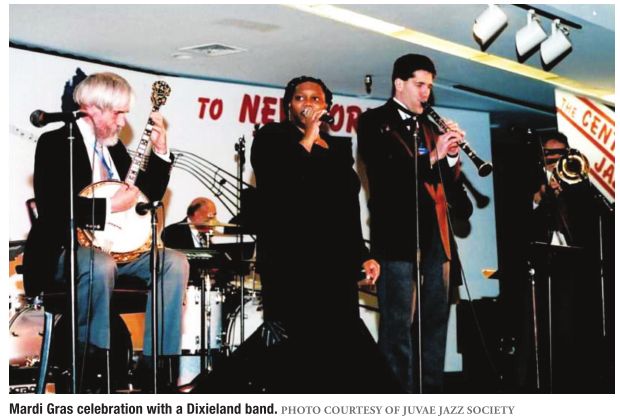
As
members of the Juvae Jazz Society continue their commitment to what
famed filmmaker Ken Burns called, “our (America’s) great contribution to
the arts,” they will need to recognize the task ahead, as well as the
legacy behind. The original Central Illinois Jazz Festival began in 1976
simply through the desire of local enthusiasts to share their joy of
jazz with others willing to shell out a few bucks to enjoy a toetapping,
ear-tingling good time. For nearly 20 years, the festival used the
original formula of a four-band lineup, with a few extra all-star groups
and college bands rolling in on Sundays.

Then,
in 1994, after organizers wanted to offer more music, they decided a
jazz club would complement the event and placed a legal pad in the hotel
lobby during the next festival as a signup sheet. After enough
participants joined, they named their new jazz society after Juvae
Marlatt, a young woman from Forsyth killed in a car accident on the way
to a jazz concert in St. Louis near the time the group formed. Soon the
fledgling organization held a meeting, appointed Bob Fallstrom as
president (he was honored in memoriam in 2015 for years of dedication to
the festival and society), and Mike Osborne, who collected dues and
wrote bylaws, as “ticket taker.” In August 1994 they publicly presented
the Barrett Deems Big Band in concert and were officially underway as a
jazz society.

Now,
as the festival faces a hiatus for the first time in 42 years, there’s
time for reflection and rejuvenation. Director Maggie Brown talked of
the necessity of finding “new recruits” because of the age factor of
typical members, of continuing to bring in different types of more
diverse, jazz-related music, from Zydeco to Ragtime, Dixieland to
traditional jazz – all while expanding the festival’s social media
reach. “We just couldn’t do that and continue to organize for the
festival,” she explained about the need to for a break in 2018. “But
we’ll be back with diversified music, always something upbeat you can
dance to. We are all about sharing the happy music.”

Tom
Irwin is a Springfield-based, singersongwriter, folk musician who
wouldn’t know a minor flatted fifth if he played one, but enjoys the
grand sounds of jazz and its many relatives, while sincerely hoping the
genre grows to rise again to great heights of popularity and influence.
Reach him at [email protected]


