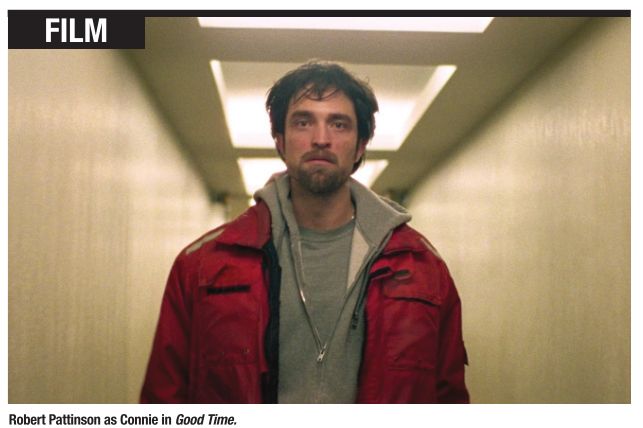
Critics and fans alike have been heaping praise upon Josh and Benny Safdie’s Good Time since
its premiere at the Cannes Film Festival earlier this year. It’s easy
to see why, as this is a “Hey, look at me!” production, one suffused
with style and meant to signal there are brave new visionaries behind
the camera. Actually, the film has style to spare – far too much for my
taste – as this becomes a spectacle of distractions meant to draw our
attention away from the faulty script that’s riddled with far too many
lapses in logic to keep track of. Only the work of Robert Pattison,
doing his best to distance himself from his vampire past, keeps us
engaged throughout.
The
first scene is an effective hook that promises much more than is
ultimately delivered. Nick Nikas (Benny Safdie) is being asked a series
of simple questions to help a psychiatrist (Peter Verby) evaluate his
mental capabilities. The extreme close-ups used here are ironic, as
there’s really no way we can penetrate what this poor young man is
thinking or feeling. The intensity and single tear Safdie is able to
produce during these moments generates ample sympathy for the character
from the start.
His
brother Connie (Pattinson) interrupts the interview, abruptly taking him
from the office, telling him he needs his help for a very important
job. This would happen to be a hair-brained bank robbery that seems to
go off without a hitch. However, when Nick panics he’s taken into
custody, which sends Connie on an all-night odyssey to raise $10,000 to
bail his brother out before he gets hurt or worse among the prison
population.
The first
45 minutes of the film works as the Safdies’ intense approach mirrors
the manic nature of Connie’s plight. Perhaps the movie’s best moment
occurs at the office of the bail bondsman, where he tries to get his
unstable girlfriend
(Jennifer Jason Leigh) to charge the $10,000 to her mother’s credit
card. When it’s denied, the panic among all rapidly escalates, and
there’s a feeling of genuine tension the movie never duplicates.
From
there the series of circumstances Connie is forced to endure becomes
much too much to swallow. A ridiculous case of mistaken identity, a
woman who’s far too trusting in letting him into her home, and a
convenient stash of stolen loot that will put everything right – if only
it can be found – defy all sense of logic. Any credibility the Safdies
have created with the audience goes out the window once the descent down
this nonsensical narrative rabbit hole is underway.
Obviously
never having heard of a tripod, the film is composed of one jittery
handheld shot after another, its characters framed as if they were 10
pounds of potatoes stuffed into a five-pound sack while a pulsing techno
soundtrack blares throughout, meant to mirror the characters’ anxiety.
As I said, this is initially an effective approach, but its repetition
ends up becoming something to endure rather than enjoy. It’s an
exhausting film, but not in a good way.
To
be sure, Pattison is fun to watch as the amoral Connie, a shiftless
young man always on the make, ready to use anyone who crosses his path.
There’s little if anything sympathetic about him and the actor embraces
this, fully immersed in the character’s unpredictable, opportunistic
nature. It is obvious Pattison is having a good time stretching himself
here, and he’s fun to watch; I just wish that in the end I hadn’t felt
as if I’d been bludgeoned by Good Time.
Contact Chuck Koplinski at [email protected].
For a review of The Hitman’s Bodyguard, go the Cinemascoping blog at http:// illinoistimes.com.


