ART | Scott Faingold
For a few weeks earlier
this summer, Chicagobased artist James Pepper Kelly became a temporary
fixture at area coffee houses and bars, picking local denizens’ brains
about their hopes, dreams, concerns and stories revolving around the
city of Springfield. Kelly was one of the first artists to participate
in the Springfield Art Association’s recently minted Residency for
Visual Artists program and when he wasn’t interacting with townies he
was deep in research at Lincoln Library or poring through public
records. He was back in town Sunday to distribute the end product of his
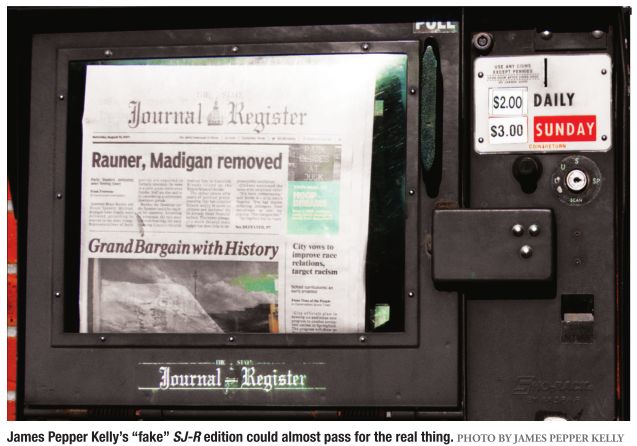
time here – a convincing-looking replica of the State Journal-Register that
reads like a broadsheet from an alternate universe featuring the
near-utopian front page headline “Rauner, Madigan removed.”
“Everyone
I talked to was super-generous,” said Kelly during a break from
distributing his handiwork around Springfield on Sunday afternoon. “They
were generous with their opinions and about spending time with me. I
learned a lot from everyone that I talked to.” Kelly explained that the
intent of the paper he created, far from the Onion-style parody of central Illinois foibles one might expect, instead reflects the town that Springfield could be,
based on the things its residence shared with him. “What I realized,
working on it over time, was that there were so many more amazing
details and stories than I will ever be able to use,” he said, “but I
think [the finished product] distills a lot of the conversations in
broader strokes.”
Kelly says he sees the paper as a call to action, and it does seem like a sort of broadsheet sequel to Vachel Lindsay’s Golden Book of Springfield, one
that implicitly counters Lindsay’s fanciful vision of a 21 st -century
Springfieldian utopia with a more activist approach. “I’m faking fake
news,” he said. “It’s got all these speculative versions of reality of
the future of what Springfield could be, what people want it to be. When
people read this, I don’t want there to be this cynical ‘gotcha!’ at
the end of the stories.” Instead, many of the articles conclude with
phone numbers for government offices and other public servants for
readers to contact. “That way people can get to the end and actually do
something about it.” Some of the stories, including one about basketball
courts in Enos Park, are straight reporting based on Kelly’s research.
“There’s a quote from Jim Langfelder that I pulled straight from a real SJ-R article from just three or four days [before printing]. It’s an overall blending of truth and fiction.”
The
process of getting the papers around town was involved. “I left Chicago
at 5 a.m. and rode down the interstate with my wife in the side-seat
where she was rolling and rubberbanding several hundred copies. We had
the backseat overflowing with newspapers.” They arrived at 11:30 a.m.
and placed copies in some SJ-R vending machines downtown. “I
thought a lot about the ethics of this – I wanted to put these into the
machines but I didn’t want people paying and not getting the actual
paper they paid for.” He developed a process which involved taking the
real State Journal-Register copies and folding them inside out,
wrapping them in his alternate version. “You would still get all the
real content – I didn’t want to burn anyone!” The most ambitious and
physically demanding part of the distribution process was making
home-deliveries throughout the Enos Park neighborhood (home of the SAA
grounds where Kelly was housed during his residency). “My wife would
drive the car with one tote bag full of papers and I’d run alongside
with another one and we threw them on people’s porches – we did several
hundred papers on people’s lawns throughout the neighborhood.”
Most
of the time he just ditched the papers and left because he didn’t want
to hang around and make it awkward, Kelly said. “There were a couple
times I was around when people saw it and it was fun to watch some
doubletakes – they would glance at it and walk away and then come back
20 seconds later, going, ‘What? What does this mean?’”