
Try this tomato pie
Way back in February I got
the gardening bug, so I started several different varieties of tomatoes
in plastic lettuce containers that I’d been hoarding for that purpose.
In a warm east-facing window, seedlings with names like Black Krim,
Brandywine, Sun Gold, San Marzano and Green Zebra popped up and lined
the windowsill. Eventually these little darlings made their way to the
garden, and I am now beginning to be inundated with their fruit. The
ripe juicy tomatoes that I had so pined for in the dead of winter now
seem to be coming out of the woodwork.
There
are several strategies for dealing with a surplus of tomatoes. The
first, and likely best, is giving them away to loved ones and even
complete strangers.
However,
it’s possible that even after you’ve foisted off as much fruit as you
can upon friends and neighbors, you’ll still find yourself with an
assortment of ripe tomatoes staring at you from the counter. Chopping
the tomatoes whole (remove the core but leave the skins and seeds) and
freezing two-cup portions in quart sized zip-top freezer bags works well
for adding to soup or making tomato sauce. Leaving in the skins and
seeds is a personal choice; most classic recipes call for them to be
removed and discarded. After a long simmer I don’t find their texture to
be objectionable, and the flavor and nutrition that they bring to a
dish is definitely worthwhile.
When
my mother put up tomatoes, she would peel them by dropping the whole
tomato in boiling water for 30 seconds, then plunging the tomatoes into a
bowl of ice water. This allowed the skins to slip off easily. Then she
would chop them and remove the seeds, and salt them about one teaspoon
per two cups of chopped tomatoes. When I make this today I leave in the
seeds and add a pinch of sugar to enhance flavor.
This
mixture would be left to drain in a non-reactive colander over a bowl
for about an hour. Much of the salt drains away into the liquid that
accumulates, and the resulting tomatoes are ready to be packed up and
frozen or used right away. (Use the tomato liquid to boil pasta or make
risotto, or as the base for an amazing bloody mary). Freezing fruit
causes the water in it to expand and burst cell walls, resulting in a
mushy product when thawed. This salting method helps to retain texture
by essentially pulling the water out of the cells beforehand. It’s also
handy if you don’t want the water in the tomato to result in a soggy
dish, for instance when adding tomatoes to quiche or topping a pizza, or
if you want to reduce water content and still keep the tomatoes raw for
a salsa or salad.
Another
method for reducing water content in tomatoes (and my favorite) is
roasting them. Whole cherry tomatoes or chunks of large beefsteak
tomatoes can be tossed with olive oil, salt, pepper and a pinch of sugar
before being transferred onto a parchment lined rimmed baking sheet.
Roasting at a high heat (400 convection) reduces down the liquid and
caramelizes the sugars, intensifying the tomato flavor. Herbs, onion and
garlic can be added to the roasting tomatoes as desired. This roasted
tomato mixture is ready to use in recipes or can be frozen or canned.
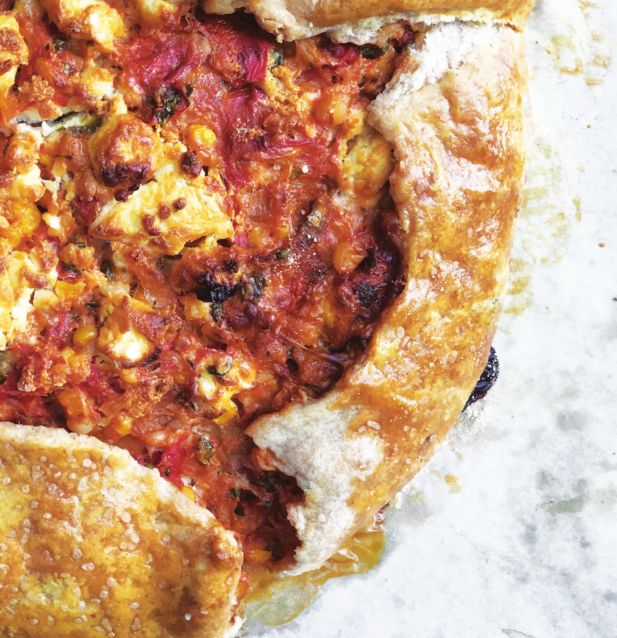
I
use these roasted tomatoes in a tomato and sweet corn pie, which has
become my summer potluck go to. It is one that I initially made up just
because the ingredients were ones that I had on hand. It has now become
one of my most requested recipes. Some sort of summertime hybrid between
a pizza and a quiche, this pie has layered fire roasted sweet corn and
tomatoes with fresh herbs and goat cheese. The pie dough and filling can
be made ahead, then assembled and baked the day you want to bake the
pie.
Sweet Corn & Roasted Tomato Galette with Chevre
• 1 quart whole cherry tomatoes or 4 large beefsteak tomatoes, roughly chopped
• 1 tablespoon olive oil
• ½ recipe pie dough
• 1 tablespoon butter
• ½ cup minced shallot or onion
• 4 ears sweet corn
• 1 teaspoon chopped fresh thyme
• 1 tablespoon fresh parsley, chopped
• 1 tablespoon flour
• 1 egg
• 6 ounces crumbled chevre, divided
• Salt and pepper to taste Preheat the oven to 425-degree convection.
Toss
the tomatoes with olive oil and season with salt and pepper. Roast in
the hot oven until the tomatoes have burst and their juices begin to
reduce and caramelize, about 30 minutes. Remove from oven and let cool.
While
the tomatoes are roasting, make ready the rest of the filling. Shuck
the sweet corn and, using a sharp knife, cut the kernels off of the ear.
Use the blade of the knife to scrape along the cut cob to get out as
much corn milk as possible.
Heat
the butter in a skillet and sauté the shallots until softened and
slightly translucent. Add the sweet corn and thyme and sauté until the
corn is cooked through and lightly browned. Combine with the roasted
tomato mixture and let cool slightly. Add the tablespoon of flour,
parsley and beaten egg and mix well. Add half the chevre crumbles and
mix lightly. This filling can be made up to four days ahead and also
freezes well.
When
you’re ready to bake the galette, roll out a disc of pie dough on a
sheet of parchment into a 12-inch circle. Using both hands, lift the
sheet of parchment with the dough circle onto a baking sheet. Mound the
chilled filling into the middle of the dough circle, and sprinkle the
remaining chevre on top of the mound. Bring up the sides of the dough
around the mound of filling in a pleated fashion. Brush the finished
galette with egg wash and bake on the bottom rack in a 425-degree oven
for 15 minutes. Reduce the heat to 325 degrees and bake another 45
minutes, until the crust is golden and the filling is bubbling. Let cool
at least 30- 45 minutes before serving.
Contact Ashley Meyer at [email protected].


