America is a nation composed of immigrants, the fairly recent descendants of immigrants, native peoples and the descendants of slaves. Unlike regions of the world where majorities may descend from those who resided nearby for hundreds of years, the circumstance simply is not possible given the founding of the United States a mere 241 years ago. Americans who crave a sense of national pride can celebrate the difficult lives of courageous predecessors who either risked everything to escape threats of war, violence, economic hardship, famine, political repression or religious persecution or who emerged strong from the worst possible oppressions to collectively build the freedoms we enjoy today.
However, today we live in a peculiar time. Fortunately, the loudest voices do not represent the majority well. I believe that most Americans understand our history of immigration, therefore recognizing inaccuracy, hypocrisy and cowardly isolationism in inflammatory rhetoric that would demonize communities of new residents. We know that America’s fundamental principles include life, liberty, pursuit of happiness and equality. Yet economic struggles, political uncertainty and steady news of global violence leave us all feeling vulnerable and fearful. Psychology shows that in fear we are at our worst. We can each give in to the worst of our impulses or commit to the best of our values.
Waves of nationalism, xenophobia and linguistic intolerance have consistently followed times of national distress and, in turn, have often caused them. Nationalist sentiments across Europe contributed to the outbreak of World War I. In the United States during World War II, thousands of Americans were stripped of their freedoms and interned based on race. The wars led to public schools in German-American communities being forbidden to continue offering German language or bilingual curriculum. During the Depression, systematic targeting of Mexican ethnic communities forced the legally sanctioned “repatriation” to Mexico of up to 2 million residents, well over half of them American born citizens.
Today,
U.S. residents of various backgrounds are experiencing a surge in hate
crimes. Violence, threats and vandalism are merely the tip of an
iceberg. The actually visible crimes rely on more subtle support in the
forms of a range of hostile attitudes, exclusive informal policies,
rejecting behaviors and dishonest claims about the danger or
undesirability of certain groups.
Thus
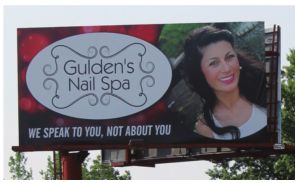
I arrive at the purpose for sharing my concerns. Recently spotted in
Springfield on MacArthur Avenue: A huge billboard displaying an
attractive woman freshly polished by a salon grooming, flanked by the
advertised Gulden’s Nail Spa of Wabash Avenue and their promise that,
“WE SPEAK TO YOU, NOT ABOUT YOU.”
I
am not certain that men in general will understand the reference, but
most salon patrons know the experience of listening to cross-colleague
conversations in Vietnamese interspersed with one’s own English
conversation with her manicurist or pedicurist. Nails Magazine reported
2013 statistics showing that 48 percent of professionals in the U.S.
nail industry are Vietnamese American. Therefore, many U.S. nail salon
owners and technicians are bilingual, speaking their primary language as
well as emerging or intermediate/advanced English.
As
a Caucasian American woman, I have heard monolingual women like me joke
mostly good-naturedly in mock paranoia, “I hope they aren’t saying
nasty things about me!” But the idea comes from a place of truth about
our reactions to Other peoples and unfamiliar languages. Whereas
discomfort with unknown Others is an aspect of human nature we all must
overcome to live in a just and peaceful society, Americans in particular
have a counterproductive pride in our linguistic low-achievement and a
history of enforcing it. Related to old, deep cognitive iconography
about America as a white, English-speaking nation, policymakers
continually insist on supporting our singlelanguage abilities at the
expense of the overwhelming amount of research-supported benefits of
multiple language use for individuals and nations. The least gracious of
white, English-only Americans try to socially enforce the status as
well. Of course our bilingual neighbors aren’t speaking about us. They
are using the most accessible and fluent means of communicating thoughts
and feelings.
Gulden’s
Nail Spa and its “WE SPEAK TO YOU, NOT ABOUT YOU” is discreet,
sophisticated bullying. It is ugly and exclusionary, and at the saddest
possible time – a time when we all know the power with which xenophobic
ideas can take hold and a time when some will provoke them deliberately
for personal gain.
Sarah
Eccles has a master’s degree in Teaching English as a Second Language
and is adjunct faculty at University of Illinois Springfield.