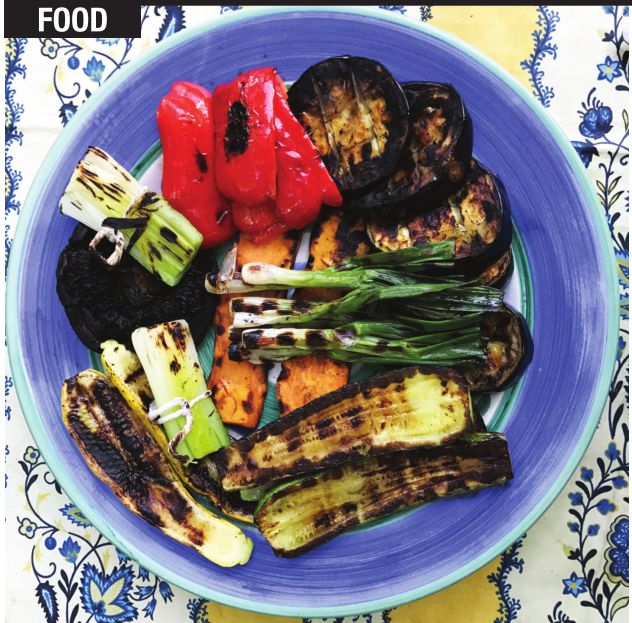
My obsession with cooking outdoors over fire must have been carried forth in the DNA from my primal ancestors. Grilling adds depth and complexity to vegetables in a way that can’t be achieved by steaming or boiling. I challenge my vegetable-hating friends who were brought up eating bland and insipid canned or frozen veggies to experience the alchemy that occurs when vegetables are grilled over an open fire.
Many vegetables are suitable for grilling.
Some densely textured vegetables need to be partially or wholly cooked before grilling. Leafy vegetables such as kale just need a brief pass over the flames. Any vegetable that is to be grilled should be brushed or tossed with oil and salted before grilling. Other flavorings such as herbs, vinegar or lemon juice may be used. Ideally vegetables should be cut to a uniform thickness. Small vegetables or vegetables cut into bite-sized pieces are easiest to deal with when skewered.
Create a two-zone charcoal fire. Place the hot coals on one side of the grill. This gives you a place to move vegetables from one side to the other to keep them from burning. In general a moderate to low-heat fire is desirable when grilling vegetables. If using a gas grill, adjust the burners so that you have a hotter side and a cooler side.
Below is a partial list of vegetables suitable for grilling and tips on preparing each: Artichokes – Trim the artichokes and boil until just barely tender in salted and acidulated water. Cut in half, remove the choke, brush with oil, sprinkle with salt and grill cut side-down until lightly browned.
Asparagus – Brush with oil and lightly salt. Choose thick spears and keep the tips away from the hottest part of the fire. Grill just until crisp/tender.
Beets – Wrap unpeeled beets in foil pouches with a little olive oil and grill until soft. Or grill peeled, halved beet until lightly charred.
Bell peppers – Core, halve and seed peppers. Cut each half lengthwise into 3 strips. Oil lightly, sprinkle with salt and grill to desired doneness – anywhere from crisp/tender to completely softened. Peppers can also be cut into 1 ½-inch squares and skewered.
Carrots – Oil and season; grill 5-7 minutes until softened.
Corn on the cob – Corn can be grilled either by peeling back the husks, removing the silks, then pulling the husks back over the corn and placing on the
fire. After the kernels are partially cooked, remove the husks, brush
the corn with olive oil and place directly on the fire. Turn frequently
until the corn is lightly browned.
Eggplant
– Cut into slices or planks, depending on what type of eggplant is
used. The pieces should be at least ½-inch thick. The surfaces that will
be placed on the grill should be peeled, otherwise peeling is optional.
Score the surfaces that will be placed on the grill lightly. Brush with
oil and salt. Grill until the eggplant is completely tender. In the
Middle East, eggplant is grilled/ roasted by oiling a whole unpeeled
eggplant and placing it on the fire. Grill, turning frequently, until
the outside is blackened and the inside is fully cooked and soft. The
eggplant is then cut in half and the flesh scooped out to use in dips
and as a purée.
Kale – Give the leaves a quick turn on the grill over high heat so they don’t dry out.
Leeks
– Cut off dark green tops. Slice in half, lengthwise. Wash thoroughly
to remove sand and dirt. Boil in a large pot of salted water until they
start to soften, about 3-5 minutes. Transfer to ice water to stop
cooking. Dry on paper towels. Brush with oil, sprinkle with salt and
pepper and grill until golden brown and very slightly charred, about 3-5
minutes. Turn and repeat for other side.
Mushrooms
– Grill portabellos either whole or in ½-inch-slices. Large cremini,
shiitakes, button mushrooms, and large oyster mushrooms can also be
successfully grilled. Smaller cremini, shiitake and button mushrooms can
be threaded on skewers. All should be brushed with oil and salted and
peppered before grilling. Grill until tender and golden brown. In
general, wild mushrooms such as morels and chanterelles are very
delicate and are not good candidates for grilling.
Onions
– Cut onions into slices at least ½-inch thick. Pierce the onion slices
with skewers or toothpicks to keep from separating. Brush the cut sides
of the slices with oil, salt and pepper and grill on both sides. You
may wish to grill them until completely softened or until crisp/tender,
depending on the flavor of the onion, and its final use.
Potatoes
– Potatoes should be steamed or parboiled before grilling. Do not
overcook, or they may crumble apart when grilling. Trim unpeeled baking
potatoes lengthwise into planks about 1 ½-inch thick. Steam or boil just
until tender. Brush with salt and pepper, and grill until quite brown
and crispy on the outside. Round boiling potatoes such as red potatoes
can be cut into quarters or large chunks. Cut before cooking. Fingerling potatoes may be left whole. Boil or steam and proceed as above.
Scallions – Trim the root end and all but about 6 inches of the green. Grill until soft and lightly charred.
Summer squashes – Choose
small to medium-sized squashes that do not have large seeds in the
center – zucchini, yellow squash, pattypans. Cut in halves or planks of
even thickness. The squash should be at least ½-inch thick. Oil,
sprinkle with salt and pepper and grill to desired tenderness. Depending
on thickness, and desired doneness, you may or may not need to turn
them.
Sweet Potatoes –
Peel sweet potatoes and cut into ¼-inch planks. Brush with oil, salt
and pepper, and grill on both sides until tender and golden brown.
Tomatoes
– Choose tomatoes that are ripe but are still firm. Cut a thin slice
off the top of round tomatoes, and halve Italian tomatoes. Gently
squeeze out some of the seeds. Oil the cut sides, salt and pepper, and
place the cut sides down on the grill. Grill until browned and slightly
softened. Do not overcook and let get mushy.
Contact Peter Glatz at [email protected].


