
Putting food scraps to good use
Approximately 40 percent of the food produced in the United States, approximately 133 billion pounds, will end up in the trash. That’s roughly equivalent to buying five bags of groceries, then pitching two of those bags in the trash on the way out of the store. In a country where 42 million people suffer from food insecurity, this is an unconscionable reality. Households, restaurants and grocery stores alike throw away huge quantities of perfectly safe, edible food.
Waste is actually built into the business model of many grocery stores, which are responsible for about 10 percent of the food waste in the United States. Low waste percentages in perishables are often seen as indications that the store is not adequately stocked and that customers are not being offered premium produce choices. Stores want to be fully stocked at all times so quantities don’t run low and compel their customers to look elsewhere to fill their shopping carts. Fully stocked produce displays are more attractive and are set up to entice the customer, often at the expense of produce quality. That perfect pyramid of apples on display at the store may look nice, but the apples on the bottom get beat up and bruised, and often end up in the dumpster.
Modern shipping, refrigeration and the global food trade have trained modern shoppers to expect perfect, unblemished, identically shaped produce year-round. In an effort to satisfy their customers, commercial growers and grocers stock their products accordingly. Consumers place a premium on the cosmetic beauty of a product, regardless of its flavor or freshness. We have come to associate uniform perfection with quality and safety, and often pass over perfectly good B grade produce simply because it is oddly shaped or less than perfect.
The food wasted by grocers may seem staggering, but households on average waste twice as much food as supermarkets. Food prices in the United States are among the lowest in the world, thanks to controversial agricultural subsidies, causing many of us to overbuy groceries and then discard them when they show the slightest sign of browning, oxidation or wilting.
Many consumers today operate under the assumption that if a product is past its “sell by” date, then it is not safe to eat and should be pitched. In reality, “sell by” dates are guidelines to indicate freshness, and many foods are still good long after their “sell by” date. Many products, such as cheese, eggs, milk and yogurt can be perfectly safe to consume after their “sell by” date if they have been properly stored and have been consistently held at 40 degrees or below.
If
you come across expired food in your fridge, give it a look-over and
have a good sniff before discarding, especially if it’s unopened. If
you’re still not comfortable eating yogurt or milk that’s a week past
its “sell by” date, save it to cook or bake with. The cooking process
will kill off any bacteria that may cause you concern. Milk that has
soured slightly is wonderful to bake with and can be an excellent
substitute for buttermilk. Use your nose. Obviously you don’t want to
use anything that is moldy or rottensmelling, but there’s no need to
waste products simply because they are no longer pristine.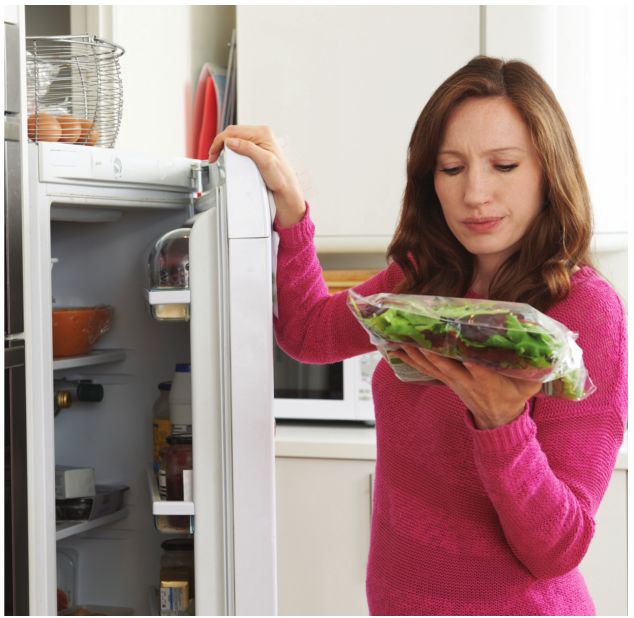
Composting
is a wonderful way to keep food out of the landfill, but in an ideal
world food will make its way to the compost bin only as a last resort. A
better solution is to get the most out of your food dollars by
minimizing waste from the beginning. Clean out your fridge regularly, so
you can be mindful of what you have and how fresh it is. This will help
you plan meals accordingly and use up what you have. Have some red
peppers that are starting to wither? Move them to the front of the
produce bin and work them into tonight’s dinner. While they might not be
well suited to a crunchy salad, they will be perfect in a stir-fry or
soup. If you know that your week is busy and you won’t be able to cook
them before they go totally bad, chop them up and stash them in the
freezer to use the next time you make soup or chili.
Many
produce scraps can be given a second life in the hands of a resourceful
cook. Save parsley stems, leek trimmings, carrot peels, celery
trimmings, onion and pepper scraps and mushroom stems in a zip-top bag
in the freezer. Once the bag has filled up, transfer the frozen scraps
to a slow cooker and cover with water. Cook on low for 24 hours, and
then strain out solids. The resulting vegetable broth is culinary gold –
the key to making delicious, deeply flavored soups, stews and sauces.
My
family is slightly asparagus-obsessed, and I eventually got tired of
filling up my compost bin with the tough ends that I snapped off this
precious and pricey vegetable. I grabbed my soup pot and sautéed some
diced onions in butter, then added my asparagus trimmings, covered them
with cold water and let them simmer for about 20 minutes until they were
very tender. After cooling slightly, I transferred the whole mess to a
blender and let it go for a full minute, until the mixture was
completely puréed. Finally I poured the asparagus purée through a
fine-meshed sieve to remove the tough asparagus solids, and then
seasoned it with salt and pepper. The resulting soup cost practically
nothing and will freeze beautifully. This method also works well with
broccoli stems and pea pods.
When life gives you vegetable scraps, don’t throw them out – turn them into dinner!
Contact Ashley Meyer at [email protected].


