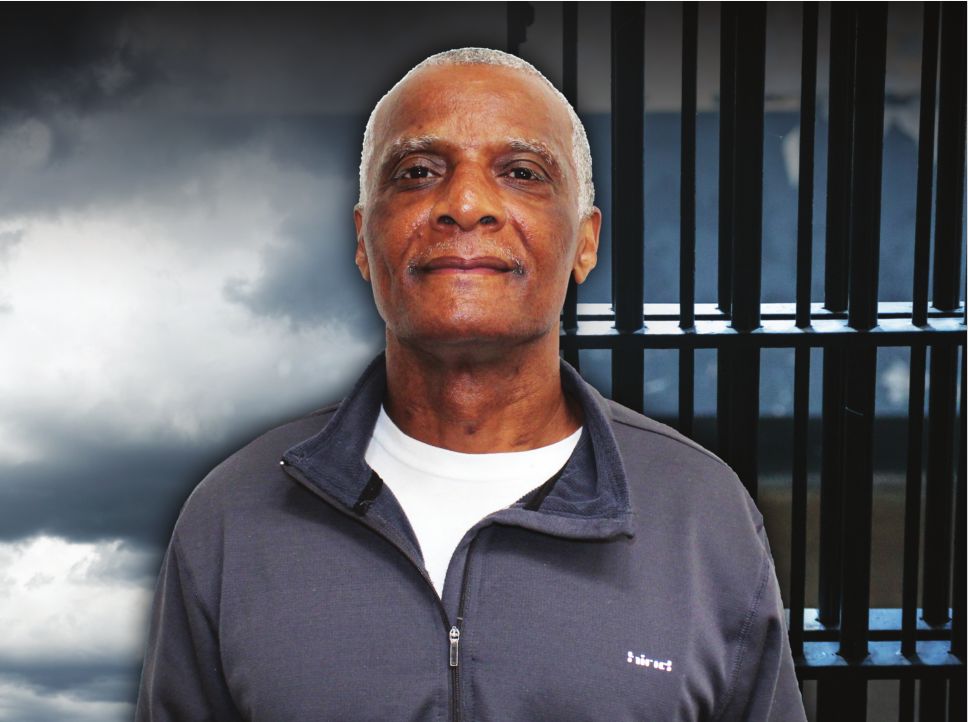
Illinois Innocence Project wants to help ease exonerees back into society
The Illinois Innocence Project based at University of Illinois Springfield, is part of a nationwide network of groups working toward overturning wrongful convictions. Since it began in 2001, the IIP has helped win freedom for 10 innocent people, the most recent of which was Charles Palmer, set free on the day before Thanksgiving 2016, after 18 years in prison for a crime he didn’t commit.
“Initially, the innocence movement was primarily legal in its operations,” said Larry Golden, founding director of IIP. “The goal was to get innocent people like Charles out of prison. Now that we’ve been successful, we’re beginning to face the problem of how to make sure there is the help and support they need when they get out.”
Golden pointed out that the general subject of prisoners reentering society is hardly unique – for example, Gov. Bruce Rauner has stated a goal of having 25 percent of the prison population released within the next 10 years. However, not all released prisoners are created equal. “The state is dealing with this from the perspective of people who have limited terms in prison, so they have a chance to prepare people before they get out.” In contrast, for instance, Charles Palmer had a two-week window during which his being released became a vague possibility and it wasn’t until the day before Palmer’s release that John Hanlon, IIP executive and legal director, was informed it was probable Palmer would be released. “The challenge is almost minute by minute,” said Golden. “The average exoneree doesn’t have any money, a job or even any place to go. It’s a tremendous challenge.”
The challenges for recently released former prisoners extend to all aspects of life, Golden pointed out. “How does this person get a dollar to even buy a soda at the corner store? At the same time, while he is technically an innocent person, when he applies for a job he’s still got this conviction on his record.” To address these problems, the IIP has a small group of graduate students in the social work program at UIS researching the relevant issues and working on practical solutions, including a guidebook listing various helpful resources. “This way in the future, as people get out, they’ll have
something to refer to,” said Golden, who pointed out that nearly all
people released from prison have some form of psychological stress,
post-traumatic stress disorder being particularly common. Other IIP
clients faced serious health issues which have not been treated. “Even
simple things like getting a credit card or a driver’s license or a
library card can prove to be huge challenges,” he said. “Not to mention
all the advances in technology.”
This Saturday, April 29,
Charles Palmer will be among the speakers at the Illinois Innocence
Project’s 10th Annual Defenders of the Innocent event at the Crowne
Plaza Hotel in Springfi eld. Visit http://www.uis.edu/ illinoisinnocenceproject/ for additional details, including costs of reserved seats and sponsorship opportunities.
In many ways, the recently
released Charles Palmer might seem more fortunate than many other IIP
exonerees, due to good health and a fair amount of family support, but
his case still illustrates the uncertainty experienced by many in his
situation. The complications began before he ever set foot outside of
jail.
“I only found
out I was going to be released at about 8:30, 9 o’clock the same morning
I got out,” Palmer remembered. “Mr. Hanlon said don’t tell nobody, so I
had to hold it inside.”
“In
a situation like that, we don’t want the word getting around in the
jail that he might be getting out because there’s all kinds of
shenanigans that occur,” added Golden.
“Even after he told me that [I was being released], it’s never real until it happens,” said Palmer.
Aspects
of the transition process that seem benign, even unabashedly positive,
from the outside can be problematic for the newly exonerated. For
instance, Palmer’s release on the day before Thanksgiving was itself a
double-edged sword.
“Within
24 hours he’s in a celebration with all of his family, many of whom he
hasn’t seen for years, some grandkids not even born at the time he was
incarcerated,” said Golden, “and he doesn’t have any time to even sit
back and say, ‘I’ve been in prison for 18 years, I just got out and now
I’m expected to be a husband and a father and a grandfather, an elder in
the family – as if nothing ever happened with my life.”
“It was even more than that,” said Palmer.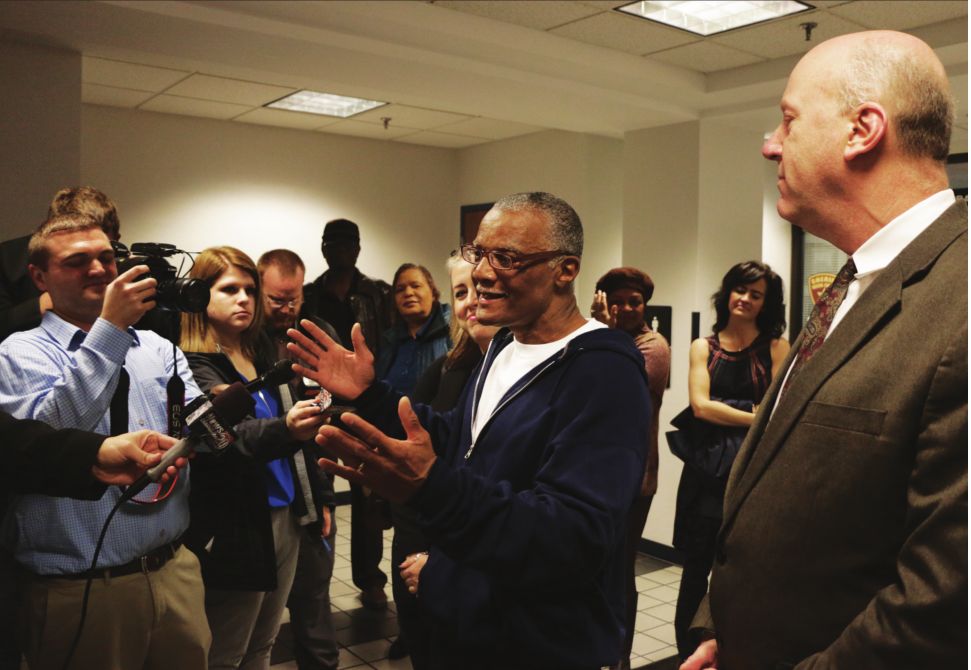
“A
lot of people act like life should just go on. They don’t understand
that you’ve been in a different environment, totally, for almost 20
years. Man, you can’t just come right back out here and jump into
society. It was a ton of people at Thanksgiving
dinner. I smiled, ate, you know, did my best to interact – but that was
trying, being in that family setting. There were a lot of people I
hadn’t seen for years, and I’m already a little bit leery, cautious. I
always think everybody’s got an ulterior motive. These are the struggles
I have now.”
Another
double-edged sword for Palmer presented itself in one of his first
major decisions: where to live. Unlike many exonerees, he has a fairly
robust support system, including his wife, Deborah, who stuck with him
throughout his incarceration. Deborah had been residing in Bloomington,
while most of Palmer’s family was in Decatur, where he had been living
at the time of his arrest. Palmer says he now regrets his decision to
settle in Decatur once released. “His family is in Decatur and so it
made sense when Charles decided that was where he needed to be,” said
Golden. “He gets to spend time with his grandkids there and things like
that, but one of his problems with being in Decatur include avoiding
potentially hostile law enforcement, prosecutors and others who may
remember him from before. You have to remember that outside of his
family, the people that he knows in Decatur are people from 18 years
ago that he may not want to see. We find that to be one of the biggest
challenges for the exonerees – if they go back into the communities from
which they came, it’s more difficult than if they can start a life
somewhere else.”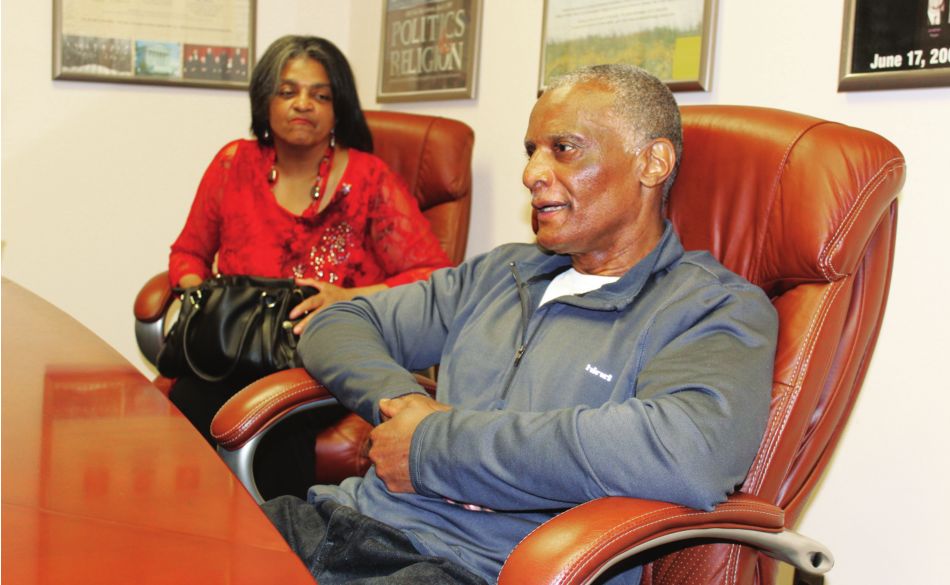
Trust
and boundary issues often become prominent for those starting anew
after years inside the prison system, and both have been issues for
Palmer in the months since he was set free. He described interactions
with family members who he felt both violated confidences and
over-monitored his behavior. “There’s caring and then there’s policing,”
Palmer explained. “I would go out somewhere and my sister would ask who
I was with, who that person was related to, what’s his last name.
That’s too much. I ain’t gonna go through all that. I try to work things
out in my own way and a lot of times it might be the wrong way. I might
bump my head a couple times but as long as I don’t bump it into the
justice system, I’m great, you know?” At the time he was interviewed,
Palmer was upbeat and energetic, partially because he had found
temporary employment over the past several weeks, doing maintenance work
on a house owned by a member of the Macon County Criminal Justice
Group, an advocacy organization in the area. “If you had asked him how
things were going just two months back, it would have been totally
different,” says Golden. “There was a period of real struggle because he
didn’t have any work and he couldn’t find a job and his days were
structured very differently at that point than they are now. In a lot of
ways, you’re actually seeing him at sort of a good time, in the sense
that he has work to go to during the day.”
Part
of Illinois’ compensation procedure for those released from prison
after being proven innocent is the issuing of a “certificate of
innocence” by the Court of Claims. Once the certificate is received,
compensation is based on the length of incarceration, and for 18 years
in prison Palmer would be entitled to around $220,000 from the state.
According to Golden, there are currently 18 individuals in Illinois due
compensation dating back as far as two years and who have not received
money due them as a result of mistakes by the government. The Illinois
Innocence Project is sponsoring a bill – SB1993 – which would authorize
this money being awarded immediately. However, predictably, the bill has
been caught up in the state’s budget problems.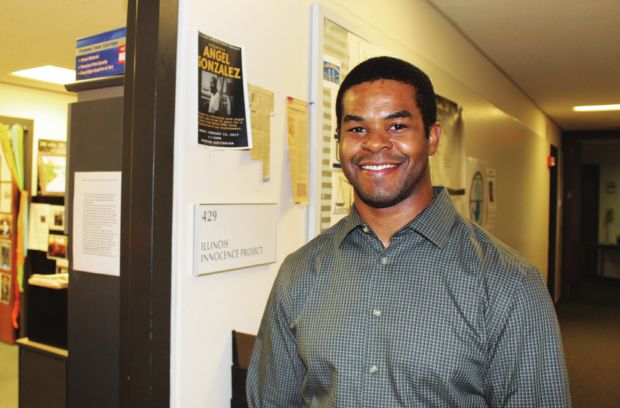
Some
exonerees are also legally eligible to sue the state for damages in
cases where a violation of the individual’s constitutional rights has
occurred. Such cases can involve lengthy litigation but have resulted in
major awards totaling millions of dollars.
According
to Golden, there appears to be no systematic “program” currently in
place to resolve the challenges individuals face upon release throughout
the network of Innocence Project organizations. The IIP has two social
work students working on a “guide” for their exonerees.
Bryanna
Shinall is a graduate student in social work at University of Illinois
Springfield and works as a research intern for IIP. She and her
colleagus have been tasked with creating systems and procedures to help
exonerees find resources to make the transitions which have proven so
challenging for Palmer and others. “The handbook we are working on takes
a sort of shotgun approach,” she explains, “a listing of all the
services that they might use.” Shinall said that ideally it would be
possible interview future exonerees while they are still incarcerated in
order to perform a personalized needs assessment to determine things
like whether they want to return to their home community or try living
somewhere else and what kinds of services they will require. “That way
we would have at least a little bit of heads-up. But instead we have to
scramble at the last minute because we can’t anticipate when they will
get let out,” she said.
One
important thing for people to realize, according to Shinall, is that
exoneration is not as clean a process as we think it is. “The evidence
comes to light and the judge says, ‘OK, you’re free.’ It doesn’t stop
there,” she explains. “Their life doesn’t immediately start to get
better, it doesn’t immediately wipe away everything that has happened to
them for however long they were incarcerated or what they went through
during the trial or when they were originally picked up by police. A lot
of them were incarcerated when they were in their late teens or early
20s and they’ve spent, on average, 15 or 20 years in prison and it took
away a huge part of their lives and I think that’s something people
don’t realize – it’s not as clean and happy as, ‘You’re exonerated, you
can go free now.’” “The Illinois Innocence Project is a nonprofit that
for the most part has been directing its resources towards getting guys
out of prison,” says Sean Blackwell, another UIS graduate student in
social work and research intern for the project who works with Shinall.
“Many of its grants and much of its funds have been allocated toward
things like conducting DNA tests and all the other activities that are
related to getting people out of prison.” To help determine effective
ways to facilitate reentry into society, the interns have conducted
research involving making contact with exonerees throughout the state of
Illinois. “We were able to get a window into some of the issues they
were dealing with. Many of these individuals don’t know exactly how to
assimilate, resocialize, they are at a deficit when it comes to putting
together an effective resume that will work in an increasingly
competitive work environment,” Blackwell said.
There
are a few specific recommendations the research indicates will be most
effective in helping the transitions of the recently freed exonerees.
“We are finding that these individuals would benefit from having a
mentor,” Blackwell said, “somebody to help them navigate through the
society when they get out, help them figure out everything from catching
a bus to getting on the internet, to making copies, to programming a
cellphone – things that many of us take for granted but which they were
out of the loop for and so were unable to learn.”
Blackwell also reported that their research indicates that
exonerees should receive a psychological evaluation within the first 72
hours of being released, “just to get a baseline of where their
psychological state is and see if they need any help moving forward from
there.” In addition, and just as importantly, financial literacy
counseling is recommended, to give them some insight into things like
how to open a checking account, how to save money and other ways to keep
their heads above water.
“They
are extremely vulnerable when they first get out of prison,” Blackwell
said. “The exoneration process is not a cut-and-dried, standardized
process.
“It’s a
learning period and each day brings new problems,” said Palmer, “but all
in all, it’s great. I’d rather be dealing with things on this side than
back in there. The biggest battle is with self, anyways.”
Contact Scott Faingold at [email protected].


