Mentally ill inmates clog jails. Sometimes they die.
Tiffany Ann Rusher could be a handful. She was nonetheless loved.
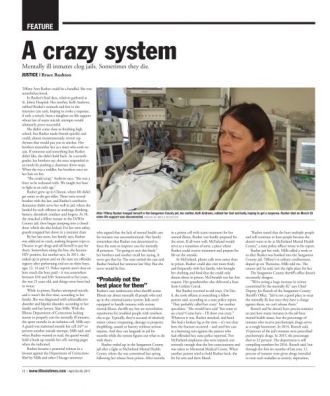
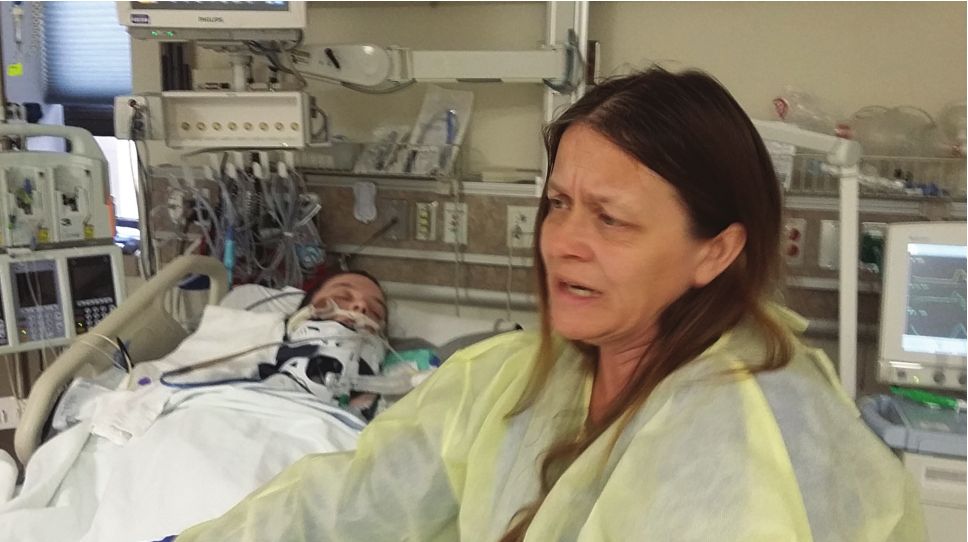
In Rusher’s final days, relatives gathered at St. John’s Hospital. Her mother, Kelli Andrews, rubbed Rusher’s stomach and feet in the intensive care unit, hoping to evoke a response, if only a twitch, from a daughter on life support whose last of many suicide attempts would ultimately prove successful.
She didn’t come close to finishing high school, but Rusher made friends quickly and could, almost instantaneously, invent rap rhymes that would put you in stitches. Her brothers remember her as a sister who took no sass. If someone said something that Rusher didn’t like, she didn’t hold back. As a seventhgrader, her brothers say, she once responded to an insult by pushing a classmate down steps. When she was a toddler, her brothers once set her hair on fire.
“She could scrap,” Andrews says. “She was a force to be reckoned with. We taught her how to fight at an early age.”
Rusher grew up in Clinton, where life didn’t get easier as she got older. There were several brushes with the law, and Rusher’s combative demeanor didn’t serve her well in jail, where she landed for such offenses as underage drinking, battery, disorderly conduct and forgery. At 18, she smacked a fellow inmate in the DeWitt County jail, then began jumping into a closed door, which she also kicked. For her own safety, guards strapped her down in a restraint chair.
By her late teens, her family says, Rusher was addicted to crack, making frequent trips to Decatur to get drugs and sell herself to pay for them. Somewhere along the line, she became HIV positive, her mother says. In 2011, she ended up in prison and on the state sex offender registry after performing oral sex on three boys, ages 12, 14 and 15. Police reports aren’t clear on how much the boys paid – it was somewhere between $10 and $30. Sentenced to five years, she was 21 years old, and things went from bad to worse.
While in prison, Rusher attempted suicide, and it wasn’t the first time, according to her family. She was diagnosed with schizoaffective disorder and bipolar disorder, according to her family and her lawyer, Alan Mills. With the Illinois Department of Corrections lacking means to properly care for mentally ill inmates, she spent months in an isolation cell, Mills says. A guard was stationed outside her cell 24/7 to prevent another suicide attempt, Mills said, and when Rusher wanted to read, the guard would hold a book up outside her cell, turning pages when she indicated.
Rusher became a potential witness in a lawsuit against the Department of Corrections filed by Mills and other Chicago attorneys who argued that the lack of mental health care for inmates was unconstitutional. Her family remembers that Rusher was determined to force the state to improve care for mentally ill prisoners. “I’m going to own this bitch,” her brothers and mother recall her saying. It never got that far. The state settled the case and Rusher finished her sentence last May. But she never would be free.
“Probably not the best place for them”
Rusher’s case underscores what sheriffs across Illinois say about mentally ill people who end up in the criminal justice system. Jails aren’t equipped to handle inmates with serious mental illness, sheriffs say, but are nevertheless repositories for troubled people with nowhere else to go. Typically, they’re accused of relatively minor crimes: trespassing, damage to property, shoplifting, assault or battery without serious injuries. And they can languish in jail for months while the system figures out what to do with them.
Rusher ended up in the Sangamon County jail after a fight at McFarland Mental Health Center, where she was committed last spring following her release from prison. After months in a prison cell with scant treatment for her mental illness, Rusher was hardly prepared for the street. If all went well, McFarland would serve as a transition of sorts, a place where Rusher could receive treatment and prepare for life on the outside.
At McFarland, phone calls were easier than in prison. Rusher could also visit more freely and frequently with her family, who brought her clothing and food that she could only dream about in prison. McDonalds was her first request. Her grandmother also delivered a feast from Golden Corral.
But Rusher reverted to old ways. On Dec. 8, she took offense at something a fellow patient said, according to a state police report. “They probably called her crazy,” her mother speculates. “She would have said ‘You want to see crazy? Come here – I’ll show you crazy.’” Whatever it was, Rusher attacked, and hard. She had a broken leg at the time – it’s not clear how the fracture occurred – and used her cast as a battering ram against the patient who had offended her, state police reported. Two McFarland employees also were injured, one seriously enough that she lost consciousness and was taken to Memorial Medical Center. When another patient tried to hold Rusher back, she bit his arm and drew blood.
“Rusher stated that she hurt multiple people and will continue to hurt people because she doesn’t want to be at McFarland Mental Health Center,” a state police officer wrote in his report.
Rusher got her wish. Mills called a week or so after Rusher was booked into the Sangamon County jail. Tiffany’s in solitary confinement, doped up on Thorazine, Mills told me. The county jail, he said, isn’t the right place for her.
The Sangamon County sheriff’s office doesn’t necessarily disagree.
“We’re seeing a huge increase in crimes committed by the mentally ill,” says Chief Deputy Joe Roesch of the Sangamon County Sheriff’s Office. “Jail is not a good place to treat the mentally ill, but once they have a charge against them, we can’t release them.”
Roesch said he doesn’t have precise statistics on just how many inmates in the jail have mental health issues, but the percentage of inmates who receive psychotropic drugs serves as a rough barometer. In 2014, Roesch said, 10 percent of the jail’s inmates were prescribed psychotropic drugs. In 2015, the percentage shot to 22 percent. The department is still compiling numbers for 2016, Roesch said, but through the first six months of last year, 12 percent of inmates were given drugs intended to treat such maladies as anxiety, depression, bipolar disorder and schizophrenia. On Feb. 10, a day picked at random by Illinois Times, 55
inmates, or 15 percent, were taking psychotropic drugs ranging from
Thorazine to lithium to Prozac in the Sangamon County jail, with as many
as five different psychotropic drugs prescribed to a single inmate,
according to records provided by the jail.
Sangamon
County isn’t alone. In Pike County, Sheriff Paul Petty says that four
or five inmates at any given time are mentally ill in jail, where as
many as eight inmates can share a single cell. The jail in Pittsfield
lacks an outdoor recreation yard – inmates can remain locked up for
months without any chance for fresh air. “They do a lot of pacing,” says
jail administrator Jordan Gerard when asked how inmates get exercise.
Petty acknowledges the quarters are tight. “If you think the walls are
close in, think of it after 10 days,” the sheriff says. “The reality of
it is, you can go ape-shit crazy in there.”
The
Pike County jail has one cell designed to prevent suicides, and Petty
says that he might add a second. Psychotropic drugs are a last resort.
So is the jail’s restraint chair.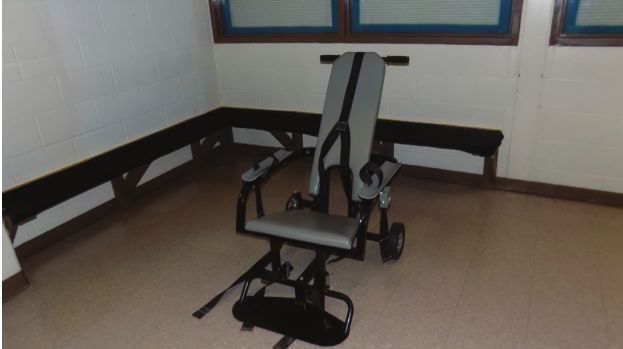
“In a chair, strapped down, is probably not the best place for them,” Petty allows.
But
Petty sees little choice for inmates who have lost control to the point
that they pose a threat to themselves or others. Putting inmates on
suicide watch in an isolation cell, where they’re supposed to be checked
at least once every 15 minutes, only goes so far, he says.
“That doesn’t help with the screaming, the yelling, the seeing things,” Petty says. “That’s when we start bringing in pastors.”
On
April 15, the day after I visited the Pike County jail, Lafayette
Scoggins, 20, hanged himself in the cell designed to prevent suicides.
Booked on suspicion of domestic battery the day before he died, Scoggins
was in the isolation cell because he’d told jailers that he’d tried to
kill himself two days earlier by swallowing a bottle of pills, Petty
said. Guards found him hanging by his shirt, which he’d torn up and tied
to an air grate, the sheriff said. He’d been to jail before. “He was,
absolutely, a kid we knew,” Petty says. Guards called him Tad, short for
Tadpole. He was on parole for a theft conviction, and the Illinois
Department of Corrections had issued a warrant to return him to prison.
The sheriff figures he didn’t want to go. Illinois State Police are
investigating the death, Petty says. Meanwhile, the sheriff’s office is
contemplating ways to make the isolation cell more resistant to
suicides. “That’s the question we’re asking ourselves,” Petty said. “Is
there a foolproof scenario?” While jails may not be the best place for
mentally ill people, sheriffs are nonetheless responsible for their
safety. Last month, U.S. District Court Judge Richard Mills ruled in
favor of the family of Dennis E. Adams, who hanged himself in the
Christian County jail in Taylorville six years ago. Adams was arrested
after a standoff that began when he shot his estranged wife in the
shoulder, then pointed the gun at his own head. Before he was booked
into jail, a mental health professional diagnosed Adams with a
depression disorder and a doctor recommended that the jail take measures
to prevent suicide and provide treatment for mental health issues.
Adams
was put in a padded cell designed to prevent suicides, and a mental
health professional who evaluated him a week later recommended that he
stay there. Dr. Terry Killian, a psychiatrist retained by the court to
determine whether Adams was mentally fit to stand trial, recommended
that he be transferred from jail to a mental health facility for
evaluation and treatment. During a deposition, Killian testified that he
believed Adams was suicidal. Despite Killian’s report recommending a
transfer to a mental health facility, Adams stayed in jail.
Instead
of remaining in the padded cell, Adams was transferred to an isolation
cell, and then to general population. On Nov. 4, 2011, hours before he
was due in court for a proceeding in a divorce case filed by his wife,
Adams hanged himself. He had spent 78 days in jail, at least two
physicians considered him at risk for suicide, yet Adams received no
treatment for mental illness while in jail, even after a psychiatrist
recommended that he be sent to a mental health center, according to
Judge Mills’ March ruling in a lawsuit filed by Adams’ kin.
In
court documents, the sheriff’s office says it has limited resources and
competing priorities. The jail had just one padded suicide cell,
according to court records, and that cell went to a woman who was
arrested after Adams, who had to be moved to make room for her. The
woman had a documented history of mental illness and had told jailers
that she’d attempted suicide three times in the three months before her
arrest. Still, the padded cell was empty when Adams killed himself.
In
a memo to Christian County Sheriff Bruce Kettelkamp written a month
after the tragedy, jail administrator Andrew Nelson wrote that jailers
decide who should be housed in the padded cell based on “immediate
need.” That didn’t impress Judge Mills, who ruled last month that the
sheriff’s office fell short in its responsibility to keep Adams safe,
and it’s up to a jury to decide the amount of damages.
“The
‘immediate need’ as defined in their policy is determined by
correctional officers, the jail administrator and the chief deputy,”
Mills wrote in his decision. “No one in the Christian County
Correctional Center was a trained mental health professional. … The
written policy did not address most of the basic components of a suicide
prevention policy.”
Court
documents indicate that settlement discussions are underway. Neither
Kettelkamp nor other Christian County sheriff’s officials could be
reached for comment.
Delays in treatment
Given
Rusher’s background, it wasn’t surprising that Sangamon County Circuit
Court Judge John Madonia in January ordered a psychiatric evaluation to
determine whether she was fit to stand trial. At that point, Rusher had
been in the Sangamon County jail for nearly three weeks, charged with
battery for attacking patients and staff at McFarland.
Rusher
said nothing during two court appearances in February. Both times, she
was dressed in a suicide smock, known as a turtle suit by jailers.
Lacking sleeves or legs, a turtle suit is little more than a padded
blanket with a hole cut in the center for the inmate’s head. Rusher’s
hands were shackled to a thick leather belt that cinched the turtle suit
around her waist. Reports on the results of fitness examinations are
supposed to be complete within 30 days of judges ordering mental
evaluations. The report on Rusher, which should have been finished by
Feb. 5, was late. On Feb 16, Judge Madonia granted a one-week
continuance after being told that the report from Dr. Killian wasn’t
ready. One week later, the report still wasn’t ready.
“Is
she in the custody of DHS (the state Department of Human Services) or
the sheriff?” Madonia asked during a Feb. 23 hearing that lasted less
than two minutes. Told that Rusher was in jail, not a state mental
health facility, Madonia murmured, “That’s unfortunate.”
During
the past three years, Roesch says that it has taken an average of six
weeks to find beds outside the jail for inmates who require inpatient
mental health care. In the meantime, employees of Advanced Correctional
Healthcare, which holds the contract to provide health care for Sangamon
County inmates, do their best to help mentally ill inmates cope. Mental
health professionals visit the jail four times a week. It’s as much
talking as anything else, according to Lydia Hicks, regional mental
health manager for Advanced Correctional Healthcare. For example,
inmates who ask for sleeping pills often are told to lay off coffee and
daytime naps. Mental illness is often intertwined with addiction, Hicks
says, and figuring out which inmates truly need psychotropics and which
prisoners simply want pills to help dull the experience of being in jail
can be tricky.
“I think functioning is what we want to keep people doing,” Hicks says.
Many
small jails in central and southern Illinois have no formal contracts
with experts to provide mental health care. And small jails are as prone
as any other to suicide attempts and other issues with mentally ill
inmates. The 53-bed McDonough County jail in Macomb, for instance, has
had 16 suicide attempts since 2012, none successful. McDonough County
Sheriff Rick VanBrooker recalls times when half the inmates in his jail
have been on psychotopic drugs.
“It’s a real problem,” VanBrooker says. “We do the best we can with what we have.”
Economies
of scale were evident during an April 6 hearing before the State House
of Representatives Mental Health Committee. Nneka Jones Tapia, a
psychologist who is the director of the Cook County jail, told
legislators that her facility provides therapy and psychiatrists for
more than 2,000 inmates who are locked up at any given time. The Cook
County jail has also opened a post-release clinic in hopes of keeping
former inmates out of jail. There is even a gardening program that gets
mentally ill prisoners out of cells and into the community. In McLean
County, where as many as 30 percent of the inmates in the 225-bed jail
in Bloomington are mentally ill, the sheriff’s office is working on a
32-bed expansion project that will create space for mentally ill
inmates.
“We’re not
equipped for mental health,” McLean County Sheriff Jon Sandage told
legislators at the hearing. “Right now, we have them housed in our
booking area. Our booking area is loud, the lights are bright. It’s not
conducive for someone who’s having a mental health crisis to get
better.”
Wayne County
Sheriff Mike Everett and Richland County Sheriff Andrew Hires told
lawmakers the situation is worse in smaller counties.
“It’s a struggle all across southern Illinois,” Hires said.
The
32-bed Wayne County jail in Fairfield is two hours from the nearest
psychiatrist, and Everett told lawmakers that his staff has neither the
training nor the room for mentally ill inmates. It can take more than
six months to find beds in mental health facilities after it becomes
clear that prisoners need help that the jail can’t provide, Everett
testified. In one recent case, he said, a mentally ill man arrested on
July 13 of last year didn’t get transferred to a state mental health
facility until Feb. 27. A case from 2012 so affected the sheriff that he
called the inmate by his first name.
“We weren’t sure what to do with Paul,” Everett testified. “He was an extremely lowfunctioning individual.”
Paul
got arrested after striking another resident in the group home where
both men lived. He was evaluated for mental issues six days after his
arrest, then spent the next seven months in jail before the sheriff’s
office, with the help of a mental health advocacy group, found a bed in a
hospital. “We had to put him in medical isolation for his own safety
and the safety of some of the other inmates,” Everett said. “The poor
guy, I felt so sorry for him, because he did not need to be with us. He
was not a criminal. He needed help.”
Within
30 days of a judge finding that a defendant is unfit to stand trial or
is not guilty by reason of insanity, the state Department of Human
Services is supposed to take custody of inmates. But DHS often blows the
deadline. According to a 2013 DHS report, the agency missed the
deadline 305 times in a single year for 558 inmates who were deemed
unfit to stand trial. The department has 1,200 forensic beds, the same
number it had in 2013, Sharon Coleman, deputy director for forensic
services for the DHS division of mental health, told lawmakers at the
April 6 hearing. The department, Coleman told lawmakers, is under
“enormous pressure.”
“Over the years, our forensic population has increased, and the number of inpatient beds hasn’t increased,”
Coleman testified. “It doesn’t necessarily always meet the need for the
number of referrals we have coming in. We work very hard to get people
admitted within a timely manner. We triage folks, particularly if
they’re deteriorating in the county jails.”
The final days
Rusher’s
case in Sangamon County languished not through any fault of the state.
Rather, delays in writing up the results of a courtordered psychiatric
examination postponed proceedings – if Rusher was a priority for the
system, it wasn’t apparent. On March 2, the report that had been due
nearly a month earlier was filed. Rusher, Dr. Killian found, was fit to
stand trial, meaning that she was able to understand the charges and
capable of assisting in her defense.
But
that didn’t mean that Rusher, who had voluntarily committed herself to
McFarland, wasn’t mentally ill. With the jail not eager to house
mentally ill inmates and DHS not obligated to take Rusher in, the
question became what to do with her.
Robert
Scherschligt, the county public defender, told prosecutors that Rusher
would plead guilty in exchange for probation. According to a memo placed
in Rusher’s file at the state’s attorney’s office, John Morse, an
assistant state’s attorney in charge of the case, wanted to be sure that
Rusher had a stable residence before prosecutors let her out of jail.
Owing to her status as a sex offender, she couldn’t stay with relatives
in Clinton because they lived near a school. On March 15 she gave
prosecutors a name. Richard Lenchner, Rusher said, will take me in.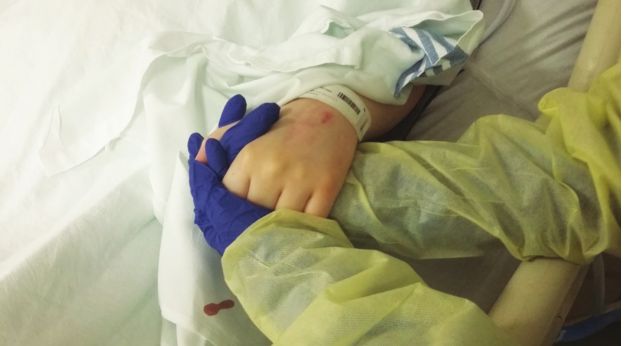
Old enough to be her grandfather, Lenchner, who was once a small-town police officer, knows Rusher’s story as well as anyone.
When
Rusher, exhausted from crack binges and hours of prostituting herself,
needed a ride home to Clinton from Decatur, she would call Lenchner.
When she tried to kill herself by cutting her wrists or swallowing a
ballpoint pen, she told Lenchner about it – he remembers four or five
attempts. He remained her friend even when she and one of her brothers
hid a firecracker in a cigarette that blew up in his face. He visited
her in prison.
When she needed money, he’d open his wallet, even though the cash would probably end up with a drug dealer.
“Did I enable her? Yeah. Did I want to?
No,”
Lenchner says. “I thought the world of Tiffany. I really did. My dad
dropped dead in front of me when I was eight years old. I’ve seen the
hard side of life. My whole damn family is gone. Tiffany, if you could
have ever known her, had a lot of good in her. She brought a lot of joy
into my life. If you were around her for 10 minutes, she was infectious.
She would win you over. She had that manner about her.”
And
so Lenchner agreed to give Rusher a room in his house. He didn’t know
what her future held, but he knew that she was in a deep hole, a
registered sex offender with serious mental illness who didn’t have a
high school diploma or GED or work history. He says that he talked with
the Clinton police chief before deciding to take Rusher in. “He said,
‘It’s not going to be easy,’” Lenchner recalls. “And I said ‘I know
that.’ There’s no way I could have promised a positive outcome at the
end. But I would have given it a try.”
On
March 17, the state’s attorney’s office agreed to the plan. Rusher’s
lawyer contacted the prosecutor: Instead of waiting for a scheduled
March 29 hearing, let’s move things up and get her out of jail on March
20. The hearing never happened. On March 18, Rusher was found hanging in
her cell and rushed to St. John’s Hospital. She died on March 30,
shortly after she was removed from life support.
Lenchner
doesn’t have good words for the system. A crack addict who sells her
body for drug money isn’t a true sex offender, even if the johns are
underage, he says. In prison, the Department of Corrections made things
worse by putting her in isolation instead of treating her mental
illness.
“With her,
they just slammed her ass in a cage and closed the lid – they didn’t
want to deal with her,” Lenchner says. “This thing could have been
handled so damn differently. It was one hell of a nightmare, for a long
time.”
Contact Bruce Rushton at [email protected].