Preserving family traditions while supporting downtown for 33 years
Last Saturday, March 11, thousands of greenclad parade watchers of all ages gathered in downtown Springfield at the “Craic O’ Noon” to experience the St. Patrick’s Day Marching Band Parade. With “Irish Hearts O’ Gold” as the 2017 theme and Contact Ministries the designated Grand Marshal, the blast from a Civil War replica cannon signaled the start of the parade just as it has since the inaugural event in 1985. Floats designed and created by local groups and families, military reenactment groups, politicians and people simply walking in support of a cause made up the nearly 100 entries in the parade line, all led by the pipes, drums and dancers of the St. Andrew’s Society of Central Illinois. There were no marching bands this year because of the possibility of extreme weather.
What has grown to become one of Springfield’s biggest cultural and community experiences began from the work of a few families and individuals dedicated to preserving Irish heritage through a downtown parade celebration.
According to Pat O’Grady, a founding committee member and past board president for several years, the night that started it all was in October of 1984 at Robbie’s, the popular bar and restaurant on the south side of the Old State Capitol Plaza. There were likely a few drinks involved and good times happening when one of the gathered friends, Ray Cachares, suggested to the group that Springfield should have an annual St. Patrick’s Day parade similar to the fun festivities in the Windy City. He reasoned that Chicago, famous for hosting one of the largest celebrations of that kind in the world, was a good model for success. Plus Cachares had decided he’d rather not drive four hours every March 17 just to go see a good Irish parade.
But at that time in Springfield history, few expected a local parade around the Old Capitol square could work. The downtown retail business was in steady decline, mainly due to the fairly new White Oaks Mall flourishing on the west side of town. Most of the clubs and bars in the downtown area were home to a seedier crowd than we experience today. At that time the now-defunct Lincolnfest was still going strong as a community party. The folks being asked to organize a St. Patrick’s Day parade saw little hope for success.
As O’Grady describes it, Cachares used some wily ways to achieve his goal of a downstate parade. The man worked the room, telling each person he talked with that they were the last one to join the inaugural parade committee, even though there really was no such thing as of yet. But before the night was over, the committee necessary to start a St. Patrick’s Day parade existed and the very next Tuesday the fledgling group met officially for the first time.
Mayor J. Michael Houston agreed to the idea and soon Springfield’s very own Celtic celebration was in motion. After months of planning, the parade debuted at 10:30 in the morning of March 16, 1985, with about 50 entries and some 2,000 spectators. The usual suspects of marching bands, floats, vehicles and walking groups populated the inaugural parade line, complete with the first Grand Marshal, William “Pinky” McHenry.
O’Grady related a story about the famed “green stripe” that marked the parade route through the downtown streets. Basing the stripe concept after Chicago’s identical idea, the committee ordered plenty of the same type of paint (not harmful to pavement and costing $65 a gallon) and the green stripe became a reality, handily showing the path of the parade down the center of the streets. After the parade was over the workers went to remove the stripe with a special cleaner. They made a pass and got no results. They made another run over the painted area and the stripe remained unfazed. No one on the parade committee knew that before application, the paint was supposed to be diluted in a 20:1 ratio. When the next year’s parade rolled around, the green stripe was faded, but still visible, as workers applied the new stripe, this time in the proper form.
In the first few years other adjustments came, such as moving the start time to noon in an attempt to catch warmer weather in the unpredictable mid-March time frame. For a short time the reviewing stand was on the west side of the Old State Capitol where a bus stop area made for an easy place to set up. No one had foreseen that by having the reviewing stand come so early in the parade, bottlenecks grew as participants waited and spaced out the bands in order to be ready at the right time for the judges. Not long after, the stand was placed where it sits today, on Sixth Street on the other side of the Old State Capitol near the end of the parade and in a better place to accommodate the marching bands.
For a few years the parade actually went through the Prairie Capital Convention Center, in one side and out the other. Opening in 1979, the PCCC was still a fairly new downtown structure and the parade helped to familiarize townspeople with the facility. O’Grady explained that they did away with the drive-through after a few years for several reasons, including not wanting to deal with the necessity of entertaining spectators in the convention center seats with activities while they waited for the big show to wind its way there and the fact the center was not always going to be available on parade day.
Through the years the St. Patrick’s Day Marching Band Parade has seen all kinds of weather, from sunny skies to snowflakes, and everything in between. Once, after tornadoes ripped through the area in March of 2006, the event was postponed so city services could be devoted solely to storm damage cleanup. When the St. Patrick’s Day parade resumed a week later, the committee designated those workers responsible for cleaning up the devastation as co-Grand Marshals with the already chosen Randy Duncan, an Abraham Lincoln personality from Carlinville.
The private committee that organizes and coordinates all the parade details started out with about 15 members and now uses hundreds of volunteers to make it all happen. The city helps with setup, street
closings and such, but financing the $6,000 to $8,000 it takes to put on
the parade falls to the board. O’Grady explained a good deal is spent
as stipends for the school bands. Since the beginning the group wanted
to encourage participation by helping to pay for travel expenses and
currently offers $250 for bands to enter and then another $100 after the
parade, plus whatever designated prize money goes to the winning bands.
Other expenses of running the parade simply come along with the
responsibility of hosting a community event of this magnitude.

The
funds once predominantly came from sponsors of program ads and fees for
parade entries not in school marching bands, but now come mostly from
corporate sponsors, explained longtime board member Molly Grady Risse.
Working with the Illinois Secretary of State office, she helped make
available for purchase a special edition, temporary, Illinois license
plate specifically designed for the parade that for several years helped
with fundraising. In a fairly recent addition to finding funds,
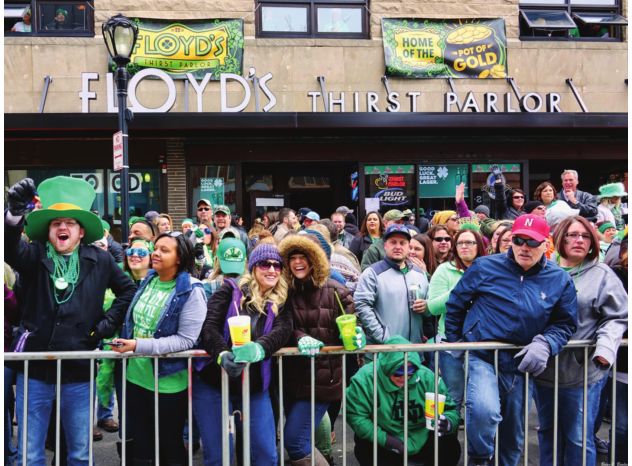
drinking customers in local bars now must purchase a wristband in order
to legally imbibe alcohol on the streets during specific hours on parade
day. Proceeds of wristband sales go directly to the parade board to defray operating expenses.
Speaking
of drinking, many feel the day is all about starting early and ending
late with downing alcoholic drinks as the sole purpose of the
celebration and indeed that is purported to be an integral part of
participating in Celtic and Irish traditions. Downtown and nearby bars
order plenty of extra booze the week before for the drinkers, and
alcohol distributors add lots of corporate swag for decorating to
encourage proper participation in what might be termed debauchery by
some. Many bars relate tales of sales that are the highest one-day
totals in a calendar year, helping to keep the businesses afloat during
leaner times.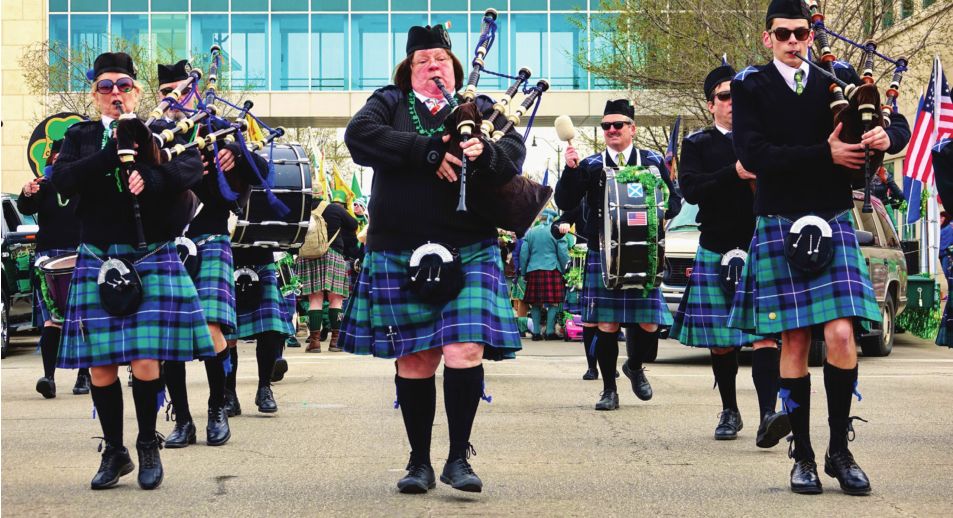
Even
with all the partying going on, the committee and organizers make sure
the intent is for a family-friendly event. Basically the family side of
the parade route is on Sixth Street around the reviewing stand while the
drinking area covers the rest, especially where the bars are grouped on
the Fifth Street strip. This year in order to better accommodate
families with kids, organizers moved the children’s area from the
previous location near the Lincoln Library on Capitol to smack dab in
the middle of it all on the northeast corner of the Old Capitol lawn
near Washington and Sixth. Hoping to induce families to hang around
during and after the parade, bouncy houses and children’s activities
were available this year in the new location. Reactions from
parade-goers seemed very positive about the improved and relocated
family space.
In
another addition this year, the parade board created the honorary title
of “Irish Bua” to recognize a citizen of Springfield who lived or still
lives with the Irish ideals of “Bua.” A Gaelic word,”Bua” can be
understood to mean many things including blessing, good character,
victory, ability and success. The inaugural award was bestowed upon the
late Patrick Grady, a renowned and successful area realtor and the 1988
parade Grand Marshal. Pat’s sister, the aforementioned Molly Grady
Risse, committee head for the VIP breakfast for sponsors, announced in
2017 the board named the pre-parade meal event in honor of her brother.
In 1994 he was named Irishman of the Year by the Sons and Daughters of
Erin, a local group of Springfield families from Irish heritage. Grady
spent nearly 50 years in a successful career while staying involved in
community development.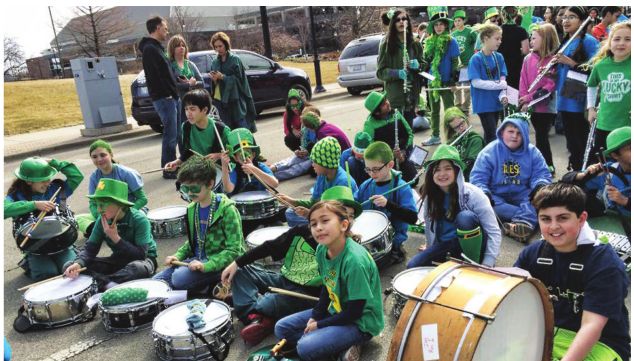
Those
families of Irish descendants are a vital and important part of
Springfield and central Illinois history, and a big reason why there is
such a successful St. Patrick’s Day parade in town. Just a thoughtful
look into our city’s businesses, government officers, neighborhoods and
private schools uncovers a plethora of Irish names, such as Kelly,
Cadagin, O’Brien, O’Shea, O’Toole, O’Grady, Grady, Davlin, Hennessy,
D’Arcy’s Pint, Dublin Pub, J.P. Kelly’s and many more. Several Catholic
parishes still hold the traditions of the Irish community together in
bonds of family and faith.
One
such family, of the many in town that continue to trace and treasure
their Irish roots, call themselves the “Brennan-Conway Clan.” They came
together in a somewhat unusual way, when back in 1928 a Brennan woman
and mother of three children was suddenly widowed. She then married a
Conway and they were blessed with six more children to form the origins
of the Brennan-Conway Clan. Today the family continues to expand, all
the while celebrating the double Irish interconnection and remaining in
familial contact.
Noticeable and consistent participants in the parade, and also in the Irish tent at the now-defunct Ethnic Village
Festival held at the Illinois State Fairgrounds during Labor Day Weekend
for many years, the clan annually takes part in the parade. In 2015
they won first prize with a float called “Born Lucky” that featured an
Irish-looking cottage on wheels. Most of the entire generational clan
participated either by walking alongside or riding on the float,
including having live Irish folk music performed by musician and
Brennan-Conway clan member Patrick Hagerman. Patrick now lives in
Florida and vividly remembers way back in 1987 when he was just a wee
lad of four years old and riding in the car with his Aunt Donna (then
Conway Miller), who was designated Grand Marshal. This is the first year
that he recalls not attending the parade and playing the Irish songs he
learned from his late mother for the family gatherings.
Becky
Schlouch, daughter of Donna (now Conway Hickerson) and Patrick’s first
cousin, explained that some 20 years ago the family experienced several
deaths in the clan during a short span of time. Realizing they only
seemed to meet during funerals, a commitment was made to be part of the
St. Patrick’s Day Parade on a regular basis. They have banners to carry
and T-shirts to wear, while inventing a yearly slogan to announce to the
world a belief in the strength and continuity of their Irish ancestry.
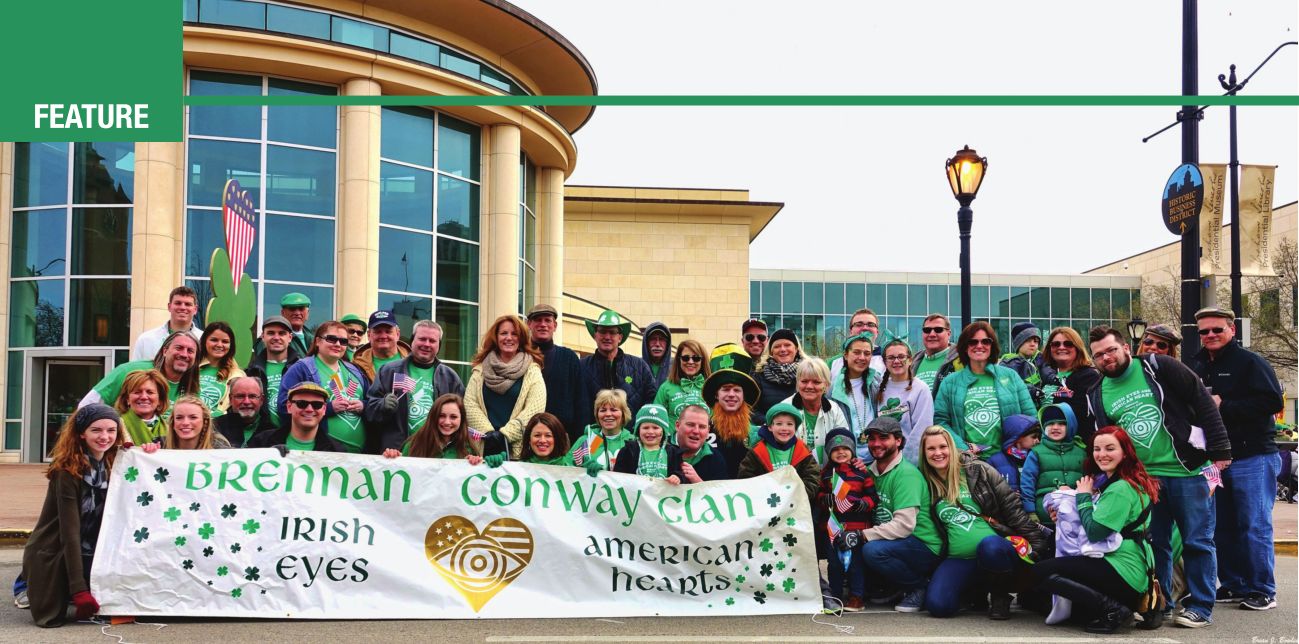
This year’s phrase was, “Irish Eyes and American Hearts,” complete with a
logo designed by a family member that incorporates a version of the
Celtic knot as an eye, intertwined with stars and stripes in a heart to
represent both sides of the family heritage. This past parade day, elder
members rode in Becky’s decorated convertible with a homemade green
shamrock and heart-shaped, red, white and blue American flag made from
wood propped in the back. Out front others from the extended family
marched holding a specially made, lettered banner proclaiming the
Brennan-Conway Clan, while the remaining members walked along, all clad
in white-on-green T-shirts, proudly displaying the 2017 logo and slogan.
With
dedication such as this continuing into the next generation along with
the big boost to the downtown economy and welcomed participation of the
city administration, all bodes well for many years to come for the St.
Patrick’s Day Marching Band Parade. As Pat O’Grady related, when he was
head of the organizing board, after months of planning through many
meetings, every year when the hectic day was over, his wife asked if
this was the last one. He just paused and then answered, “Well, maybe
just one more.”
Tom
Irwin enjoys playing Irish folk music by the Clancy Brothers and other
Celtic artists and reading the literature of Irish authors. He is the
great grandson of Gilbert Hennessey, a first-generation Irish immigrant
and Moneta Reisch, a first-generation German immigrant, owners and
operators of Hennessey Florists, once a popular flower shop and
greenhouse on Springfield’s near north side. He can be reached at [email protected].


