
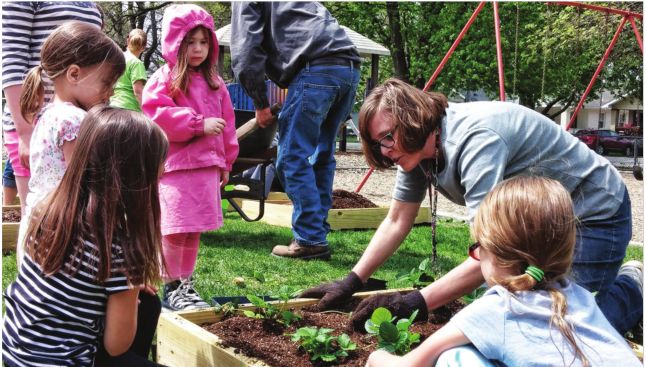
The meager harvest from school gardens
Teaching, it has been said, is like cultivating a garden. Some teachers believe that cultivating a garden is a form of teaching. The kids at Butler Elementary have been growing and harvesting heirloom seeds, specifically, seeds of the squash variety carried to Illinois in the 1830s that has been the basis of successful commercial hybrids. The next time you sit down to a Thanksgiving feast in which figures Libby’s canned pumpkin (a product, by the way, that is mostly squash), be sure to include the name Dickinson when saying grace.
Was a time in the Springfield of yore when gardening school kids tried to save not only plant varieties but school grounds, families and neighborhoods. “‘Back to the soil’ slogan of public schools,” read the headlines of a full-page Sunday feature article in the old Illinois State Journal in 1915. “Pupils of Springfield learning how to garden.” Readers learned that flower beds and vegetable plots were being tended at Dubois, Iles, Palmer, Hay-Edwards and Bunn schools.
One seed for this harvest was a country schoolteacher named E. L. Pruitt, master of Cottage Hill School, which stood until the 1960s on Washington just off Bruns Lane. In a 1902 article, “A Rural-School Garden,” he described in a frank and manly way the travail he faced turning his kids into Johnny Appleseeds by having them dig, plant, cultivate and harvest a garden 40 feet square in which the children grew along with vegetables from cabbages to popcorn and a dozen sorts of flowers.
Pruitt was an evangelist, full of fervor, and he found disciples. In 1909 principal Warren Taylor of the old Ridgely School oversaw the opening on the grounds of 40 garden plots, one managed collectively by each of Ridgely’s eight classrooms, the rest planted by eager individuals. In 1915 Miss Ella Hamilton, principal at Harvard Park, had her charges mucking about too. Over at the high school, Miss Nettie Cook, the biology teacher, was offering classroom credit to gardeners who put in at least 56 hours (!!) of actual work in the garden and passed an examination on seeds, soil tests fertilization, pests and the function of roots, stems and leaves.
Fifty-six hours. I know people who never put that much work into their marriages.
School gardens came and went, in the Depression, in the 1940s, in the 1970s and now today. Actual learning was not the only nor the most important of the many rationales for them. Over the years kiddies sharpened their trowels to help the war effort (whichever war was going on at the time), to green the planet, to make money for the family, get back to the land, to improve their diets or, as today, to preserve biologic diversity.
Ridgely’s Taylor wanted to train his kids so they could garden at home and thus brighten Ridgely, a grim factory neighborhood. In such an environment, a flowering plant will look like a weed, insofar as a weed is understood to be any plant growing out of its proper place. Taylor noted that his children, when they encountered accidental beauty in that neighborhood in the form of flowers, destroyed it. The kids didn’t realize, at least consciously, that in the larger world they too were weeds; it was Taylor’s hope, apparently, that by cultivating beauty they could see themselves as worthy of admiration too.
Pruitt reported that attendance, attention and behavior of his charges all improved once they turned into gardeners. Hamilton noted how “former ‘idle’ workers of the school are the ones who have been doing so well with their garden work.” One wonders how many of those once-idle kids had undiagnosed learning disabilities. Unruly boys in particular seemed to thrive when given a chance to use their bodies productively instead of (as Pruitt put it) “instead of knocking off hats.”
Each of these people was a hero after whom a building should be named. Alas, as happens to all heroes, their example was not widely imitated. School gardening remained only a fad, albeit a recurring one. By 1919 Ridgely’s Taylor was being described as a local pioneer in the school garden movement, “but, owing to small encouragement, his work never became very noticeable.” Hamilton at Harvard Park was familiar with what was going on in places like California, but she felt obliged to report about Springfield that “the work here has been rather slow.” By the 1950s, at many a Springfield public school there are no gardens because there is no dirt. District 186 buried many school grounds under asphalt and gravel for all-weather play, easy maintenance and, most galling of all, convenient parking for teachers.
Not so at Butler, happily, where the schoolyard offers children trees and grass and 16 raised planting beds. Preserving such a corner of a schoolyard is harder to do and, in the context of Springfield public school pedagogy, much more significant than saving a heritage squash from extinction. Professor Pruitt would be pleased.
Contact James Krohe Jr. at [email protected].
Editor’s note
Dr. Jerry Kruse, dean and provost of Southern Illinois University School of Medicine, has weighed in against the current Republican legislation to “repeal and replace” the Affordable Care Act. His is an important voice refl ecting SIU’s efforts to improve health care for low-income residents of this region. Now we need to hear from Gov. Bruce Rauner. Will Illinoisans be better off or worse off under the proposed replacement plan?
“What likely will happen is that Medicaid costs would be shifted to the states, that Medicaid expansion will be rolled back because of these costs and the decline in the federal match, and that millions of Americans will lose the insurance and the highly coordinated primary care that they received under the ACA,” Kruse wrote this week to the medical website medpagetoday.com.
“I have no doubt the [American Health Care Act] will lead to a worsening of population-based health outcomes, a worsening of outcomes for individuals who are no longer insured, dramatically higher per capita costs, and poorer access to care, particularly for the most medically vulnerable. This is a giant step backward for the U.S., and will assure that we will continue to trail the rest of the world in health care outcomes, reasonable costs, and moral accountability,” Kruse wrote. – Fletcher Farrar, editor and publisher